


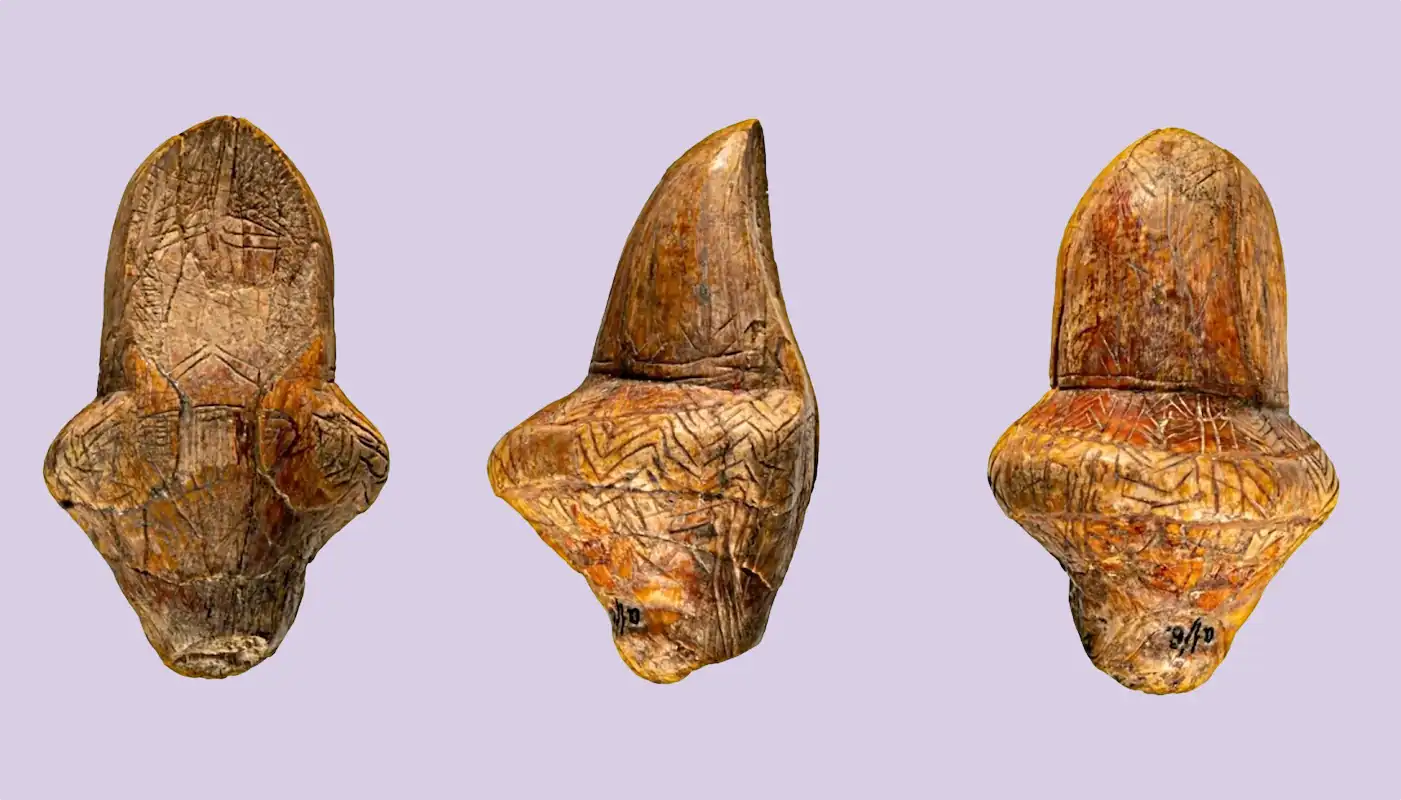
Eighteen small figurines carved from mammoth ivory at Mizyn, in the Chernihiv region of northern Ukraine, carry engraved zigzags and meanders modelled on the natural patterns inside the tusk. A study published on 11 September 2026 in npj Heritage Science reports the finding after the first detailed digital and microscopic examination of the whole group. The same paper dates the figurines to between about 18,800 and 17,400 years ago, which places them among the earliest human images known from Europe after the Last Glacial Maximum.
The study is led by Simon Radchenko of the Museum of Archaeology at the University of Stavanger in Norway. His co-authors are Oleksandr Naumenko of the National Museum of the History of Ukraine in Kyiv, Dmytro Kiosak of the Leibniz Centre for Archaeology (LEIZA) in Mainz, Anja Mansrud of Stavanger, and Andy Needham and Aimée Little of the Centre for Artefacts and Materials Analysis at the University of York. The research was funded through a Marie Skłodowska-Curie grant under the EU’s Horizon Europe programme.
Eighteen figurines from two mammoth-bone structures dug before the First World War
Mizyn lies near the Desna river and is known for large circular settings of mammoth bones, usually interpreted as the remains of dwellings. Excavation began in 1908 under the ethnographer and archaeologist Fedir Vovk. Besides the figurines, the site has produced ivory bracelets, decorated mammoth bones and ornaments of bone, ivory and shell.
According to the paper, 11 of the figurines were found in 1908 and 1909 beside one bone structure, known as Complex 1. Seven more came from a similar structure, Complex 2, excavated in 1912 and 1913. Records of exact find spots are thin. Three figurines were reportedly found beneath, or possibly inside, a mammoth skull built into the second structure, and the authors read this as a deliberate deposit.
The authors describe the group as the largest collection of Palaeolithic female depictions in Eastern Europe after the Last Glacial Maximum. They note that the figurines had received little first-hand study and that their manufacture had been reconstructed only in broad outline.
Recording the ivory in Kyiv during the war
In 2022 the National Museum of the History of Ukraine granted limited access to the figurines so they could be recorded digitally. The work was done under the “Preserving Ukrainian Legacy” project, supported by the US Department of State’s Embassy Fund Programme for Cultural Protection, and the University of York says the recording was led by the Ukrainian NGO Archaїc. Naumenko described high-quality digital records as an essential step in protecting heritage the war continues to threaten.
Six figurines (F1, F2, F4, F5, F8 and F18) were modelled in 3D by photogrammetry, which builds a model from many overlapping photographs and needs almost no handling. Polished ivory reflects light badly for this method, and the team fitted polarising filters to the camera and lamps. The authors give the models as metrically reliable to 0.37 millimetres and visually reliable to between 0.075 and 0.225 millimetres. The 3D data are published openly.
All 18 pieces were also examined under a digital microscope at up to 500 times magnification. Here the authors flag a real limit. The figurines were restored in 1990, and the cleaning and consolidants used then may have erased shallow marks and left a polymer layer that makes ancient and modern traces harder to tell apart.
Every figurine was cut from the core of the tusk
A mammoth tusk in cross-section shows two natural patterns. Owen’s lines are concentric growth rings, similar to those of a tree trunk. Schreger lines form a cross-hatched pattern visible where the tusk breaks across its width.
These patterns let the team work out where in the tusk each figurine came from. The long axis of all 18 matches the long axis of the tusk, and all were taken from its central part, with very little offset from the nerve canal. Experiments cited in the paper show that ivory near the nerve canal is exceptionally hard to split, while the outer layers separate relatively easily along the growth boundaries. The carvers chose the section best suited to a long, solid form.
The paper reconstructs the sequence of work. Blanks such as rods, cylinders and conical tips were removed by cutting, percussion and pressure flaking. The ends were tapered and the middle left broad. The design was sketched with fine scraped lines, the surface levelled, and the figures engraved with the edges of flint blades using sawing or repeated one-way cuts. Deep notches on the bases of F1, F3 and F4 appear to have been cut to help snap each piece free.
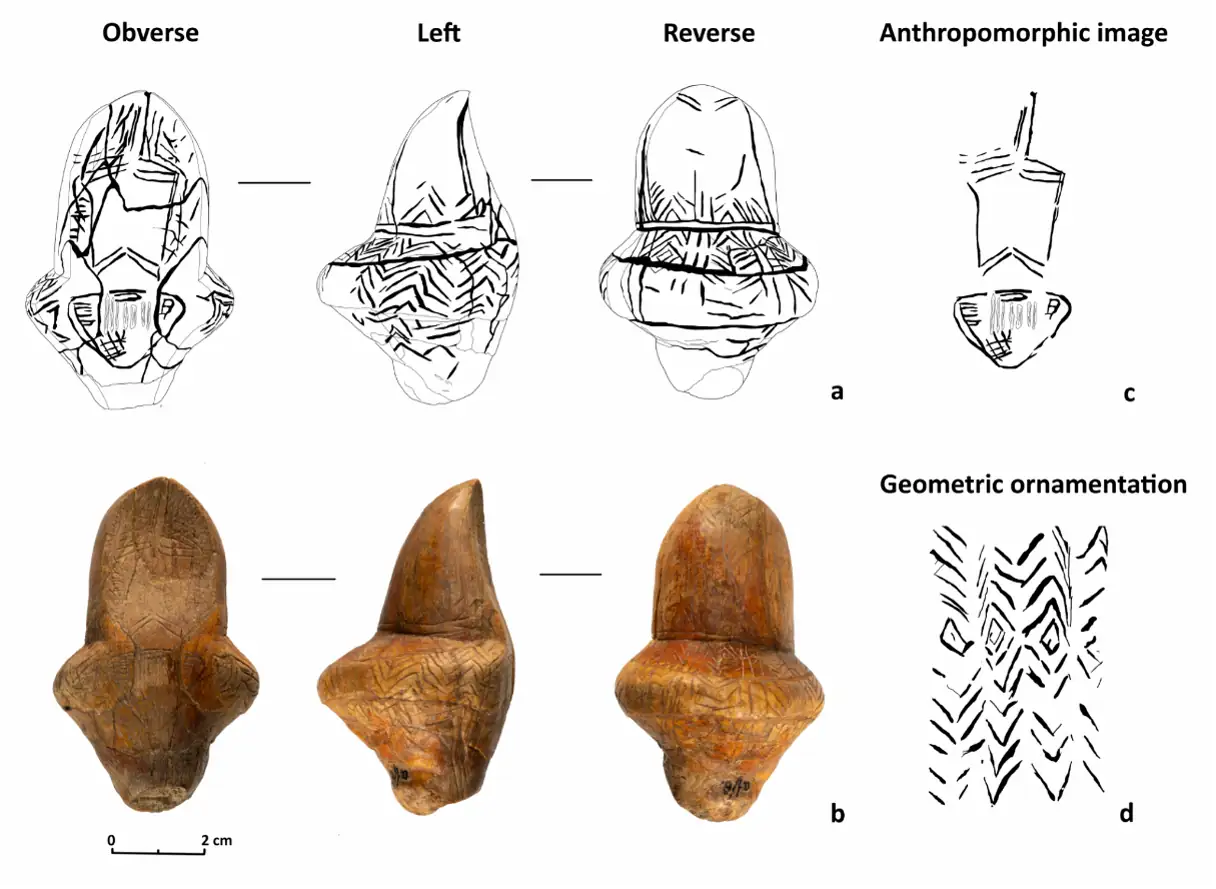
The team measured 97 engravings on the 3D models. Their cross-sections shift between U, V and W shapes from one line to the next, which the authors take as a sign that tools were swapped often, probably as they wore down. Each part of a design was cut in its own way. The human outline on the front was made with narrow, deep lines, while the tips and the triangle on the lower front were filled with wide, open strokes.
Zigzags and meanders placed where the tusk’s own lines would show
The figurines share a basic form, a long, roughly cylindrical piece with a pointed upper end and a swelling at the buttocks. The flatter front carries a schematic figure with neck, shoulders and arms above a triangle usually read as a pubic triangle, which is the main reason they are identified as female. The irregular marks around the outline have been read as hair by Lioudmila Iakovleva and as a fur cape by Olga Soffer and colleagues.
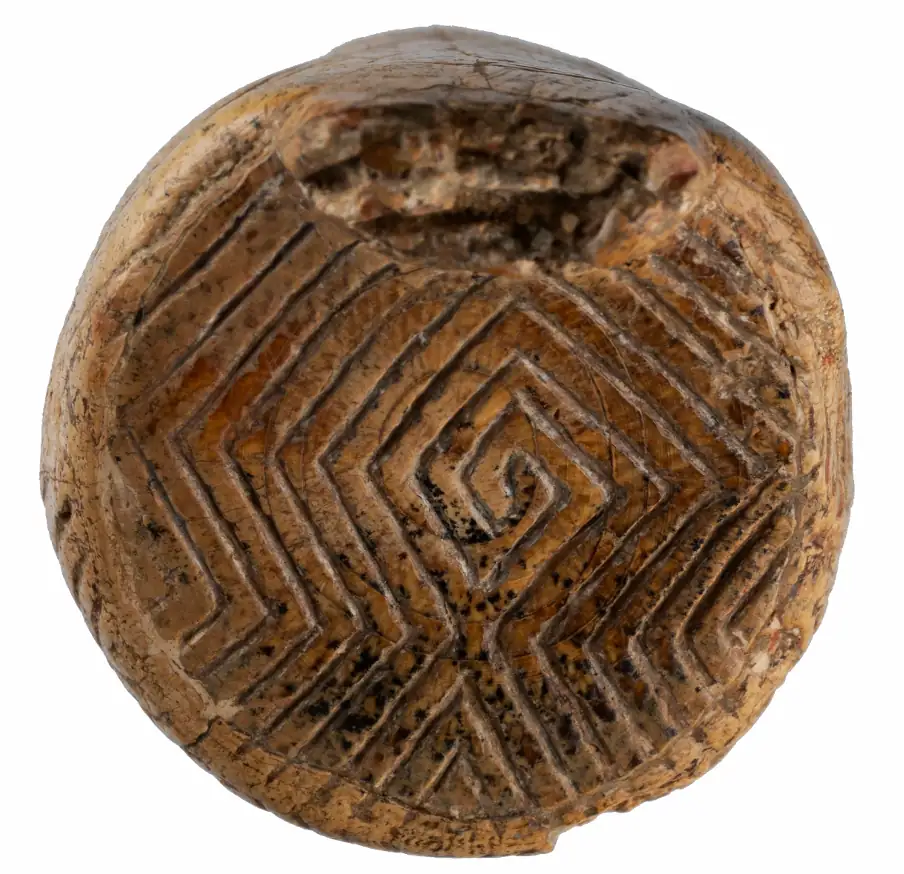
Fourteen of the 18 are engraved, and 11 carry geometric ornament on the back and sides, mostly meanders combined with rows of parallel zigzags. According to the study, the engraving reproduces Schreger lines on F2, F4, F14 and F15 and echoes Owen’s lines on F13 to F17. Parallel curved lines on F1, F3 and F7 also match the rings of the tusk. On F14 the engraved meander runs almost along the natural growth rings.
Placement carries much of the argument. On most figurines the meander sits on the wide middle section, where the tusk’s axis passes and where Schreger lines would be most visible in raw ivory. From there it turns into parallel zigzags that spread up and down the piece. The most elaborate ornament appears on surfaces that were deliberately abraded, which brings the inner structure of the ivory into view. On F1 and F4 an engraved belt connects the carved hips to the flat image on the front.
A link between Mizyn’s ornament and ivory structure was first proposed by V. Bibikova in 1965, mainly for the site’s bracelets. The new study adds a figurine-by-figurine record and argues that the carvers worked actively with the material rather than reproducing it by chance.
Bird-like and phallic forms read as one design
Several Mizyn pieces have long been described as phallic or as birds, and the National Museum’s online catalogue still labels some as female (phallic) figurines.
The authors argue that these are two extremes of one concept. Thinning the upper section made the buttocks stand out but also made the piece fragile, so the most extreme bird-like forms broke easily. Of eight such pieces, the paper reports, only three are preserved. Three bird-like figurines, F12, F16 and F17, carry the same engraved human figure on the front of their “tails”. F18 appears to have broken during manufacture, and its maker adjusted the design to suit.
A recalibrated timeline of 650 radiocarbon dates
To set the figurines in time, the team compiled 650 published radiocarbon dates from European Upper Palaeolithic sites with figurines, recalibrated them with the IntCal20 curve in the OxCal software and summarised them statistically. Dates with uncertainties above 200 years were generally excluded.
The earlier, more naturalistic Aurignacian, Gravettian and Solutrean figurines cluster on the central East European Plain, at sites such as Kostenki and Borschevo. A gap follows, roughly 23,000 to 20,000 years ago, during the Last Glacial Maximum. The York press release puts its length at 1,000 to 3,000 years. Figurines then reappear in northern Ukraine at Barmaky, Mizyn and Mezhyrich, in the early Epigravettian.
On this reconstruction, Mizyn is the earliest known site with schematised engraved figurines. Slightly later examples come from Las Caldas in Spain and Laugerie-Basse in France, where some overlap in date remains possible. The Lalinde and Gönnersdorf figurines of Central Europe follow between about 17,000 and 13,000 years ago.
The paper sets out the weaknesses of the eastern European dates in detail. Many conventional dates carry large errors. Mammoth bone can produce an “old mammoth effect”, because people sometimes scavenged bone and ivory from animals that had died centuries or millennia earlier, though the authors add that this does not hold everywhere. Soviet-era excavations often opened wide areas without fine stratigraphy, so dates from one site can blend several occupations. Even a strong set of dates can calibrate to a span of more than a thousand years.
Mizyn and Gönnersdorf as a long-running question of style
Earlier scholarship, including Gerhard Bosinski’s 1982 survey of Ice Age art in Germany and Switzerland, grouped the Mizyn figurines with the Magdalenian or the Gönnersdorf style. The term “Mezinian” has also long been used for the culture of Mizyn and related sites, and Iakovleva’s 2009 study treated the site’s art under that name.
The new paper argues that the figurines form an independent phenomenon in style and date, and that the stone tools from Mizyn show the same distinctiveness. The authors accept that some pieces (F2 and F11 to F18) resemble Gönnersdorf figurines while others (F3 to F8) differ significantly. The contrast they stress is volume. Most post-glacial figurines elsewhere were made on flatter, plate-like blanks, while the Mizyn pieces keep a full rounded form that combines an engraved frontal figure and a profile silhouette on one object.
Needham said later Western European figurines also show abstracted female forms, but “none reproduced the internal tusk patterns seen at Mizyn.” Kiosak said the results challenge the assumption that ancient art developed in a straight line from simple to complex.
The paper itself frames this cautiously, saying Mizyn may constitute a distinct phenomenon, and it notes date overlaps with Mezhyrich and Laugerie-Basse.
Mammoth skulls, “mammothness” and the questions left open
The authors present several interpretations as interpretations. The three figurines found with a mammoth skull suggest to them that the people of Mizyn returned these objects to the animal they came from. They also propose that engraving Schreger and Owen patterns onto human figures may have lent them mammoth-like qualities, borrowing the term “mammothness” from Chantal Conneller’s work on animal transformation at the Mesolithic site of Star Carr. Similar ideas are recorded among ethnographically documented hunter-gatherers.
The team asks whether the carvers saw human forms in the flow of the Schreger lines or used them as a template to lay out the ornament, and whether the practice occurs at other sites. Owen and Schreger patterns also appear on other ivory objects from Mizyn, including the bracelets, which the authors take as a sign that the practice reached beyond human figures.
Subscribe for a few dollars a month and get every long read, the short documentaries and the full archive. Cancel anytime.
Sources
Radchenko, S., Naumenko, O., Kiosak, D., Mansrud, A., Needham, A. and Little, A. (2026). Internal structure of Mammoth ivory inspired the design of Mizyn (Ukraine) Upper Palaeolithic figurines. npj Heritage Science, article in press, published 11 September 2026. Open access, CC BY 4.0. https://doi.org/10.1038/s40494-026-02988-5
3D dataset for the study. https://doi.org/10.26301/gyn6-0g59
University of York (2026). Ice Age carvers used mammoth tusk patterns to create unique art, study finds. News release, 16 September 2026. https://www.york.ac.uk/news-and-events/news/2026/research/ice-age-carvers-mammoth-tusk-patterns/
Bibikova, V. (1965). On the origin of Mizyn Palaeolithic ornamentation. Sovetskaya Arkheologiya 9, 3-8.
Iakovleva, L. (2009). The Mezinian art in Eastern Europe. Chronological, cultural and spiritual context. L’Anthropologie 113, 691-752.
Soffer, O., Adovasio, J. M. and Hyland, D. C. (2000). The “Venus” figurines. Textiles, basketry, gender, and status in the Upper Paleolithic. Current Anthropology 41, 511-538. https://doi.org/10.1086/317381
Bosinski, G. (1982). Die Kunst der Eiszeit in Deutschland und in der Schweiz. Bonn, Rudolf Habelt.
Conneller, C. (2004). Becoming deer. Corporeal transformations at Star Carr. Archaeological Dialogues 11, 37-56.
all this is so amazing .... thanks for sharing