


Derinkuyu, the deepest of Cappadocia's underground cities, descends about 85 metres into the soft volcanic tuff of central Türkiye. Its builders left no inscription. Over six decades, Turkish museum staff, Italian and Turkish cave surveyors, climate scientists and textual scholars have narrowed down who carved it and why, while a popular theory pushes its origins back to the end of the last Ice Age.
For perhaps thousands of years, local Cappadocians retreated underground when enemies approached. Their subterranean city was rediscovered by accident. Credit: Yasir999, CC BY-SA 4.0
A basement wall opened the site in 1963
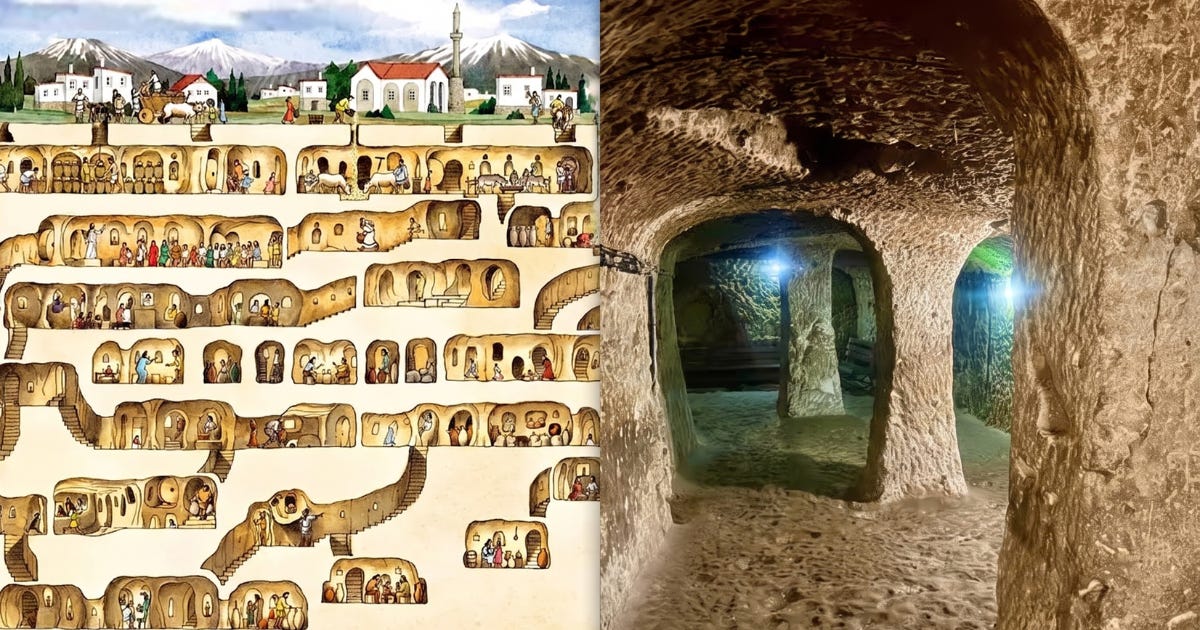
The modern history of Derinkuyu begins with a house renovation. A resident’s work on his home in 1963 exposed a dark passage, the first of more than 600 entrances that open into the underground city from houses in the town. Türkiye’s Ministry of Culture gives the complex an approximate depth of 85 metres, with stables, cellars, dining halls, churches and a place for boiling molasses. It opened to visitors in 1965, and only about ten percent of it can be visited today.
Water was built into the design. A 55-meter ventilation shaft connected to the surface also served as a water well.
Published depths and level counts vary between sources
Popular accounts often describe Derinkuyu as 18 storeys deep and able to hold 20,000 people. Official and survey figures are more modest. Measured by its 52 ventilation shafts and wells, the depth ranges from 40 to 85 metres, and the eighth floor consists of a single small chamber with a ventilation shaft.
The most detailed independent mapping comes from Roberto Bixio of the Centro Studi Sotterranei in Genoa and Ali Yamaç of the OBRUK Cave Research Group in Istanbul. They describe a network beneath the modern town on at least five overlapping levels reaching about 45 meters, divided into radial sectors that are mostly inaccessible today under the masonry houses. The two best documented sectors alone contain more than 2.5 kilometres of passages, and the total is certainly much greater.

