


This week a claim spread quickly across social media and news sites. An archaeologist, the posts said, believes "a forgotten civilization of millions" once dominated the eastern United States, building pyramids, cities and complex water systems.
The archaeologist is Edwin Barnhart, director of the Maya Exploration Center and a long-time lecturer on the ancient Americas. The claim comes from his second appearance on The Shawn Ryan Show, a long-form interview podcast hosted by former Navy SEAL Shawn Ryan. Zero Hedge then published a long write-up full of quotes, and other sites copied it. No new excavation, paper or dataset is involved.
The people Barnhart was describing are the Mississippians. They are among the best-studied cultures in North American archaeology, and their sites have been excavated for well over a century. Some of what he said is solid, some stretches the evidence, and one claim I could not trace to any published source.
What Barnhart said on the podcast
Barnhart’s main point was about status. He called the Mississippians “a massive civilization of millions of people who lived in the entire eastern United States,” and argued that Americans have “forgotten or ignored” them. He described cities with “pyramids that are 100 feet tall,” walls, farming along the rivers, and water carried by aqueducts into reservoirs inside the city.
He also defended calling Mississippian rulers kings. A man living in a palace on top of a pyramid and ruling 20,000 people is, in his words, “a little beyond chieftain level.” He ended by saying that the Mississippians, though they were not the Inca, were still an impressive and sophisticated civilization.
Cahokia’s mound, population and palisade match the record
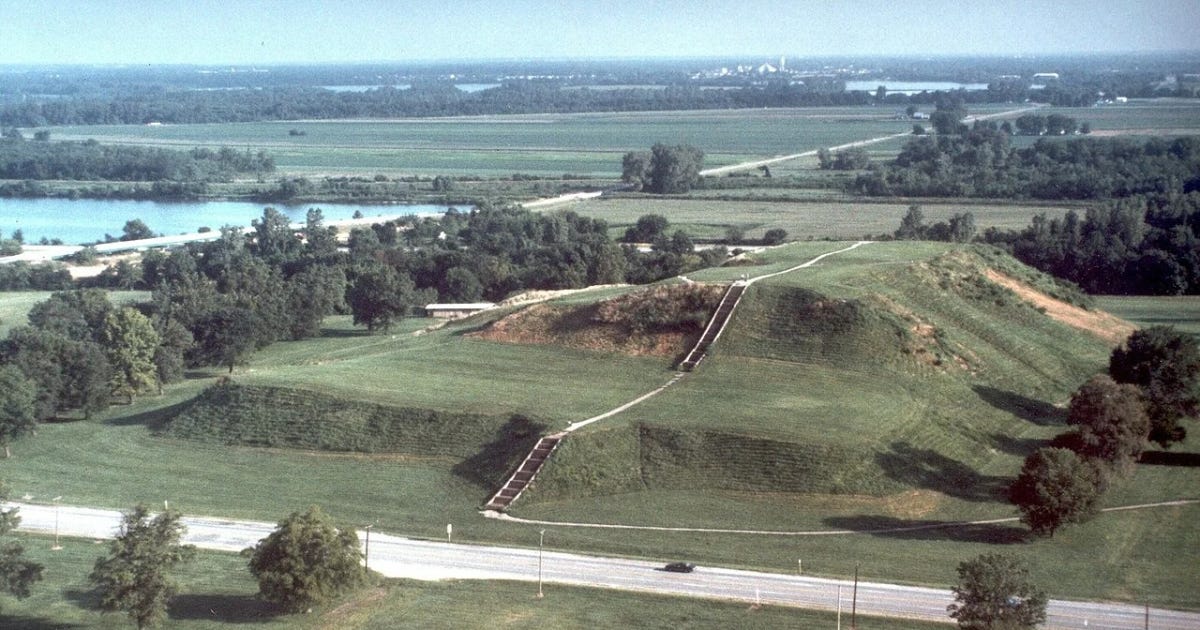
Cahokia, across the Mississippi from St Louis in Illinois, is the strongest part of his case. UNESCO, which made it a World Heritage Site in 1982, dates its Mississippian occupation to about 800 to 1350 AD. It says the settlement once covered more than 1,600 hectares.
Monks Mound, its central earthwork, rises in four terraces to about 30 metres, roughly 100 feet, and covers some six hectares. UNESCO says it was raised in 14 stages. It is the largest prehistoric earthwork north of Mexico. So Barnhart’s “100 feet” is accurate for this one mound. Calling it a pyramid is a common shorthand, but Monks Mound and other Mississippian platform mounds were made of packed earth. They had flat tops for buildings and were not tombs.
His population figure for Cahokia also sits inside the published range. He put it at 20,000 in the city and about 50,000 in the surrounding area. UNESCO gives 10,000 to 20,000 at its peak between 1050 and 1150. Archaeologists still argue over the number. Timothy Pauketat has argued for a large, densely planned city that went through a rapid founding burst in the mid 11th century. George Milner has argued for a smaller and more dispersed population. Every estimate is a model built from house counts and survey data.
The wall is real too. A timber palisade with bastions enclosed Cahokia’s central precinct and was rebuilt several times. Its course runs for roughly 3 kilometres, or about 2 miles, so his “two-mile wall” matches. Its original height is reconstructed. Barnhart put it at somewhere between 10 and 20 feet.
Mound 72 holds mass graves, but the victims were mostly local
Barnhart described a dark episode at Cahokia in which men, women and children were killed and thrown into a pit. This comes from Mound 72, excavated by Melvin Fowler between 1967 and 1971. It held at least 270 individuals, many of them in mass graves that appear to show sacrifice. One elite burial was laid on a bed of thousands of marine shell beads.
A 2016 study by Andrew Thompson, Kristin Hedman and Philip Slater in the American Journal of Physical Anthropology used strontium isotopes and dental traits from these burials. It found that most of the people in the mass graves had probably lived in or near Cahokia for most of their lives. This goes against the older idea that they were captives brought in from far away. The researchers suggested the victims may have been political rivals within Cahokia itself. Barnhart’s wider reading of the graves as a “violent reordering of society” is his own interpretation, not a published finding.
“Millions of people” is a guess at a number nobody can measure
No one has a reliable total for the Mississippian population. Their world stretched from the Great Lakes to the Gulf Coast and lasted about six centuries. It was made up of many polities that rose and fell at different times. Estimates for the whole population of North America north of Mexico around 1492 range from under 2 million to more than 18 million, and that wide spread has a lot to do with how much weight scholars give to European diseases.
A combined Mississippian population in the millions over the whole region is possible at the high end of those estimates. It has not been demonstrated, though, and Barnhart gave no source on air. The figures that can be checked, such as 10,000 to 20,000 at Cahokia at its height, are much smaller. Most other Mississippian centres, including Moundville in Alabama and Etowah in Georgia, are usually estimated at a few thousand people or fewer.
Archaeologists still argue about kings, chiefdoms and states
Whether to call Mississippian rulers kings is an old debate, not something archaeologists have ignored. For decades the standard term was “chiefdom,” meaning a ranked society led by hereditary chiefs but without the bureaucracy of a state. Pauketat and others have argued that Cahokia at its peak went beyond that, with planned urban space, a large workforce and political reach far into the Midwest. Milner and others have argued for something smaller and less centralised. Barnhart is on the “more complex” side. Many specialists agree with him about Cahokia, and fewer agree about the Mississippian world as a whole.
Spanish accounts help with the later period. Hernando de Soto’s expedition went through the Southeast between 1539 and 1543 with about 600 men. Its chroniclers described walled towns, paramount rulers and tribute networks. At Mabila on 18 October 1540, the Spanish fought the forces of the ruler Tascalusa. The town was burned and its location has never been found.
I could not find any published evidence for aqueducts and reservoirs
This was the most striking claim. Barnhart described river water being brought “through an aqueduct” into a reservoir inside a city, with channels running on to other districts. He did not name the site in the quoted parts of the interview, and Zero Hedge gave no source for it.
I found no excavation report describing an aqueduct system at a Mississippian site. Cahokia does have large borrow pits, dug for mound fill, which later held water. Mississippian builders also shaped plazas and mound surfaces so they drained well. Neither matches the system he described. Until he points to the site and the report, treat this one as unconfirmed.
Poverty Point is much older and was built by a different society
Part of the interview was about Poverty Point in northeast Louisiana, a UNESCO World Heritage Site since 2014. It is often lumped in with the Mississippians, but it is about 2,000 years older and was built by hunter-gatherer-fishers, not farmers.
Barnhart said Mound A was built around 1300 BC and that the site began around 1700 BC. These dates match the general range for Poverty Point. A 2013 study by Anthony Ortmann and Tristram Kidder in Geoarchaeology found that Mound A, about 22 metres (72 feet) tall and holding some 238,500 cubic metres of soil, went up in less than 90 days and perhaps in as few as 30. That would have needed thousands of workers. In press coverage of the study, the researchers estimated about 3,000 labourers drawn from a community of up to 9,000.
Two of Barnhart’s other statements here go beyond the evidence. I found no published support for his claim that Mound A “used to be way bigger.” His figure of 5,000 residents is also uncertain, because whether people lived at Poverty Point all year is still debated.
The podcast drew on old research
Monks Mound has been mapped since the 19th century. Mound 72 was dug more than 50 years ago. Poverty Point and Cahokia are both World Heritage Sites. What the podcast added was Barnhart’s framing, which is that this was a true civilization and is rarely taught as one. That is a fair argument. The viral version took his upper-end estimates and an unsourced aqueduct and presented them as a new claim.
Carry the ancient world in your pocket. The free Ancient Content Atlas app maps more than 1,500 archaeological sites, ancient cities and historical events, each traced to its sources. It works offline and picks up new discoveries automatically, on Android, iPhone or desktop.
📍 Explore Cahokia on the Ancient Content Atlas:
Subscribe for a few dollars a month and get every long read, the short documentaries and the full archive. Cancel anytime.
Sources:
Barnhart, E. Interview on The Shawn Ryan Show, November 2026. YouTube:
Zero Hedge. “Noted Archaeologist Claims ‘Full Blown’ Civilization Of Millions With 100-Foot Pyramids, Aqueducts, & Kings In America.” 21 November 2026. https://www.zerohedge.com/science/noted-archaeologist-claims-full-blown-civilization-millions-100-foot-pyramids-aqueducts-and
UNESCO World Heritage Centre. Cahokia Mounds State Historic Site (ref. 198). https://whc.unesco.org/en/list/198
Thompson, A. R., Hedman, K. M. and Slater, P. A. “New dental and isotope evidence of biological distance and place of origin for mass burial groups at Cahokia’s Mound 72.” American Journal of Physical Anthropology. DOI: 10.1002/ajpa.22791. University of Illinois press release, 4 August 2016: https://news.illinois.edu/ancient-bones-teeth-tell-story-of-strife-at-cahokia/
Ortmann, A. L. and Kidder, T. R. “Building Mound A at Poverty Point, Louisiana.” Geoarchaeology 28 (2013). DOI: 10.1002/gea.21430
Pauketat, T. R. Cahokia. Ancient America’s Great City on the Mississippi. Viking, 2009.
Milner, G. R. The Cahokia Chiefdom. Smithsonian Institution Press, 1998.
He’s right: this information is not widely known, nor is it taught. I’m old; even in high school (graduated 1975) we learned little about native populations prior to European contact, and what we learned was framed as savages. When I tutored a young high school girl 3 years ago, the curriculum included the sort of vague land affirmations that are common these days, but no detail that supported a framing of such an advanced civilization in N America. They taught Inca and Maya civilization but nothing in this geographic area. This is all news to me. American curriculum continues to frame European conquest and the frontier in cinematic summaries centering white men. I think I will dive into some of this material!
Doubtless