


More than 1,700 wooden writing tablets from the Roman fort of Vindolanda in Northumberland preserve the ink letters of soldiers and their families from about AD 100. They include a decurion’s request for beer, a note that accompanied socks, sandals and underpants, a military memo that calls the Britons “Brittunculi” and a birthday invitation whose closing line the editors call almost certainly the earliest known Latin writing by a woman. Robin Birley found the first fragment on 23 March 1973.
Ancient Content, November 2, 2026
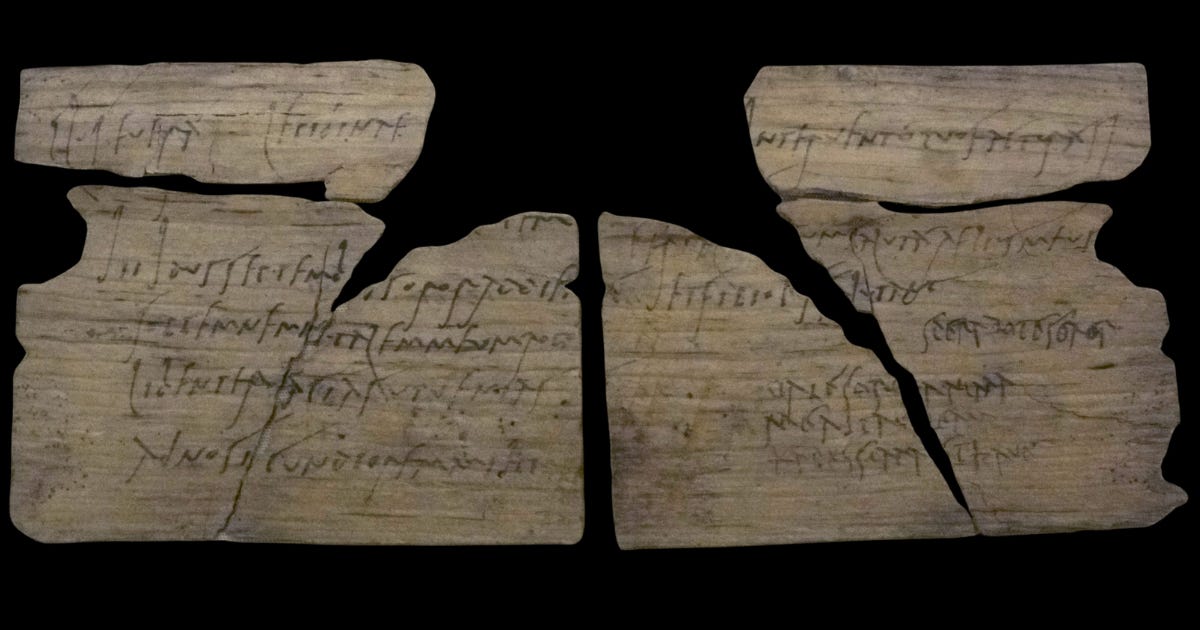
Fragments of the wooden writing tablet from Vindolanda that carries Claudia Severa’s birthday invitation to Sulpicia Lepidina, written in ink about AD 100. British Museum 1986,1001.64. Photograph by Fæ, CC BY-SA 3.0, via Wikimedia Commons. Background removed and replaced with a dark background by Ancient Content. This edited version is licensed under CC BY-SA 3.0.
The first tablet came out of a deep ditch in 1973
Vindolanda stands just south of Hadrian’s Wall, and its first timber fort dates to about AD 85. According to the British Museum, Robin Birley, the excavation director, was digging a drainage ditch near the south-west corner of the fort when he reached the earliest timber forts about four metres down. The Vindolanda Trust dates the first find to Friday 23 March 1973. An excavator passed Birley an oily fragment of thin dark wood, and when he peeled it apart he saw marks that looked to him like hieroglyphics.
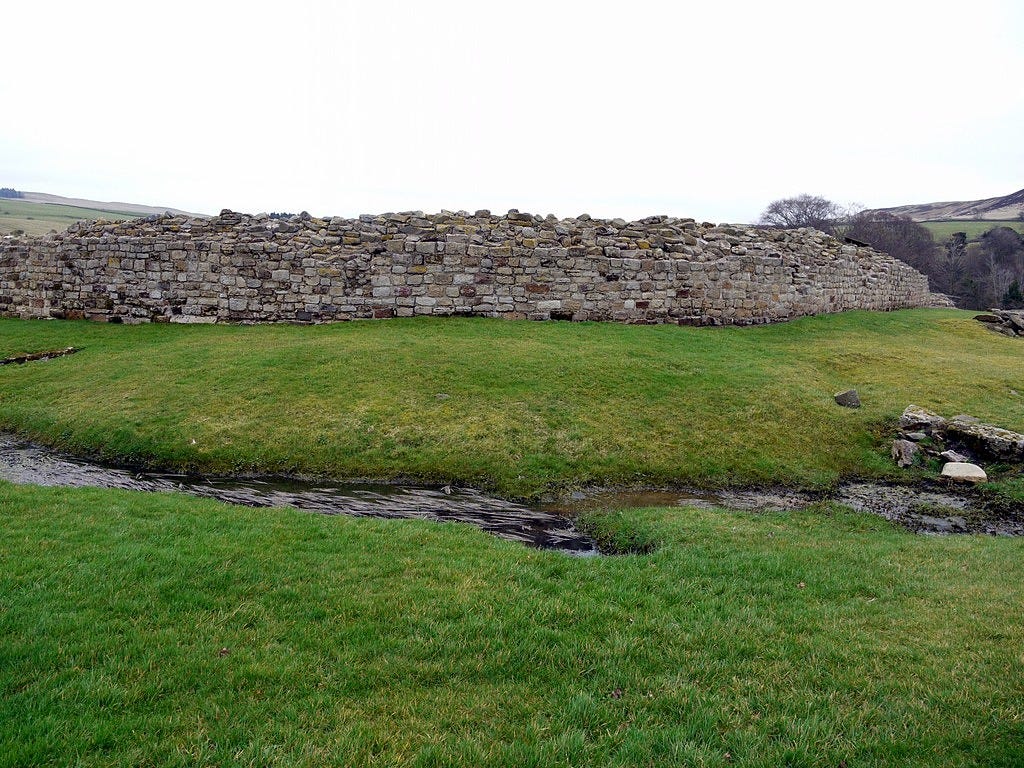
The restored south-west corner of the stone fort at Vindolanda in Northumberland. Robin Birley’s team found the first writing tablets in 1973 in a deep trench at this corner, where earlier timber forts lie about four metres below the surface. Photograph by Andrew Curtis, CC BY-SA 2.0, via Geograph
The wood appeared almost black. Richard Wright at Durham University saw a blank surface and suggested infrared photography, which can reveal carbon-based ink. A few days later Alison Rutherford of Newcastle University’s medical school photographed the fragment and the script appeared. The Trust identifies it as the well-known socks and underpants letter.
The tablets survived because the clay-rich, waterlogged layers held little oxygen. Wikipedia’s summary reports that they are thin slices of locally grown birch, alder and oak, typically 20 by 8 centimetres, written in carbon-based ink made with gum arabic and water. The British Museum places most of them around AD 100, in the reign of Trajan. The numbers below follow the Tab. Vindol. catalogue.
The first fragment is only the beginning. Below are Claudia Severa’s birthday invitation with her own closing words, a decurion’s beer request to his commander and the memo that calls the Britons “Brittunculi”. Paid subscribers, keep reading. Free readers, upgrade to unlock the rest.
