


Two extinct human populations have turned up in the genomes of people alive today. Neither has been sequenced from a fossil. Neither has a name. One of them contributed DNA to every living human, and the other reached the people of Oceania by a route nobody would have guessed.
The study appeared in Science on July 30, 2026, from a team led by Yulin Zhang and Arjun Biddanda with Priya Moorjani at the University of California, Berkeley, alongside Sarah Johnson of Berkeley's Center for Computational Biology and Colm O'Dushlaine of 54Gene.
Ancestry without a fossil
What we know about archaic ancestry, we know because certain bones held onto their DNA. Most people outside sub-Saharan Africa carry between 1 and 2.4 percent Neanderthal ancestry. Asian and Oceanian populations carry Denisovan ancestry ranging from 0.1 to 6 percent. Those numbers exist because a genome came out of a fossil.
Other archaic populations almost certainly contributed as well. The problem has always been that you cannot match modern DNA against a reference sequence that nobody has.
TRACE, the method the Berkeley team built, gets around this. It needs no archaic sample and no unadmixed outgroup, only living genomes, of which the team used more than 500 from around the world. From those it reconstructed an ancestral recombination graph, a map of how every stretch of the genome relates to every other through shared ancestry, recording where lineages split and where they rejoin.
The thing they were hunting for was depth. Most of the genome traces back to a common ancestor fairly recently. Now and then a sequence appears whose common ancestor sits far further back than it should, and that gap points to descent from a population that parted from ours a very long time ago.
Moorjani puts the change in practical terms. Nobody has to wait for a fossil to survive in exactly the right conditions any more, because living genomes hold traces of these ancestors and genealogical methods can pull some of that history back out.
They tested it before trusting it. TRACE found the Neanderthal segments it was supposed to find, and in Asian and Oceanian genomes it found the known Denisovan ones. Then it found two things nobody had characterised.
The one everybody carries
The first ghost lineage shows up in every modern human population, which places the interbreeding before the last big dispersal out of Africa, more than 50,000 years ago.
Zhang notes that earlier work had suggested such a lineage might exist without being able to say whether it was confined to Africans or when the mixing occurred. TRACE mapped the actual segments and showed the ancestry sits in everyone.
It accounts for somewhere between 0.5 and 1 percent of the modern genome, which is roughly what Neanderthal ancestry contributes in many people. The population appears to have split from ours about 800,000 years ago, around the same time as Neanderthals and Denisovans.
Then there is a result that unsettles something researchers thought they understood. Parts of the genome are known as ancestry deserts, regions where Neanderthal and Denisovan DNA is conspicuously absent, and these have been read as territory specific to Homo sapiens. Ghost ancestry is in them. Whatever was being selected against, it was not archaic DNA in general.
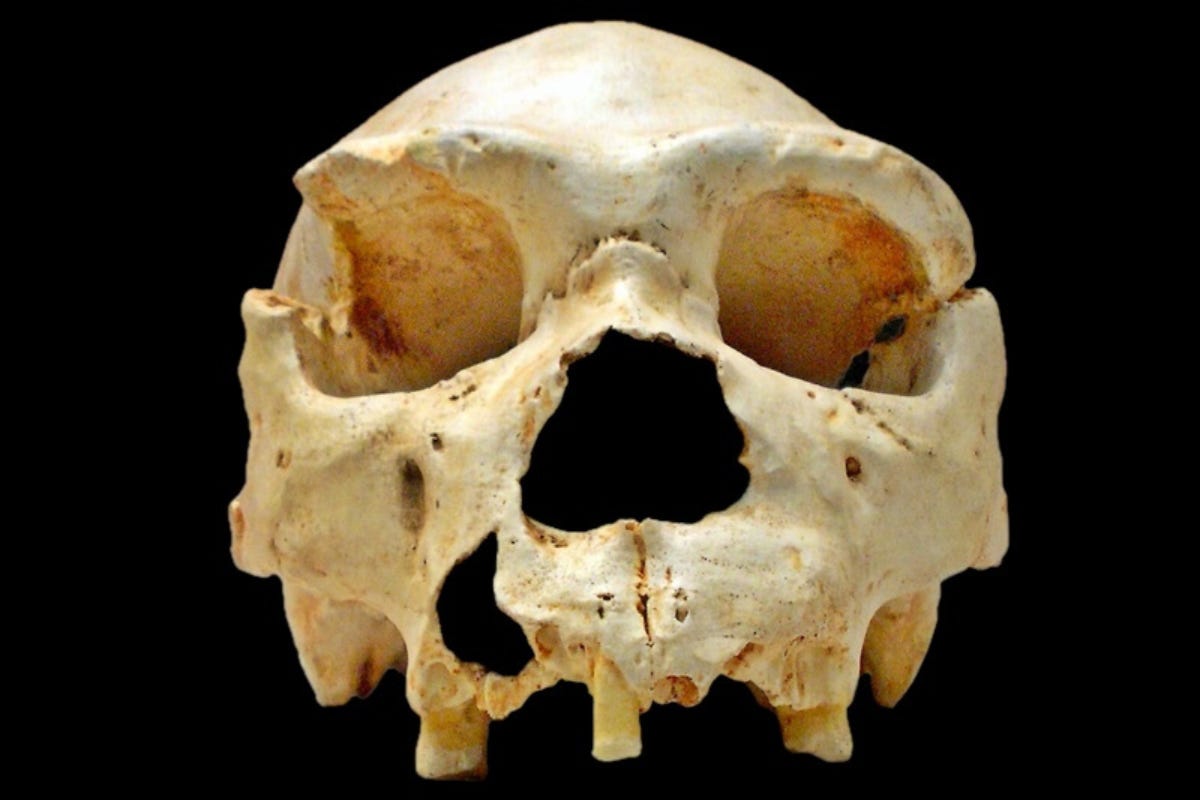
The candidate the researchers offer is Homo heidelbergensis, present in Africa and Europe between roughly 700,000 and 200,000 years ago. Chris Stringer of the Natural History Museum in London, who had no part in the study, said he agrees, pointing out that the species survived in Africa until about 300,000 years ago.
The one that came the long way
The second lineage is older and considerably stranger. It diverged from our ancestors around 1.8 million years ago, before the common ancestor of modern humans, Neanderthals, and Denisovans existed at all, and it turns up only in Oceania.
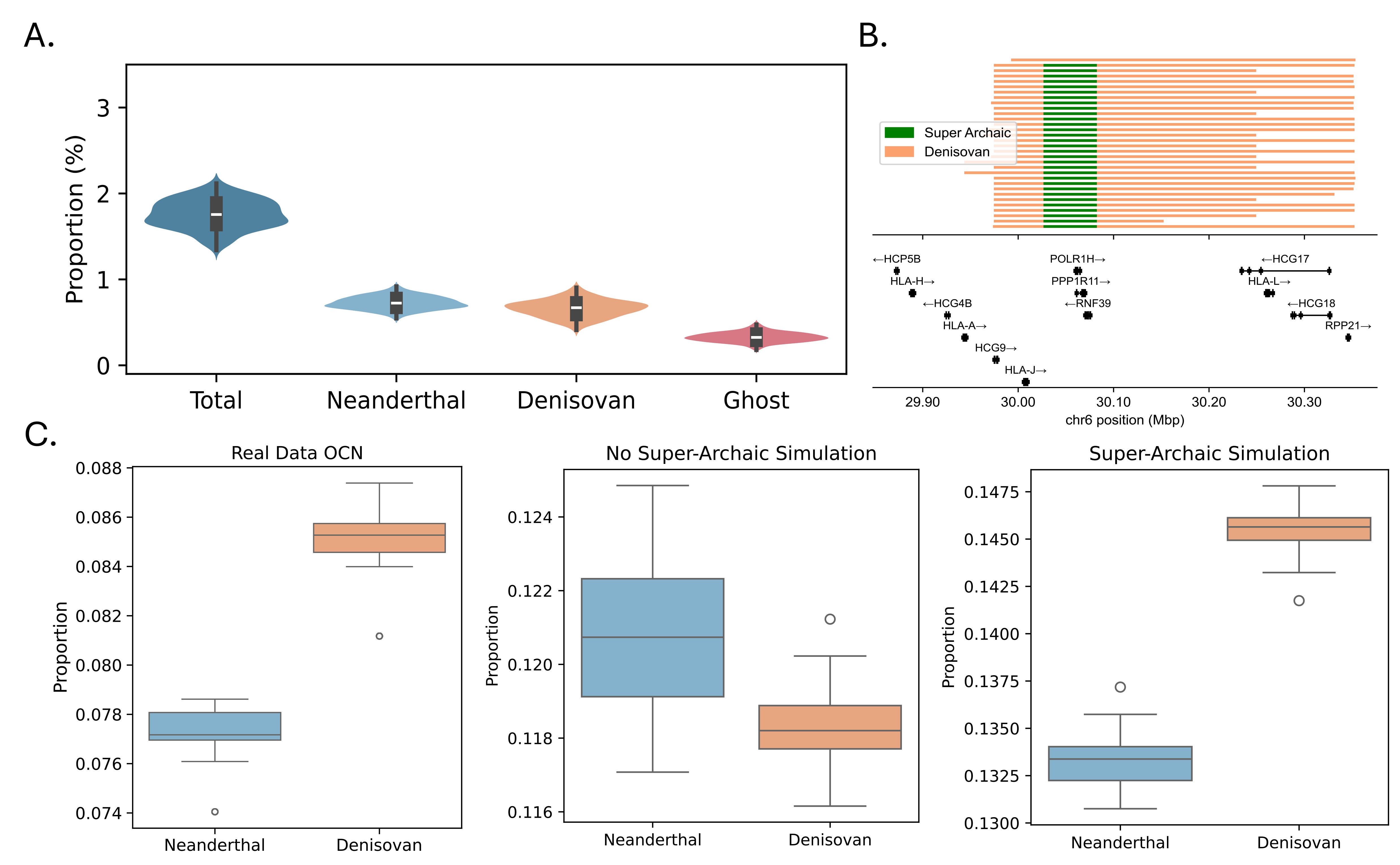
The quantity is tiny, averaging about 0.002 percent of the Oceanian genomes examined. What makes it legible is its position. These super-archaic segments sit inside regions of Denisovan ancestry and not Neanderthal ancestry, which means they arrived in modern humans through Denisovans rather than directly. Denisovan genomes themselves are thought to be 3 to 5 percent super-archaic, and only some of that was ever passed along.
Homo erectus is the obvious suspect, being the longest-surviving human species we know of. Fernando Villanea, a population geneticist not involved in the work, thinks the timing fits, and notes that Homo erectus skulls from Yunxian in China share features with Denisovan fossils. Very little Homo erectus genetic material has been analysed, though, so this stays a suggestion rather than an identification.
Immunity and metabolism
Segments from both lineages are scattered across the genome, but they cluster in regions tied to immune function and metabolism.
Moorjani is not surprised. Adapting to new pathogens and new food sources has been among the strongest pressures acting on human evolution, and interbreeding was a fast way to acquire DNA that already worked.
Less a tree, more a network
Villanea takes the findings as evidence that modern humans are the product of more than one species, and that interbreeding was the rule rather than the exception. Hybridisation shows up across the evolution of many species, he says, and results like these help shift scientific thinking away from human exceptionalism.
Moorjani makes a related point about shape. Human history looks less like a branching tree and more like a network of populations, tied together by repeated rounds of divergence, migration, and mixture.
Stringer sees a practical use. The technique offers indirect ways to reconstruct parts of the genomes of species like Homo erectus and Homo heidelbergensis, neither of which has produced usable ancient DNA.
Moorjani expects the resolution to improve as genome databases take in a wider range of human populations. More Denisovan genomes would help a great deal, since only one has been published. And protein fragments recently sequenced from Homo erectus fossils might one day put a name to the super-archaic ancestor.
Sources: University of California, Berkeley. Zhang, Y., Biddanda, A., Johnson, S.A., O’Dushlaine, C., and Moorjani, P. (2026). “Recovering Signatures of Archaic Hominin Introgression Using Ancestral Recombination Graphs.” Science. doi.org/10.1126/science.aef8874
Now this is intriguing.