


Archaeologists studying the Iberian oppidum of Cerro de las Cabezas in Valdepeñas, Spain, have analyzed one of the most unusual Iron Age deposits yet documented in the Iberian Peninsula.
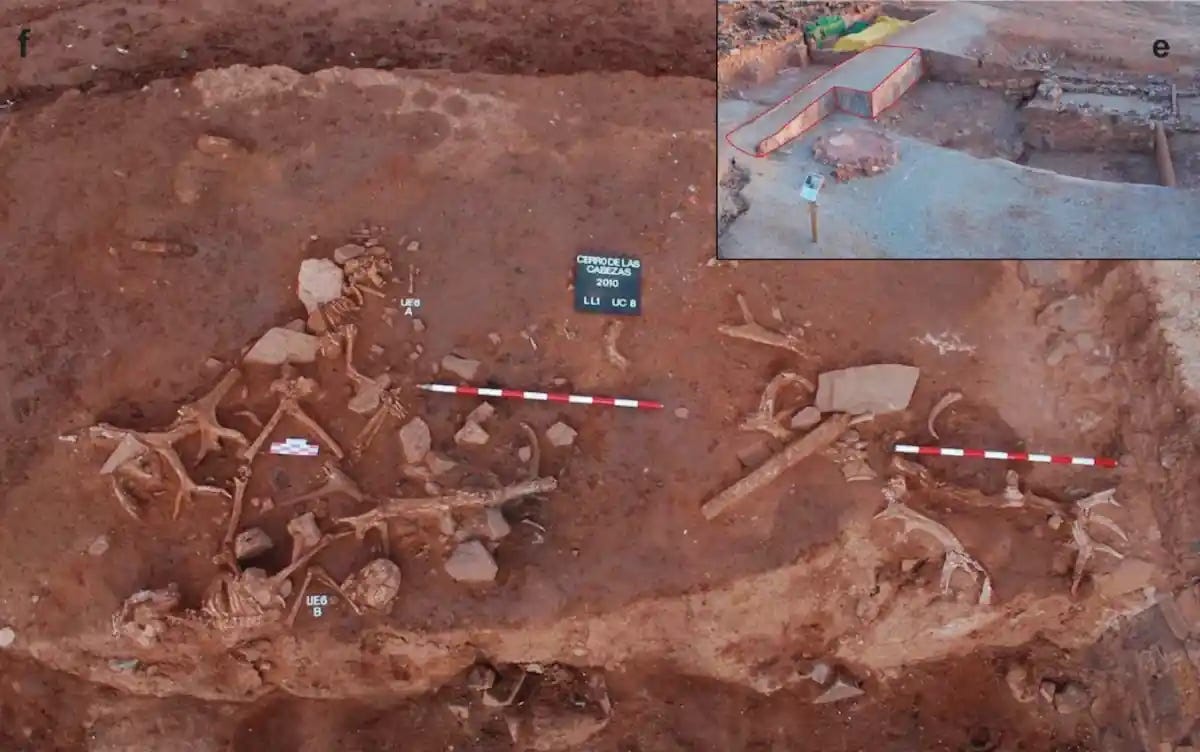
The older ramp (in red) beneath which the remains of the two studied individuals were discovered, and Photograph of the discovery in situ. Credit: J. Herrerín et al. 2026
The discovery consists of two adult male skeletons found outside the southern defensive wall of the settlement, together with six large red deer antlers. The men were not cremated, not placed in a formal tomb, and not arranged according to normal funerary custom. Instead, their bodies appear to have been deposited rapidly after violent deaths, in a filled space beside the wall.
The study, published as a Research Square preprint in 2026, was carried out by Jesús Herrerín, Aurora Grandal-d’Anglade, Nataša Šarkić, Ana García-Vázquez, and colleagues. It combines archaeology, physical anthropology, ZooMS proteomic identification, and stable isotope analysis of carbon, nitrogen, and oxygen.
The authors interpret the deposit as a case of “bad death”: a non-normative treatment of the dead connected with violence, punishment, ritual protection, or social exclusion. The presence of deer antlers makes the context even more striking, because no close parallel is currently known in Iberian archaeology for two complete human bodies deposited with large antlers in this way.
An Iberian oppidum in Oretani territory
Cerro de las Cabezas is an Ibero-Oretani fortified settlement located near Valdepeñas, in the province of Ciudad Real, Castilla-La Mancha. The site occupies a strategic position in the southern Meseta, close to routes linking the interior of the Iberian Peninsula with Andalusia and the Guadalquivir region.
The settlement was occupied mainly between the 6th and 2nd centuries BC. It was protected by walls, gates, towers, and defensive sectors, while excavations have also revealed domestic areas, storage spaces, sanctuaries, streets, warehouses, and urban planning features.
Cerro de las Cabezas is one of the most important sites for understanding the Oretani, an Iberian people of the central and southern interior. Its architecture, ceramic production, defensive system, and evidence of Punic influence show a complex community connected to wider Mediterranean and inland networks.
The new deposit was found in Area LL1, outside the south-eastern wall, close to the modern A-4 motorway. Its location near the defensive perimeter is central to its interpretation.
A deposit outside the southern wall
The remains were uncovered during the 2010 excavation campaign, beneath an earthen ramp connected with the modern visitor route.
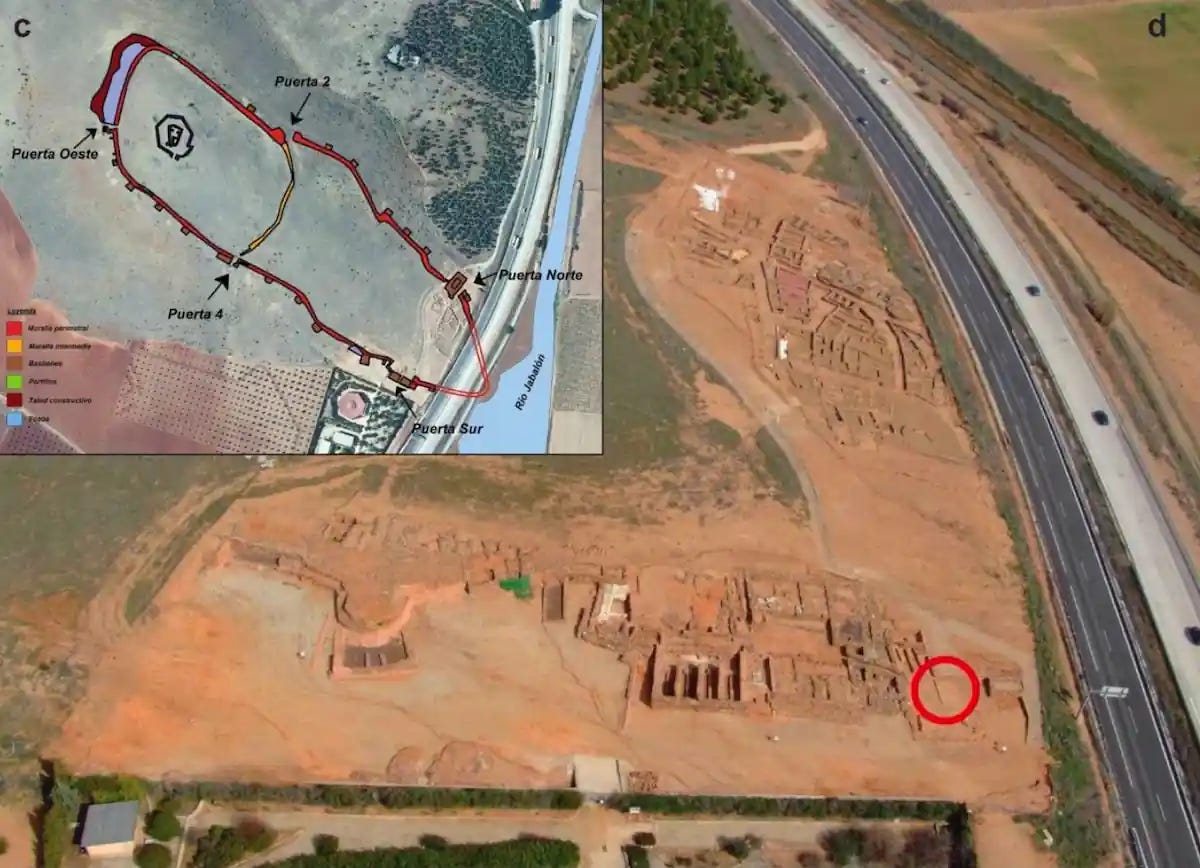
Plan of the settlement’s walls and gates, and Aerial view of the site with the red circle marking the location of the findings. Credit: J. Herrerín et al. 2026
The two individuals, named Individual A and Individual B, were found in anatomical articulation, meaning the bodies decomposed in place rather than being moved after skeletonization. They were associated with six large red deer antlers, some of them more than one meter long.
The deposit belonged to a single stratigraphic unit, LL1/Ue6. It was located directly on a use-surface connected with the final occupation phase of the wall. Based on the stratigraphic relationship, the context dates to the late 3rd or early 2nd century BC, near the final stage of the oppidum’s occupation.
No burial cut was found. No tomb architecture was present. There was no protected burial chamber, coffin, or formal funerary arrangement. The bodies appear to have been placed into a filled space and covered quickly.
This setting already made the deposit exceptional. In Iberian funerary practice, cremation was the dominant ritual, normally performed in necropolises. Complete adult inhumations in settlement contexts are rare, and articulated bodies connected with violent death are even more unusual.
A different kind of death
The expression “bad death” is used by researchers to describe deaths and post-mortem treatments that fall outside accepted funerary norms.
In many ancient societies, a person who died violently, dishonorably, outside the community, in war, by execution, or under ritual suspicion could receive a different kind of treatment after death. The body might be excluded from the cemetery, displayed, mutilated, placed in a boundary zone, or deposited in a way that communicated punishment or social separation.
At Cerro de las Cabezas, several features point in this direction.
The two men were not cremated. They were not placed in a regular burial area. Their bodies were deposited outside the wall. The arrangement was rapid and irregular. Both show evidence of extreme violence. The antlers appear to have been deposited at the same time as the bodies.
This combination suggests that the deposit was not a normal burial. It was a deliberate act with social and symbolic meaning.
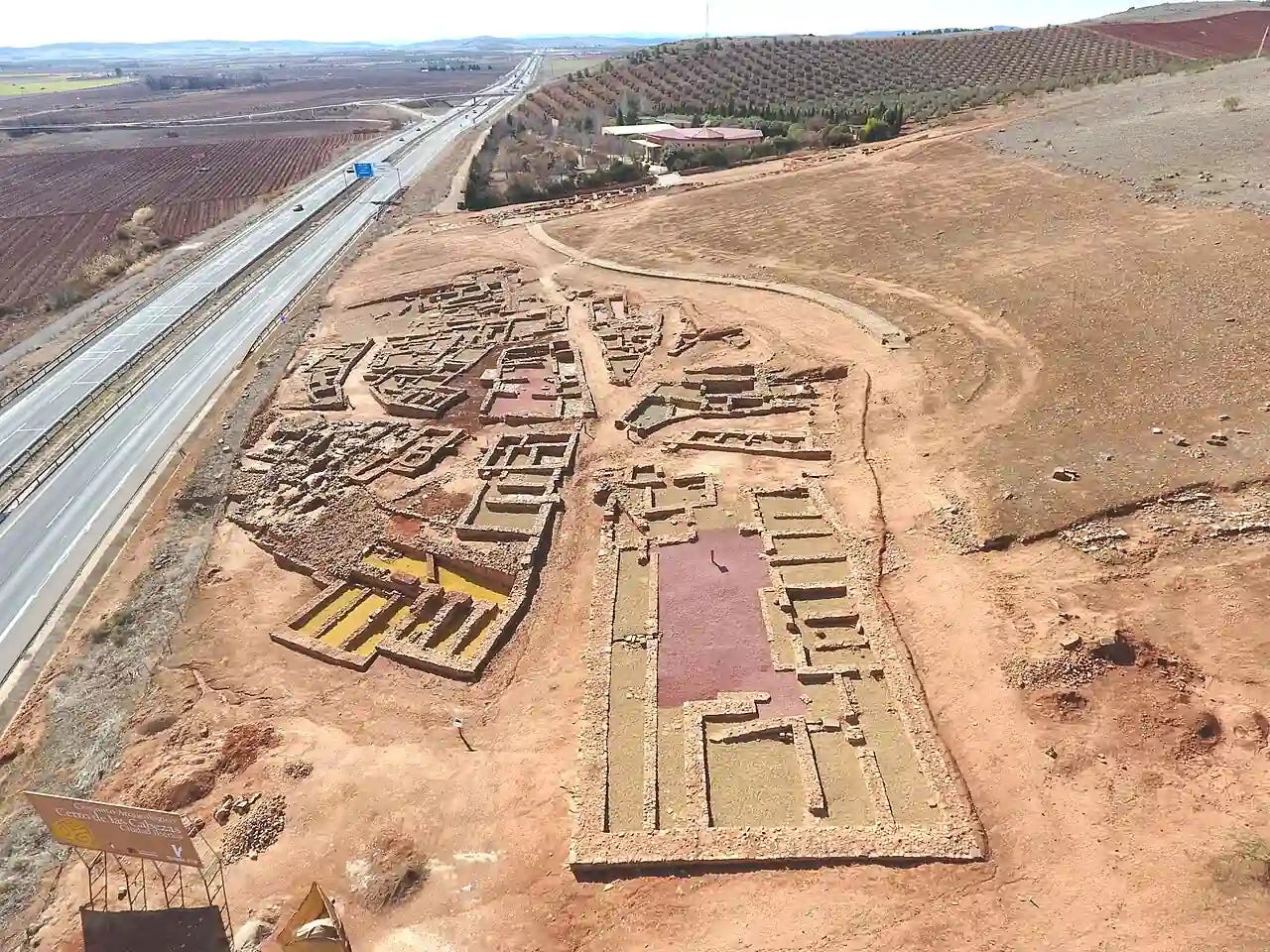
View of Cerro de las Cabezas site. Credit: ElDesmitificaRelatos / Wikimedia Commons
Individual A: a man with signs of mobility
Individual A was identified as a male between 35 and 45 years old.
He was found lying on his left side, with the body still in close anatomical articulation. His upper limbs showed medium robusticity, while his lower limbs were more robust. The researchers identified musculoskeletal markers linked with regular long-distance walking or significant physical mobility.
One important sign came from the Achilles tendon insertion. Reactive bone formation in this area may reflect sustained or intense physical activity connected with movement.
His teeth also preserved information about life history. He had advanced periodontal disease and severe wear on the upper incisors. This kind of wear may sometimes be related to using the teeth for tasks beyond ordinary chewing, although the exact activity cannot be reconstructed with certainty.
These details suggest a physically active adult male, possibly involved in movement, carrying, herding, or other labor-intensive activities.
The injuries of Individual A
Individual A had evidence for two separate traumatic episodes.
The first injury was a blunt-force blow to the frontal bone. This injury showed early healing, including porosity and rounded fracture edges. The researchers estimate that it occurred between two and six weeks before death.
This means the cranial injury was not the fatal event. It belongs to an earlier episode of violence or accident.
The second injury was far more severe. A deep transverse cut was found on the distal third of the right femur. The cut was made by a heavy sharp-edged weapon, possibly a sword, axe, or similar chopping blade.
The blow penetrated deeply into the bone but did not completely sever the limb. The weapon likely struck with great force, damaging the bone and soft tissues. The researchers suggest that the cut would have severed major vessels in the popliteal region, causing major blood loss and plausibly leading to death through hypovolaemic shock.
The position of the leg suggests that the injury happened while the man was lying face down or otherwise incapacitated. After death, he appears to have been thrown or placed without careful arrangement, ending up on his left side with the injured leg twisted unnaturally.
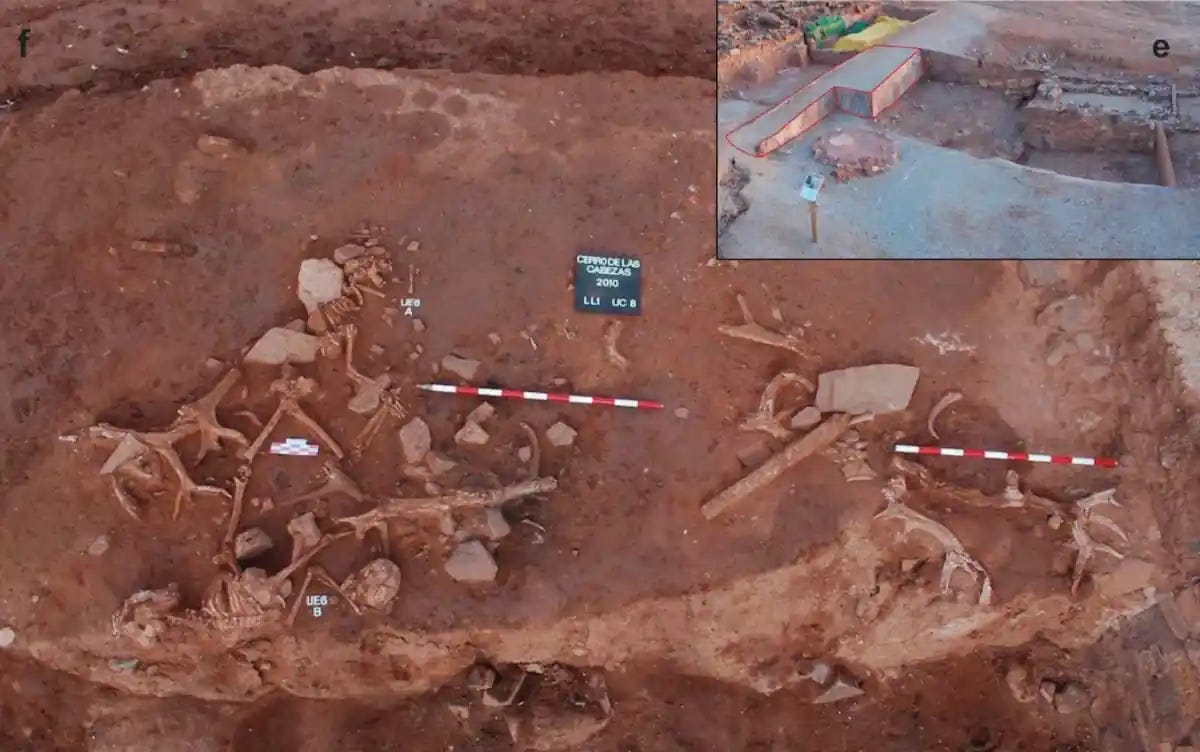
Older ramp marked in red, with the in situ discovery of the two individuals beneath it. Credit: J. Herrerín et al. 2026.
Individual B: decapitation and forced posture
Individual B was identified as a male between 40 and 59 years old.
His body was discovered in a twisted prone-lateral position. Most of the skeleton remained in anatomical alignment, but the head had been separated from its normal position and placed about 40 centimeters away.
The skull, mandible, and first three cervical vertebrae were still attached to one another. This detail is important. It shows that the head was removed while soft tissues were still present, and that the separation cannot be explained as later movement after decomposition.
The researchers interpret the evidence as decapitation. The pattern suggests a cut through the middle cervical region, around the C3 to C4 level. The most likely position was prone, allowing access to the back of the neck.
The body posture also points to rapid and rough handling. The trunk was twisted, the arms were displaced above the shoulders, and the legs lay in a forced position. The authors suggest that the corpse may have been lifted by the extremities or thrown into the feature.
The head placed with the body
The decapitation of Individual B is especially important because it differs from better-known Iberian severed-head practices.
In northeastern Iberia and southern France, severed heads were sometimes treated, curated, displayed, or nailed as trophies. These practices are often linked with warfare, enemies, power display, or ritual treatment of opponents.
At Cerro de las Cabezas, the head was not removed for separate public display. It was placed back into the same deposit with the body and antlers.
This makes the Cerro de las Cabezas case different. It may share the broader Iron Age language of violent treatment of the dead, but it does not fit neatly into the known pattern of displayed severed heads.
Here, the head seems to belong to the final depositional sequence itself. It was part of the act, not a trophy kept elsewhere.
The sequence of deposition
The study reconstructs a possible order for the event.
First, several deer antlers were placed at the base of the feature. Individual A was then deposited, probably after receiving the fatal sharp-force injury to the right femur. His body came to rest on the left side, partly over the antlers.
Individual B was deposited immediately afterward, with his body partly over Individual A. More antlers were then added above the bodies. Finally, the severed head of Individual B was placed on top of the deposit, resting above the left arm and over one of the antlers.
This sequence is important because it shows that the deposit was not a random accumulation of bones. The bodies and antlers entered the feature as part of a single rapid episode.
The act was rough, but structured. The bodies were treated without funerary care, but the antlers were deliberately included.
Six red deer antlers
The six large red deer antlers are one of the most unusual elements of the discovery.
Some were placed below the bodies. Others lay above or between the human remains. Their positions suggest they were deposited at the same time as the corpses.
The study argues that the antlers were unlikely to be ordinary waste or practical tools. Their size, number, placement, and close association with the bodies point toward symbolic or ritual meaning.
Red deer had importance in Iberian culture. Deer remains appear in sanctuaries, cremation deposits, communal deposits, and feasting contexts. Deer are also represented in Iberian sculpture, including at Castulo, another Oretanian site.
Antler was also a valued material for making objects. Iberian craftspeople used it for handles and other worked items. But the Cerro de las Cabezas antlers were not simply raw material. Their arrangement with executed bodies suggests a different role.
Antlers, walls, and protection
The location beside the defensive wall opens another interpretive path.
In parts of Iron Age Iberia, especially Celtiberian contexts, deer antlers were sometimes placed beneath foundations, walls, or monumental structures. These deposits have often been interpreted as apotropaic acts, meaning rituals intended to protect a place, boundary, building, or community.
Examples are known from sites such as Blacos, La Hoya, Solar del Antiguo Instituto, and Peñahitero. At La Hoya, antler and stone arrangements have been interpreted in connection with ritual practice and possible deer cult.
Cerro de las Cabezas lies in Oretani territory, but Oretanian lands bordered Celtiberian areas to the north. Shared ritual practices or symbolic influences are therefore possible.
The deposit may have combined two dimensions: punishment of the men and symbolic protection of the settlement wall.
Punishment and protection in one act
The study does not reduce the deposit to a single explanation.
The evidence points to violent death, exclusion from normal funerary rites, rapid deposition, and a symbolic association with antlers. It may have been connected with execution, social sanction, public display, ritual protection, or a foundation-like deposit near the defensive perimeter.
These possibilities are not mutually exclusive.
In ancient societies, violence and ritual could overlap. A punished body could become a warning. A death outside normal order could be transformed into a protective act. A boundary deposit could reinforce the social and physical limits of the community.
At Cerro de las Cabezas, the wall was not only a military structure. It marked the edge of the settlement and the community. Placing violently killed men and symbolic antlers outside that line may have carried a message about power, protection, exclusion, and control.
Diet from stable isotopes
The study used stable isotope analysis to reconstruct diet and mobility.
Carbon and nitrogen isotopes in bone collagen can help identify broad dietary patterns. Oxygen isotopes in bone and tooth enamel can provide clues about drinking water and mobility, because water isotope values vary geographically and environmentally.
Only Individual A yielded collagen suitable for dietary interpretation. Individual B’s collagen preservation was too poor.
Individual A’s carbon and nitrogen values suggest a diet based mainly on terrestrial C3 resources, with a significant contribution from animal protein. The evidence points especially toward domestic animals rather than wild deer.
The comparison between rib collagen and tooth dentine suggests that his diet remained relatively stable from adolescence into adulthood. There is no strong sign of a major dietary shift between youth and the last years of life.
Water signatures and movement
Oxygen isotope values were obtained for both individuals.
Individual A and Individual B showed different oxygen isotope signatures in bone and enamel. The difference between their values suggests that they may have grown up or lived in areas with distinct drinking-water signatures.
However, the authors are cautious. Both values still fall within the broader variability documented in nearby regional contexts, including Motilla del Azuer and the Campo de Calatrava Volcanic Field.
For this reason, the study cannot firmly identify either man as non-local.
Still, the difference between them is meaningful. It suggests that the two men did not necessarily share the same life history. Individual A’s oxygen values are closer to those of pigs from the site, and his skeleton shows signs of habitual long-distance walking. The researchers tentatively suggest a possible connection with herding domestic animals, but this remains speculative.
ZooMS and the animal remains
The study also used ZooMS, or zooarchaeology by mass spectrometry, to identify some animal bone fragments.
This method examines collagen peptide markers to identify animal remains when ordinary visual identification is difficult. At Cerro de las Cabezas, ZooMS helped classify ambiguous faunal fragments, including remains compatible with Sus sp., meaning pig or wild boar.
This matters because the animal isotope data helped build a local baseline for interpreting the human values.
The antlers themselves belonged to red deer, Cervus elaphus. Only one of the antlers preserved enough nitrogen for collagen isotope analysis. The results must therefore be interpreted carefully, especially because antler tissue reflects a particular period of growth rather than the animal’s full yearly diet.
Iberian funerary customs
The Cerro de las Cabezas deposit stands out because it does not match normal Iberian funerary practice.
Cremation was the dominant funerary rite in many Iberian communities. The dead were usually cremated and placed in necropolises, often with grave goods depending on status, identity, and local tradition.
At Cerro de las Cabezas itself, the known funerary record is limited. Earlier evidence included infant burials within domestic structures. The discovery of two uncremated adult males outside the wall therefore adds a very different kind of evidence.
The bodies were complete and articulated, but the context was neither formal burial nor ordinary disposal. It was something more socially charged.
This is why the authors place the find within the category of non-normative or “bad death” practices.
Severed heads in Iberian archaeology
The new discovery also connects with a broader Iberian and Celtic tradition of violent treatment of heads.
Severed heads are known from several Iberian sites, especially in the northeast. Some skulls were nailed, displayed near gates or towers, treated with substances such as resins or oils, or positioned in prominent places.
These practices have often been interpreted as the display of enemies, trophies, warnings, or powerful ritual objects. They may have marked victory, territorial control, prestige, or protection.
Recent work has expanded the known geographical range of Iberian severed-head practices. Finds from Olèrdola and Molí d’Espígol show that this ritual was not restricted to the groups traditionally associated with it.
Cerro de las Cabezas contributes to this wider discussion, but with a distinctive form. Individual B was decapitated, but his head was deposited with the body, not displayed separately. The context also includes six deer antlers, making it unlike the classic severed-head cases.
A violent deposit at the edge of the settlement
The placement outside the wall may have been central to the meaning of the event.
Settlement boundaries were powerful spaces in Iron Age communities. Gates, walls, towers, and entrances controlled movement and symbolized the separation between inside and outside, citizen and stranger, order and threat.
Human remains placed near these boundaries could carry strong messages. They could warn enemies, mark punishment, protect the settlement, consecrate a construction phase, or dramatize social power.
The Cerro de las Cabezas deposit was located outside the southern defensive wall during the final phase of the settlement. The antlers and violently killed bodies were therefore placed in a liminal zone: close to the community, but outside normal social and funerary space.
That position may be the key to the whole event.
The final occupation phase
The deposit dates to the late 3rd or early 2nd century BC.
This was a period of major tension and transformation in the Iberian Peninsula. The Second Punic War, Roman expansion, and changing power structures affected many communities. The Oretani territory, located in the interior but connected to wider trade and military routes, was part of this changing world.
The study does not claim that the two men were casualties of a specific historical event such as war. The evidence does not allow that level of precision.
But the date places the deposit during the final occupation phase of Cerro de las Cabezas. This was a moment when social, political, and military pressures may have been intense.
The violent deposit beside the wall may reflect local conflict, punishment, ritual anxiety, or attempts to reinforce communal order at a time of instability.
A rare view of social power
The bodies from Cerro de las Cabezas preserve more than physical violence.
They reveal how a community may have used death as a social message. The men were denied normal funerary treatment. Their bodies were placed in a boundary zone. Their injuries suggest execution or extreme violence. Their association with antlers links the act to ritual symbolism.
This makes the discovery important for understanding power in Iberian society.
Power was not expressed only through walls, weapons, trade, or elite goods. It could also be expressed through the treatment of bodies. A corpse could become a public statement. A violent death could be transformed into a ritual event. The boundary of a settlement could become a stage for social control.
The Cerro de las Cabezas deposit shows that death could be used to reinforce community norms, mark exclusion, and perhaps protect the settlement at the same time.
Science behind the interpretation
The strength of the study comes from combining several methods.
Archaeology provided the context: location, stratigraphy, wall association, body position, and antler placement.
Physical anthropology reconstructed sex, age, trauma, posture, health, dental wear, and musculoskeletal activity.
Stable isotope analysis provided information about diet and possible mobility.
ZooMS helped identify animal remains that were difficult to classify visually.
Together, these methods allow the deposit to be interpreted as a single event rather than a collection of isolated finds.
The evidence does not produce one simple answer. It builds a layered picture: two adult men, violent death, rapid deposition, symbolic antlers, boundary placement, and possible connections with punishment and protection.
A unique Iberian case
The authors describe the deposit as exceptional and possibly unique in the Iberian archaeological record.
There are other examples of severed heads, foundation deposits, human remains in unusual contexts, and antler deposits. But the combination at Cerro de las Cabezas is extraordinary: two complete adult male bodies, clear violent trauma, six large red deer antlers, no formal grave, no cremation, and a location outside the defensive wall.
The find does not fit neatly into one known category. It touches several traditions at once: bad death, execution, boundary ritual, antler symbolism, defensive-wall deposition, and Iron Age practices involving human remains.
This complexity is what makes the discovery valuable.
Rather than offering a simple story of burial or execution, Cerro de las Cabezas reveals a ritualized act at the edge of an Iberian city, where violence, symbolism, and social order converged.
Sources
Herrerín, J., Grandal-d’Anglade, A., Šarkić, N., García-Vázquez, A., et al. (2026). “Bad death” at the Ibero-Oretani site of Cerro de las Cabezas (Valdepeñas, Spain): an anthropological and multi-isotopic (δ13C, δ15N, δ18O) study. Research Square. DOI: 10.21203/rs.3.rs-9781535/v1
La Brújula Verde. (2026, June). Unique Discovery at the Iberian Oppidum of Cerro de las Cabezas: Two Executed Men Deposited Alongside Six Deer Antlers in a “Bad Death” Ritual. La Brújula Verde.
Valdepeñas Tourism. Archaeological Park Cerro de las Cabezas. Concejalía de Turismo, Valdepeñas.
Reguero González, J. (2021). Arqueología de la arquitectura en el oppidum oretano de El Cerro de las Cabezas (Valdepeñas, Ciudad Real): los bastiones de la puerta S. Archaeopress.
Universitat Autònoma de Barcelona. (2026, February 4). New study expands the frontiers of Iberian severed head ritual. Department of Prehistory, UAB.
De la Fuente-Seoane, R., Molist, N., Principal, J., Riba-Vidal, M., Tarifa-Mateo, N., & Subirà, M. E. (2025). Cabezas cortadas iberas en contextos cosetanos e ilergetes. Nuevas aportaciones bioantropológicas en El Molí d’Espígol (Tornabous, Lleida) y Olèrdola (Olèrdola, Barcelona). Trabajos de Prehistoria, 82(2), 1049. DOI: 10.3989/tp.2025.1049