


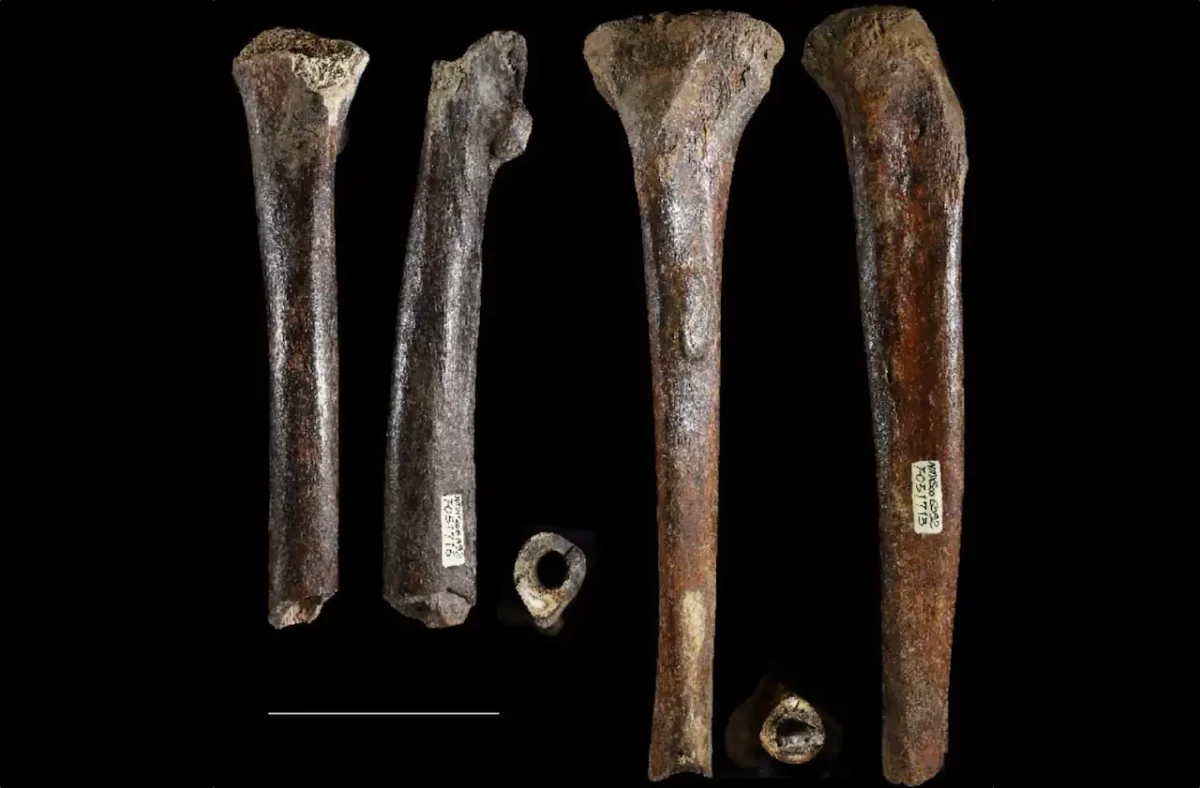
A femur and a partial tibia dredged from the seafloor of the Penghu Channel have been identified as Denisovan from their collagen proteins, and they are among the largest leg bones known from Pleistocene Homo. The preprint reporting them, by Yousuke Kaifu, Chun-Hsiang Chang and colleagues, went up on bioRxiv on 8 August 2026 and has not been peer reviewed.
A trawler brought them up from a hundred metres down
An industrial trawler brought them up from about a hundred metres down, roughly 25 kilometres off Taiwan’s southern coast, along with a large quantity of animal bone. The material was acquired by researchers in 2010 from a collection donated by the Taiwanese artist Li-Ren Hou to the National Museum of Natural Science, and some of the bones were recognised as hominin at that point.
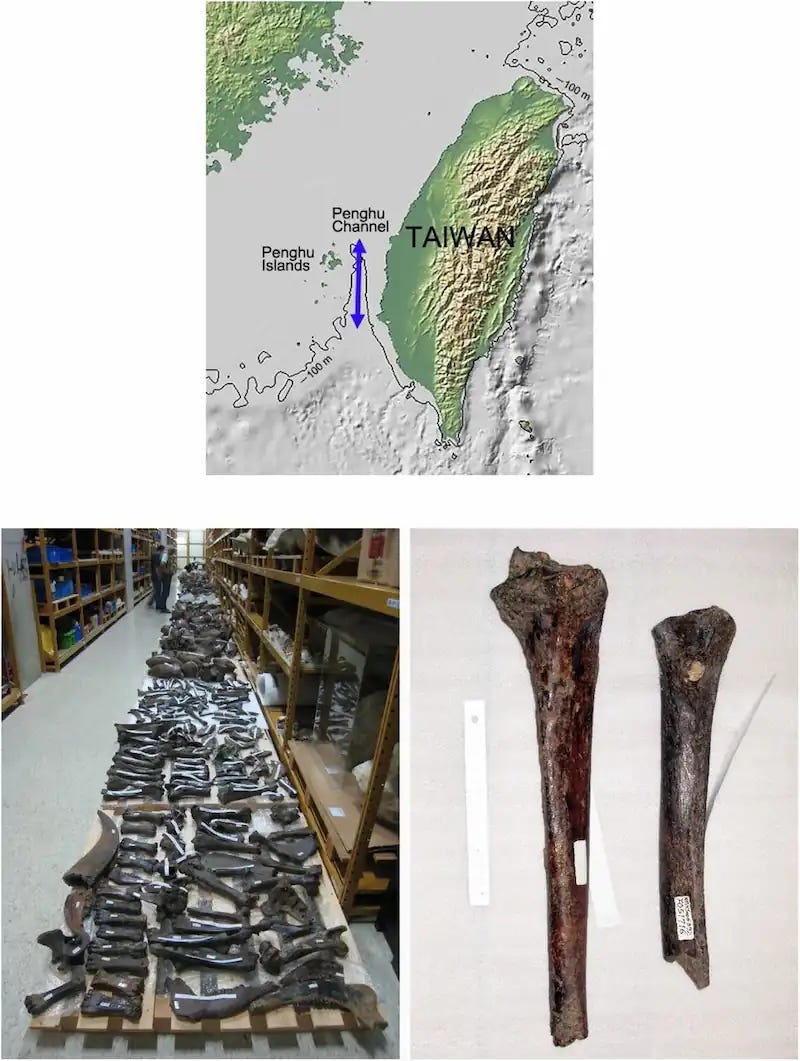
During glacial periods when sea levels dropped, the channel was dry land connecting Taiwan to the Asian mainland.
The context is worth being plain about. These fossils came out of indiscriminate trawling, so they arrived jumbled together with no stratigraphy and no record of where on the seafloor any individual bone was picked up. Kaifu’s own paper says as much, that there is no record of when or where in the Penghu Channel each of the leg bones was collected. Nothing establishes that the two individuals were contemporaries, or that either is contemporary with Penghu 1, the mandible identified as Denisovan in Science last year.
One method says 45,000 years, another says 160,000
Radiocarbon on purified collagen from the tibia gives a calibrated age of 45,575 to 44,522 years before present. That is the figure in all the coverage.
Uranium-series dating on the same bone, published by Rainer Grün and Chris Stringer in 2023, indicated an age in excess of 160,000 years. The femur could not be dated by that method at all.
John Hawks, who works on Denisovan material at the University of Wisconsin, calls this a divergence by a factor of four and not a minor difference. His reading is that a radiocarbon age from purified collagen is fairly convincing evidence the uranium modelling was wrong, which has consequences well beyond Penghu, since a great many East Asian fossils are dated by uranium uptake and few can be checked against radiocarbon. The Harbin skull is among them.
The size claim has a sampling problem
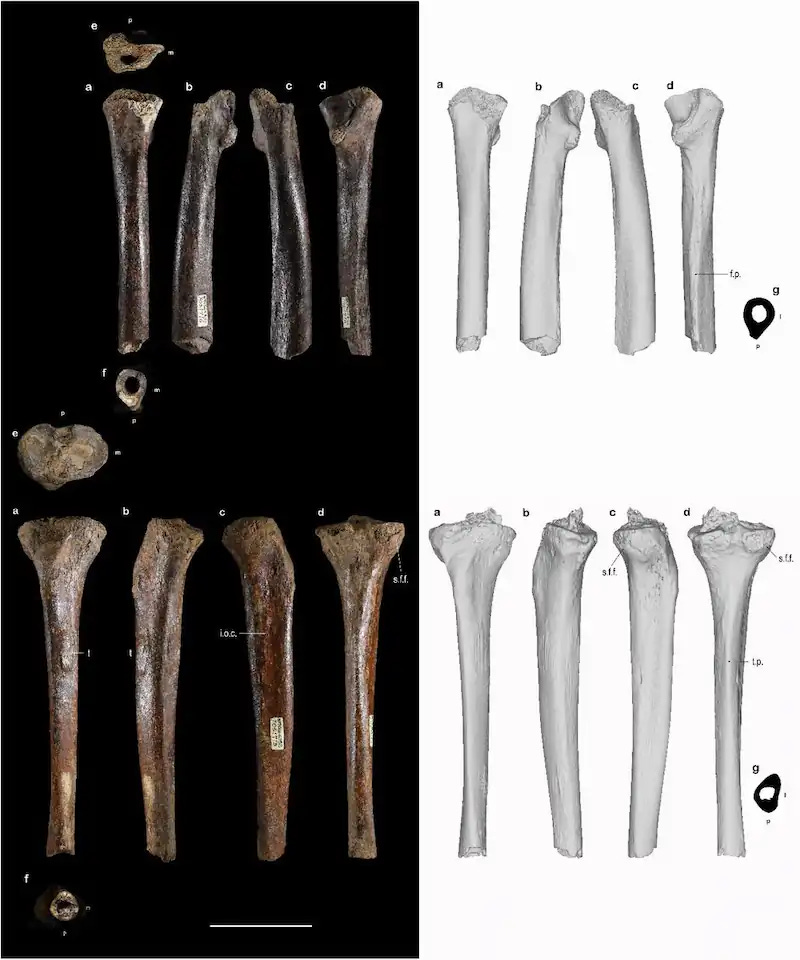
The paper’s central argument is that Denisovans in this region were larger than earlier Homo erectus and larger than Late Pleistocene Homo sapiens in eastern Asia, and that this runs against Bergmann’s rule, which predicts body size declining as you move toward the equator. The authors also suggest the large Denisovan brain may follow partly from large body size.
Hawks is sceptical, and his objection is about how these bones came to be in a collection at all. Trawling nets catch larger and thicker elements more readily, and thicker bones survive the process with their morphology intact. A collector sorting through dredged material will pick out the well-preserved pieces, and thin or juvenile bones are less likely to be recognized as anything.
There is also a wider pattern. Hawks has written previously on the sample bias in known Denisovan remains, which are mostly male. Both Penghu individuals are identified as male.
His conclusion is that the sample sizes for groups other than Neanderthals are small enough that he would not make much of these measurements beyond saying the bones are human.
The isotopes put them at the trophic level of carnivores
A companion preprint led by Minoru Yoneda, posted the same day, ran stable isotopes on the same bones. Nitrogen values put the Penghu 3 individual at a trophic level comparable to carnivores, close to what is seen in Neanderthals. The carbon indicates a landscape dominated by C4 plants, which fits a southern coastal setting and differs from the C3 environments of the Neanderthals and of Tianyuan, the early modern human from northern China.
Hawks notes that isotopic composition is not vulnerable to the biases that affect the body-size argument, which may make this the more useful result of the two papers.
East Asia has almost nothing from these millennia
The Denisovan record has a gap. Neanderthals are abundant in the window between 70,000 and 45,000 years ago, so abundant that the term classic Neanderthals exists for them. East Asia has almost nothing from those millennia that can be attributed to Denisovans or to any other archaic human.
If the radiocarbon date holds, Penghu 3 sits directly in that gap and becomes some of the latest direct evidence for Denisovan survival anywhere. Hawks describes this as the major value of the new material, and adds that if collagen survives this well in the tibia, DNA may too, which would tell us considerably more about late Denisovans than anything currently available.
Thanks for reading. Support Independent Ancient Content. Your support helps me create more archaeology posts, articles, and mini history videos:

Sources: Kaifu, Y., Chang, C.-H., Tarusawa, Y., Sawafuji, R., Yonemoto, S., Shimamura, S., Takai, M., Kono, R.T., Sun, C.-H., Tsai, C.-H., Yoneda, M., and Tsutaya, T. (2026). "Denisovan Leg Bones From Taiwan Reveal Large Body Size." bioRxiv, doi.org/10.64898/2026.08.07.743438. Yoneda, M., et al. (2026). "Habitat and Feeding Ecology of a Denisovan From Late Pleistocene Taiwan." bioRxiv, doi.org/10.64898/2026.08.07.743455. Hawks, J., "Legs of the Last Denisovans," 8 August 2026. Grün, R., and Stringer, C. (2023). Quaternary Science Reviews 322, 108379. Tsutaya, T., et al. (2025). "A Male Denisovan Mandible From Pleistocene Taiwan." Science 388(6743), 176 to 180.