


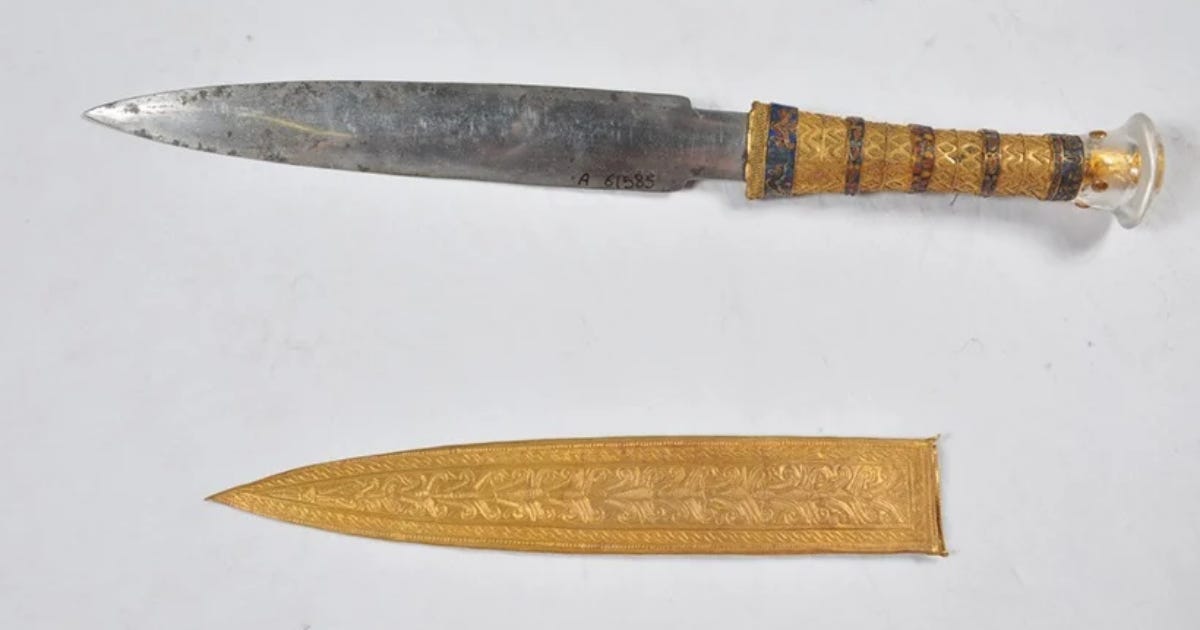
Tutankhamun’s meteoritic iron dagger (JE 61585) beside its gold sheath. The dry conditions in the tomb kept the blade free of rust. Credit: Egyptian Museum of Cairo, via Eos
When Howard Carter’s team examined Tutankhamun’s mummy in 1925, they found two daggers in the linen wrappings, one with a gold blade and one with a blade of iron. In 2016 an Italian and Egyptian team aimed a portable X-ray device at the iron blade and measured 10.8 percent nickel and 0.58 percent cobalt, a combination typical of iron meteorites. A 2022 Japanese study went further and proposed that the dagger was forged at low temperature and may have reached Egypt as a diplomatic gift from Mitanni, an idea that other specialists have challenged.
Ancient Content, October 30, 2026.
Carter found two daggers in the wrappings of the king’s mummy
Howard Carter found the tomb of Tutankhamun in 1922. In 1925 his team examined the king’s mummy and found two daggers among the bandages. The one with a gold blade lay on the abdomen. The other lay on the right thigh. Its blade is iron, its handle is gold decorated with cloisonné and granulation, and its pommel is rock crystal. The gold sheath carries a lily on one side and feathers ending in a jackal’s head on the other.
The dagger now carries the Cairo Museum number JE 61585 and Carter’s number 256K. It measures roughly 35 centimetres, and its blade is about 22 centimetres long. The dry tomb left the iron free of rust, and the blade is finely made from an apparently homogeneous metal. A few other iron objects came from the tomb, among them 16 miniature blades and an iron Eye of Horus amulet on a gold bracelet.
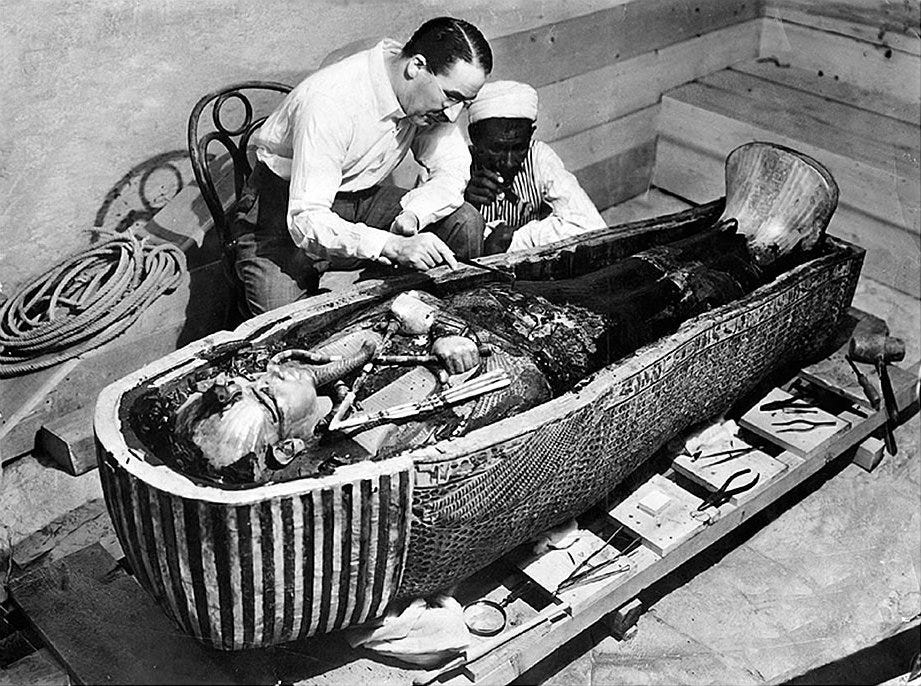
Howard Carter and an Egyptian foreman work on the innermost coffin of Tutankhamun during the excavation of the tomb. Credit: The New York Times photo archive, via Wikipedia (Public Domain)
Earlier tests gave conflicting answers
Scientists had suspected a meteoritic source for decades. A 1970 analysis mentioned by the researcher Bjorkman in 1973 reported high nickel, but it was never published and its methods are unknown. A 1994 X-ray fluorescence study found only 2.8 percent nickel, a figure that did not fit meteoritic iron. The conflict stood until 2016.
A portable X-ray device measured the blade without touching it
The nickel result is only the beginning. Below are a meteorite found in Egypt in 2000, a diplomatic gift from a king of Mitanni and a published comment that disputes the latest theory. Paid subscribers, keep reading. Free readers, upgrade to unlock the rest.
