


On the floodplain of the Tula River, just outside the fenced perimeter of one of Mexico's most famous archaeological zones, a team of archaeologists has uncovered something that complicates the tidy story of how a great city dies.
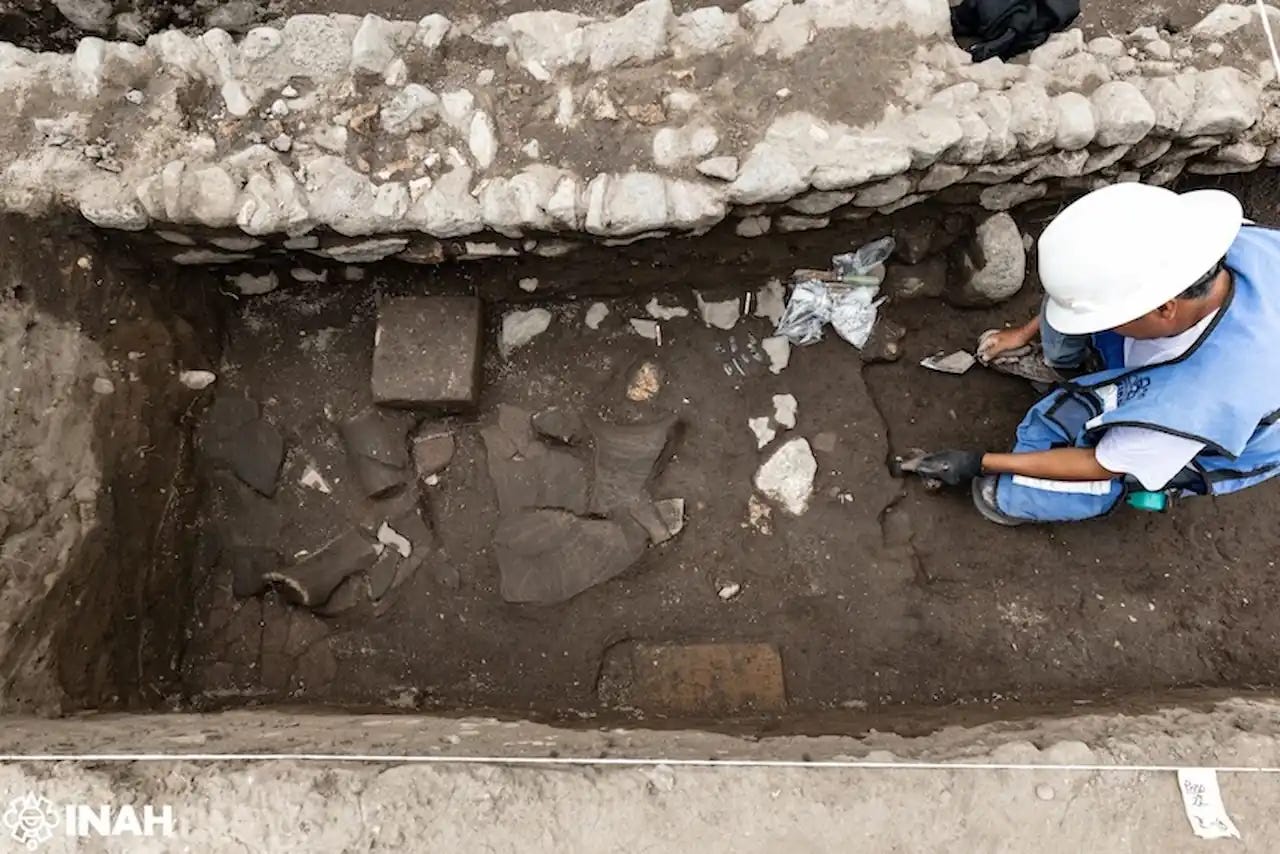
Excavation area near the perimeter of the ZAT and adjacent to the Tula River, where archaeologists uncovered a wealth of discoveries. Credit: Gerardo Peña, INAH
Carved stone panels that once decorated Pyramid B, the towering, atlante-topped temple of the Toltec capital, were pried loose around a thousand years ago, carried roughly 100 meters from the ceremonial heart of the city, and reused to adorn an elite residence on the outskirts. Buried beneath the floor of a nearby house lay the remains of six children, sacrificed together.
The discovery, announced by Mexico’s National Institute of Anthropology and History (INAH), emerged from a salvage operation that began in May 2026, prompted by the construction of a water treatment plant in the 16 de Enero neighborhood of Tula de Allende, in the state of Hidalgo. What the excavation has produced is less a single artifact than a window onto the city’s afterlife, the centuries when Tula’s monumental core was fading in significance while people on its margins worked to claim its prestige for themselves.
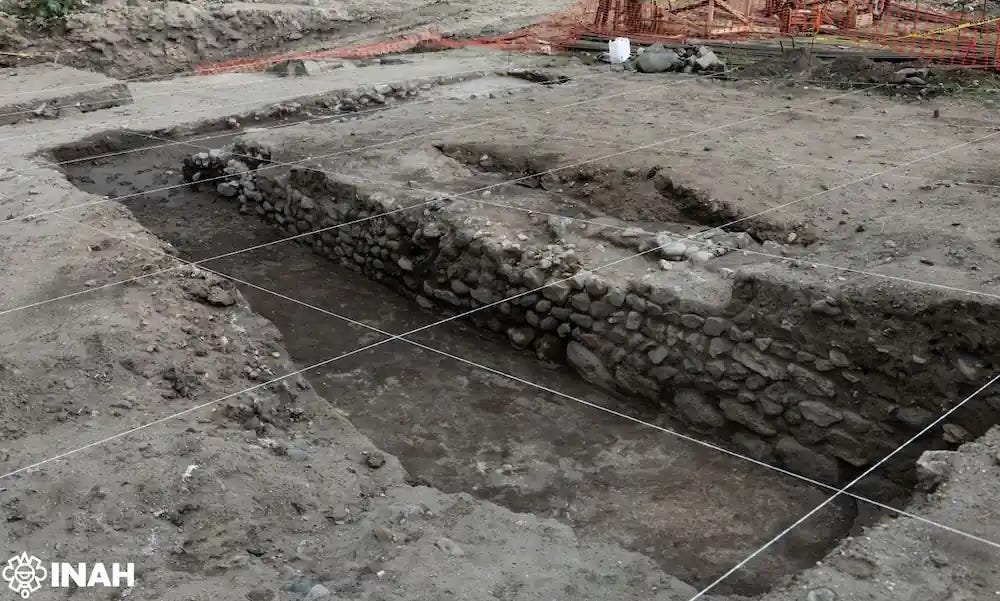
Researchers from INAH uncovered a 40 by 80 meter structure featuring detached reliefs from Pyramid B, along with children’s burials and evidence of ritual sacrifice. Credit: Gerardo Peña, INAH
The capital of the Toltecs
Tollan-Xicocotitlan, or Tula, was the seat of the Toltec civilization, which dominated central Mexico in the centuries before the rise of the Aztecs. The city reached its height between roughly 900 and 1100 AD, sprawling across several square miles and, by some estimates, housing tens of thousands of people. Its civic center included temple pyramids, a palace complex, ball courts, and the colonnaded structures that gave the site its monumental character. By the twelfth century, however, Tula’s influence had collapsed.
The most recognizable monument at the site is Pyramid B, also known as the Temple of Tlahuizcalpantecuhtli, the “Lord of the Dawn” or “House of the Morning Star,” an aspect of the feathered-serpent deity Quetzalcoatl associated with the planet Venus. The five-tiered pyramid is crowned by four colossal basalt warrior figures, the famous atlantes, which once helped support the roof of a temple at its summit. Its façades were originally clad in carved and brightly painted stone panels depicting processions of jaguars, coyotes, eagles, and serpents, imagery binding the Toltec rulers to war, sacrifice, and cosmic order.
It was precisely these decorative panels, or fragments matching them, that the new excavation recovered far from the pyramid itself.
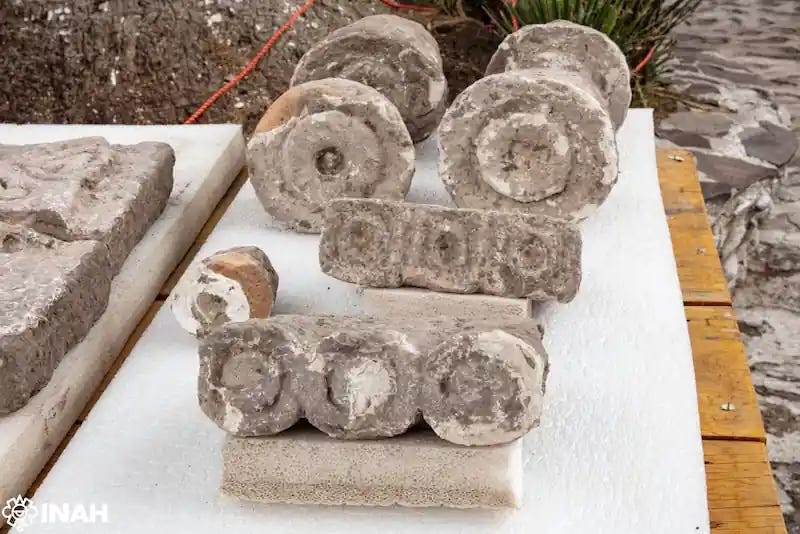
The structure’s decoration featured depictions of chalchihuites, greenstone beads associated with power and wealth. Credit: Gerardo Peña, INAH
Panels carried to the periphery
The salvage area sits nearly 100 meters from the boundary of the Tula Archaeological Zone, adjacent to the river. There, archaeologists exposed a substantial building, roughly 40 by 80 meters, decorated with images of chalchihuites, greenstone beads long associated with power, fertility, and wealth in Mesoamerican symbolism. Within and around the structure they found two carved tombstone-like slabs whose iconography points unmistakably to a single origin.
One slab depicts the god Tlahuizcalpantecuhtli; the other shows a feline. Both match the imagery known from Pyramid B. The Tlahuizcalpantecuhtli panel measures about 78 by 53 centimeters, the feline panel about 53 by 42 centimeters, and both retain traces of their original stucco and polychromy. For Luis Gamboa Cabezas, the lead archaeologist on the project, the context speaks to a deliberate act of borrowed legitimacy. At a moment when the core of Tula may no longer have held the same sacred authority, he suggests, people from the periphery came to the old palace area, took the symbols they needed, and used them to identify themselves as Toltecs, to feel, and to be seen as, heirs to the city’s greatness.
The feline panel also resolves a question that had lingered for the better part of a century. In the mid-twentieth century, the archaeologist Jorge R. Acosta documented processions of coyotes and felines moving from right to left along the east side of Pyramid B, but found nothing comparable on the west. The newly recovered slab shows the animals moving in the opposite direction, from left to right, evidence that the procession of carved beasts once wrapped all the way around the structure, rather than decorating only one side.
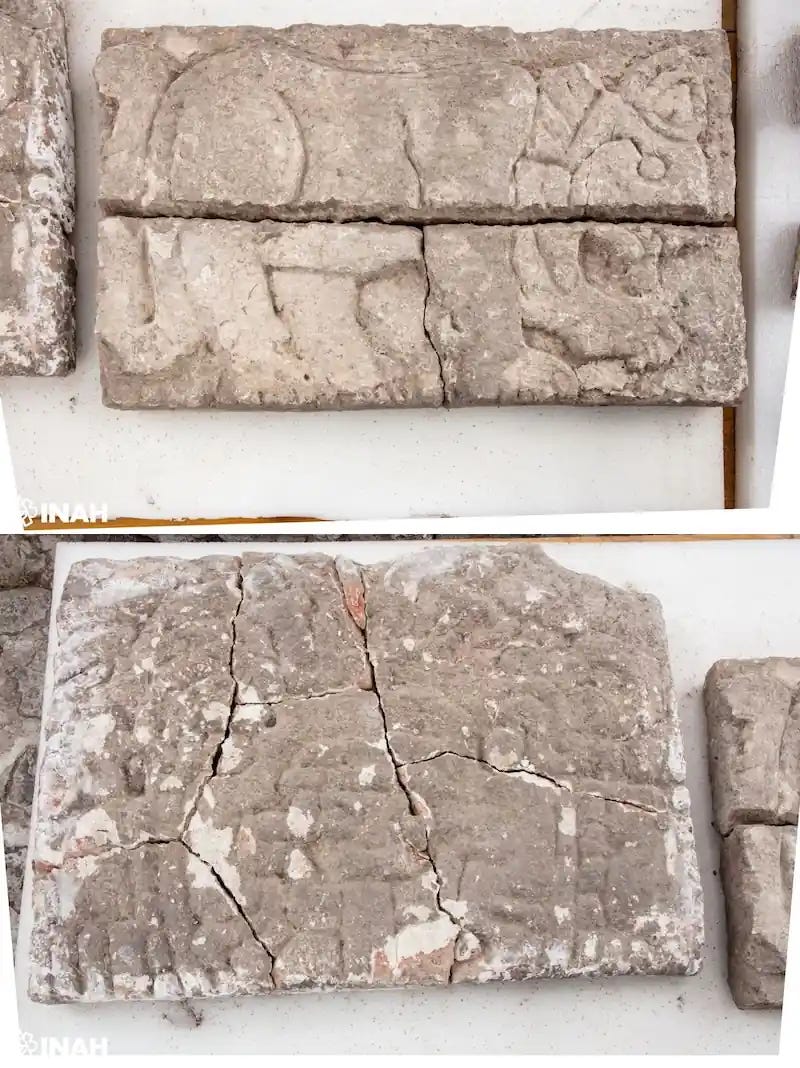
Two reliefs were uncovered by INAH researchers, one depicting a feline and the other the deity Tlahuizcalpantecuhtli. Credit: Gerardo Peña, INAH
Six children beneath a floor
If the reused panels speak to ambition and identity, other finds from the same operation speak to something darker. Among the primary and secondary burials recovered was a single offering of six infants, aged between one and six years at the time of death, placed together beneath a house floor. Child sacrifice is well attested at Tula and across Mesoamerica more broadly; earlier work near the Toltec capital has turned up groups of children associated with rain deities and altars, and the site’s history of ritual violence is one of its most studied and unsettling features.
Another artifact deepens that picture. The excavators recovered a copper awl whose tip matches a scraping mark found on a human lower jaw, evidence, they believe, that the tool was used to remove skin in a ritual context, a practice known from later Mesoamerican religion in connection with deities of renewal and agricultural fertility.
The broader haul of material, dating from roughly 1100 to 1521 AD, reflects a community that continued to live and work in the shadow of the old capital long after its political collapse. Archaeologists recovered vessels, plates, bone awls, shell beads, seals, spindle whorls, and numerous figurines, including a blue-painted fragment showing a canid wearing a headdress and a vessel fragment bearing a feathered serpent. The area’s deep ritual significance was already apparent. In a 2018 rescue phase, researchers found 23 skulls bearing the dental and cranial modifications typical of pre-Hispanic elites, placed in vessels and aligned near an altar.
Heirs to a fading city
Taken together, the finds sketch a portrait of Tula’s long twilight. As the monumental center lost its grip on sacred and political authority, communities on the periphery did not simply abandon the Toltec legacy. They appropriated it. They stripped sacred imagery from the great pyramid, installed it on their own elite buildings, and continued to perform the rituals, including human sacrifice, that had defined Toltec religious life. Many groups settling in the area over the following centuries adopted Toltec architecture, artifacts, and styles precisely to assert their standing as the city’s rightful successors, a claim later cultures, including the Aztecs, would also stake.
The discovery carries a pointed lesson about how much remains hidden. As INAH archaeologist Carlos Arriaga Mejía noted, the protected polygon of the Tula Archaeological Zone represents only a sliver of the original pre-Hispanic city, a reminder that significant remains may lie beneath any patch of ground in the region, and that development and heritage protection must work in tandem.
Because the artifacts were recovered from land historically prone to flooding from the Tula River, their preservation demands careful handling. Each piece is transported to camps within the archaeological zone for safekeeping, then cleaned, classified, and registered in INAH’s databases for future study and possible public display. Once the architectural remains have been documented and consolidated, they will be covered with geotextile and earth to protect them. INAH and the Hidalgo State Water and Sewerage Commission have agreed to set the area aside for low-impact construction that will not bear down on the buried Toltec structures. That arrangement allows the water treatment plant to proceed while leaving the relics of the Lord of the Dawn undisturbed beneath the soil.
Source. National Institute of Anthropology and History (INAH), Mexico