


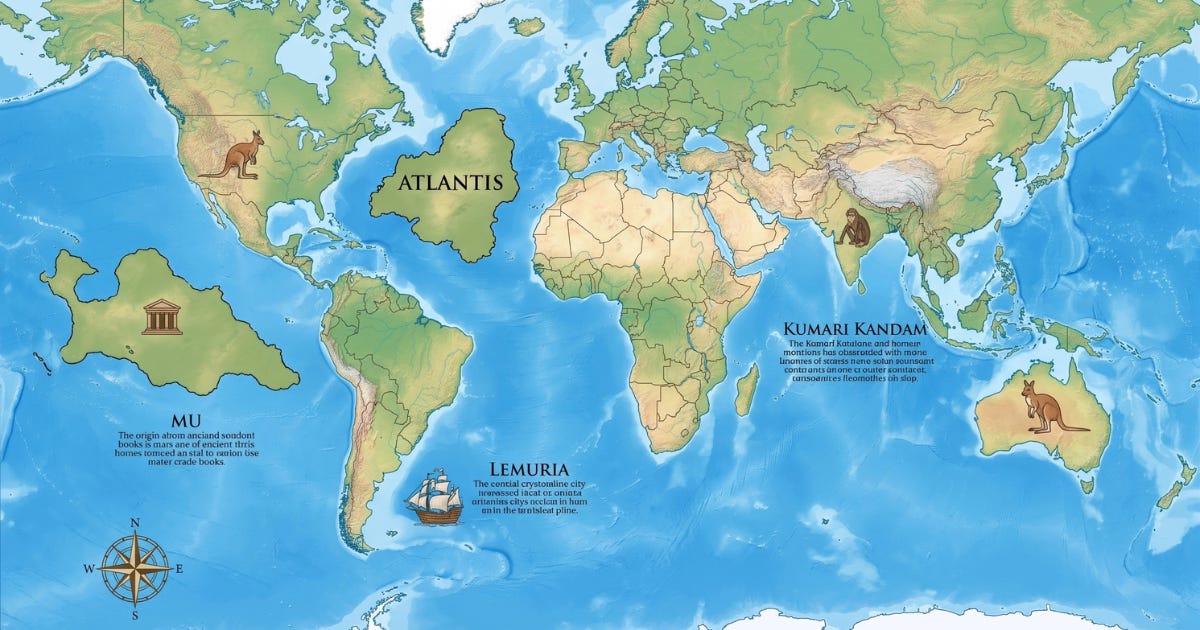
Lemuria, Kumari Kandam and Mu usually travel together. Books and videos treat them as three names for the same drowned homeland, a vast land in the Indian or Pacific Ocean whose survivors carried civilization to the rest of the world.
Each of the three has a traceable origin, and they turn out to be very different things. One began as a scientific hypothesis about lemurs. One is a genuine strand of ancient Tamil literature. One came from a misreading of a Maya book. They merged in the twentieth century, and underneath all three lies a drowned world that is real.
Lemuria began as a zoologist’s answer to a puzzle about lemurs
In 1864 the British zoologist Philip Sclater published a short paper called The Mammals of Madagascar. He was troubled by a pattern in the fossil record. Lemur-like primates appeared in Madagascar and in India, and he could find no trace of them in the lands between.
His solution was a land bridge, a continent in the Indian Ocean connecting the two, since sunk. He named it Lemuria, after the animals it was meant to explain.
For a scientist of the 1860s this was a reasonable idea. Continental drift had not been proposed, and land bridges were the standard way to explain why related species turned up on separate landmasses.
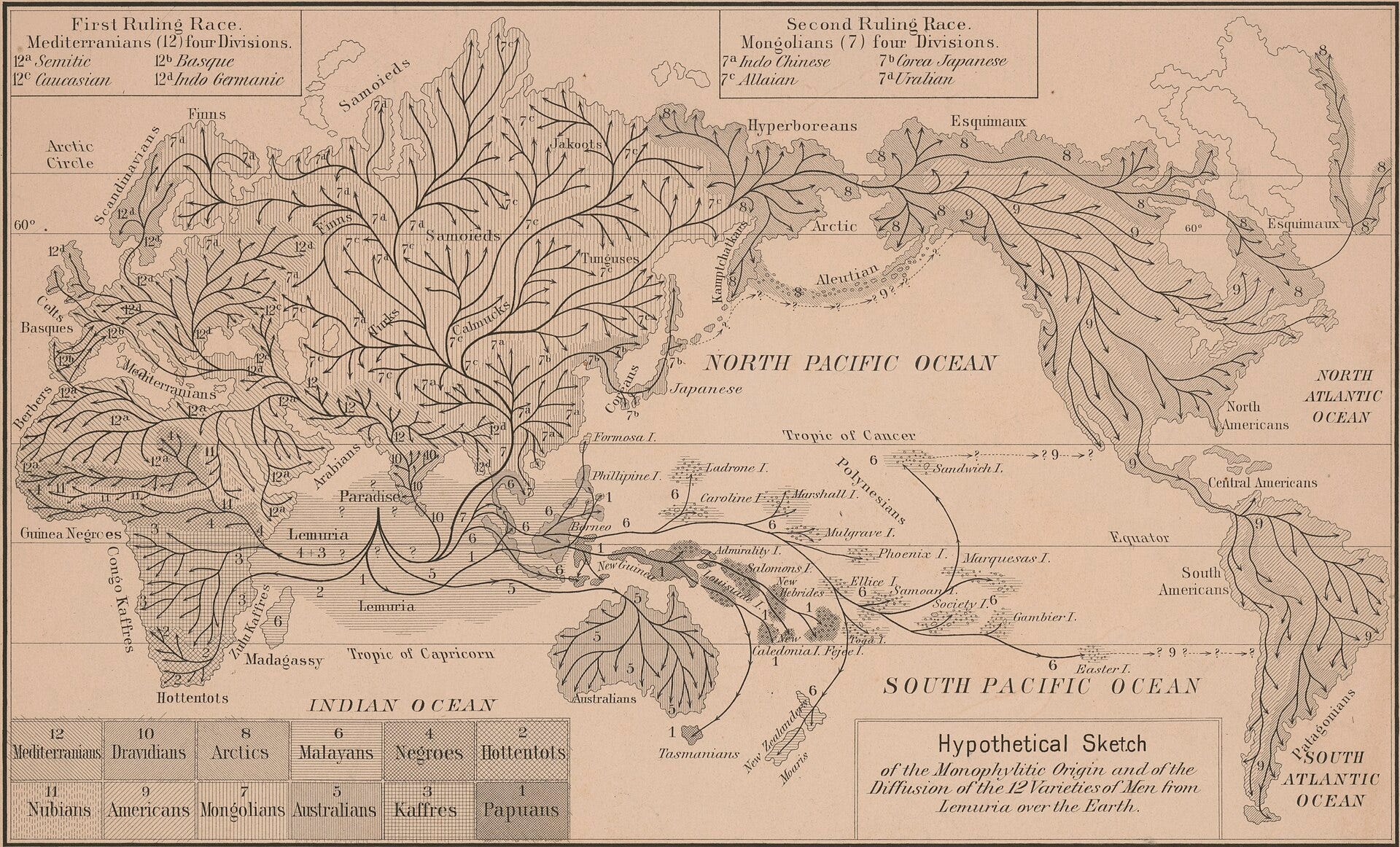
An 1876 map illustrating the supposed location of Lemuria and the hypothetical dispersal routes of the "12 varieties of men" from their alleged Lemurian origin across the globe. Credit: Public Domain
Occultists turned it into a homeland of lost races
The idea did not stay with zoology for long. In 1868 the German biologist Ernst Haeckel suggested Lemuria might be the cradle of humanity, a lost paradise where the first humans had evolved and from which they spread.
In 1888 Helena Blavatsky, founder of Theosophy, made it far stranger. In The Secret Doctrine, Lemuria became the home of the Third Root Race, giant beings who lived long before Atlantis. Her follower William Scott-Elliot published The Lost Lemuria in 1904, complete with maps.
By the early twentieth century a hypothesis about primate fossils had become a spiritual history of humanity.
Tamil literature already remembered a land taken by the sea
Here the story changes character, because this part rests on genuine ancient texts.
The Silappatikaram, one of the great Tamil epics, composed in the early centuries AD, mentions in passing that the cruel sea swallowed the Pahruli river and the many-peaked Kumari mountains in the south. The Manimekalai, its companion epic, tells how the port city of Puhar was swallowed by the sea after its king neglected the festival of Indra.
Then there are the Sangams, the legendary academies of Tamil poetry. A commentary on the Iraiyanar Akapporul, written down around the eighth century, says the first Sangam met in a southern Madurai for 4,440 years with 549 members including gods, and the second at Kapatapuram for 3,700 years. Both cities, it says, were lost to the sea. The third Sangam met at the present Madurai, where the surviving classics were composed. A later medieval commentator, Adiyarkkunallar, described the lost land as divided into 49 territories between the Pahruli and Kumari.
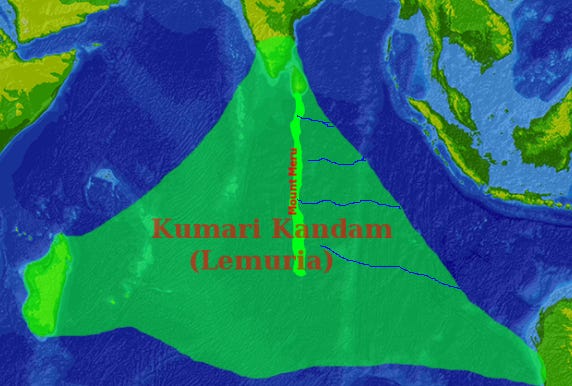
"Lemuria" in Tamil nationalist mysticist literature as Kumari Kandam, connecting Madagascar, South India, and Australia, covering most of the Indian Ocean. Credit: CC BY-SA 3.0
The name Kumari Kandam itself comes from the fifteenth-century Kandapuranam, where it refers to a portion of the world rather than a sunken continent. The historian Sumathi Ramaswamy, in The Lost Land of Lemuria, traced how Tamil writers in the late nineteenth and twentieth centuries fused these older traditions with Sclater’s Lemuria, producing a Tamil homeland stretching toward Madagascar and Australia, the cradle of Tamil language and culture.
The fusion was modern. The memory of a southern coast taken by the sea is old.
Mu came from a misreading of a Maya book
In 1864, the same year Sclater named Lemuria, the French priest and antiquarian Charles Étienne Brasseur de Bourbourg set out to translate a Maya codex, then called the Troano Codex and now part of the Madrid Codex.
