


The Greeks believed the underworld broke through to the surface in a few particular places. At some of them animals dropped dead, at one a priestess spoke for a god, and at another the living could ask questions of the dead.
Modern geologists and archaeologists have now examined three of the most famous. One turned out to be exactly as the ancient writers described it, and still lethal. One sits on real gas-bearing faults, though what that gas did remains in dispute. And one, it seems, was never an oracle at all.
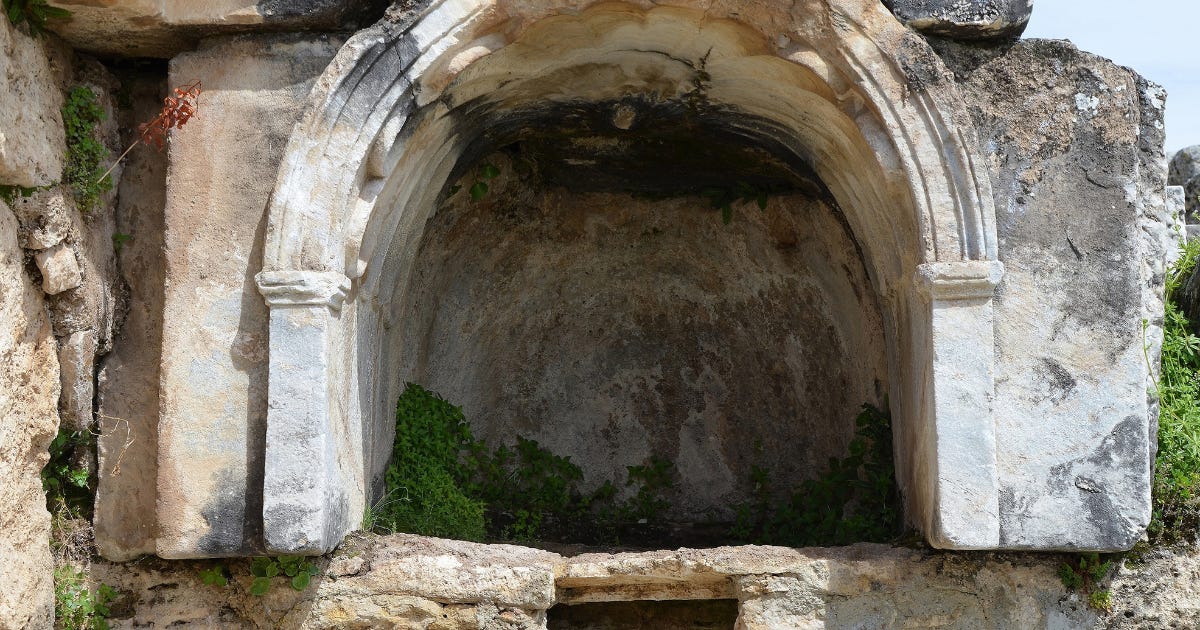
Strabo threw sparrows into the gate at Hierapolis
Hierapolis in Phrygia, the ancient city above the white travertine terraces of Pamukkale in Denizli province, held a sanctuary called the Ploutonion, sacred to Pluto, lord of the dead.
The geographer Strabo visited around the turn of the era and left a precise account. A small opening, just big enough for a person, led down into the ground. It was filled with a vapour so thick the floor could barely be seen. Any animal that went in died. Bulls led inside collapsed and were dragged out dead, and Strabo threw in sparrows himself and watched them fall. The only ones who could enter unharmed were the Galli, the castrated priests of the mother goddess Cybele. Strabo wondered whether this was divine protection or some antidote. Pliny the Elder recorded the place as well.
For a long time this read like one of the stranger tales in ancient literature.
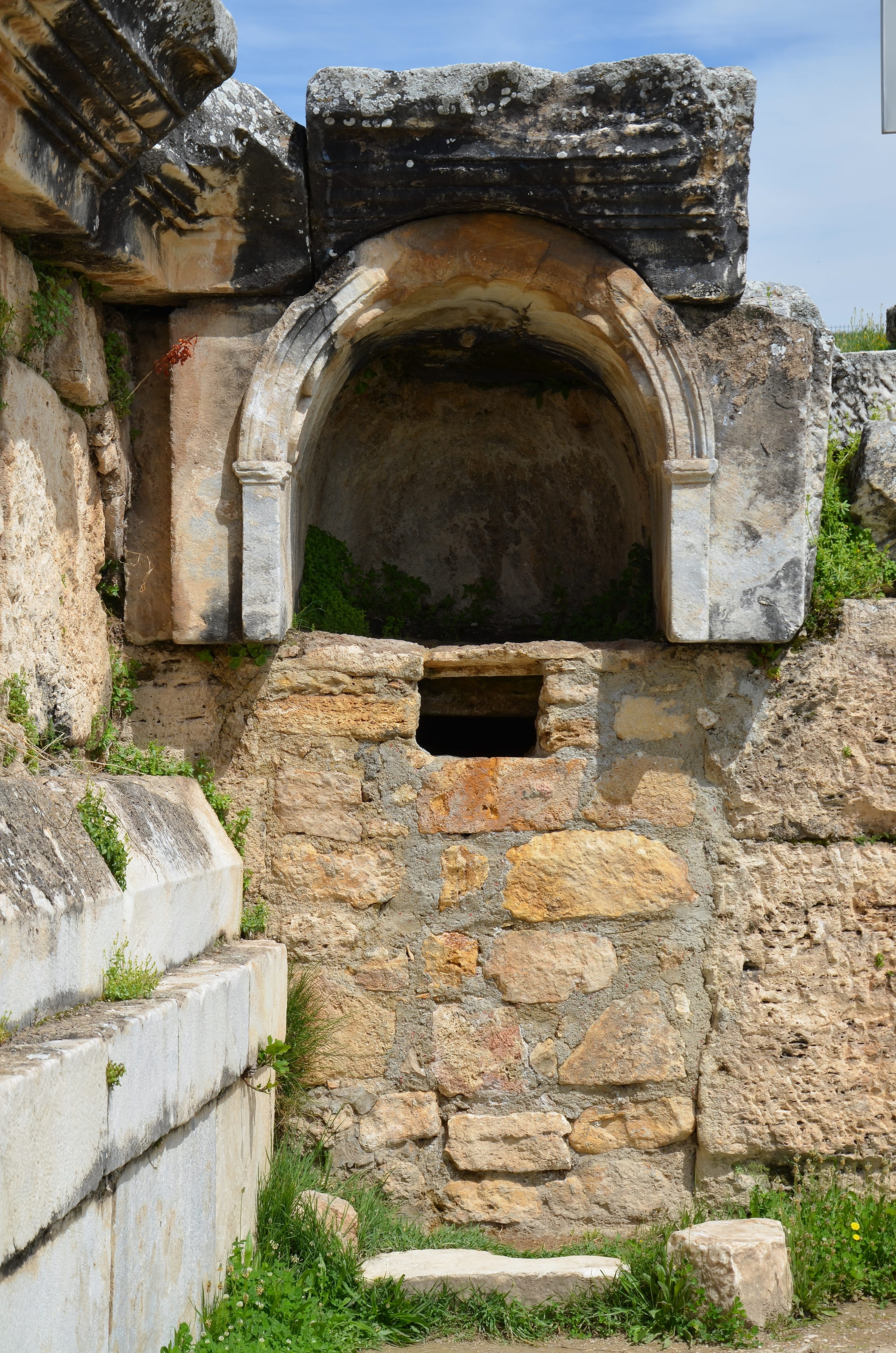
The cave was found again in 2013 by following a spring
Francesco D’Andria of the University of Salento, who spent decades excavating Hierapolis, found the Ploutonion in 2013 by tracing the course of the city’s thermal spring back to its source.
His team uncovered a temple, a small grotto opening beneath it, and a walled arena in front with stepped seating where spectators could watch the sacrifices. Inscriptions were dedicated to Pluto and Kore, the queen of the underworld. Statues of Cerberus, the three-headed hound who guards the gate of Hades, and of a serpent came out of the ground nearby. Christians destroyed the sanctuary in the sixth century AD, and earthquakes did the rest.
During the excavation, birds that flew too close to the opening dropped dead.
Carbon dioxide at up to 91 percent, and why the priests survived
In 2018 the volcano biologist Hardy Pfanz of the University of Duisburg-Essen published measurements made with Turkish geologists Galip Yüce of Hacettepe University, Ahmet Gülbay of Eskişehir Osmangazi University and Ali Gökgöz of Pamukkale University. Inside the grotto, carbon dioxide reached 91 percent. Gas escaping from its mouth into the arena ran between 4 and 53 percent depending on height above the ground, and at night it reached levels that would kill a person within a minute.
A note to free subscribers: Your support helps keep Ancient Content independent and focused on original research. Upgrade for just a few dollars a month to unlock every long-form article, short documentary, and the complete archive. Cancel anytime.
For paid subscribers: Continue reading the full article below. Thank you for supporting Ancient Content and helping keep this work independent.

,_a_sacred_cave_believed_to_be_an_entrance_to_the_underworld_and_the_oldest_local_sanctuary,_Hierapolis,_Phrygia,_Turkey_(31528582034).jpg)
_in_Hierapolis_01.jpg)