


A fossilized Neanderthal from France has revealed an unexpected chapter in the final history of the Neanderthals. The individual, nicknamed Thorin, belonged to a population that appears to have remained genetically isolated from other Neanderthal groups for around 50,000 years, despite living within a region where other Neanderthals were present.
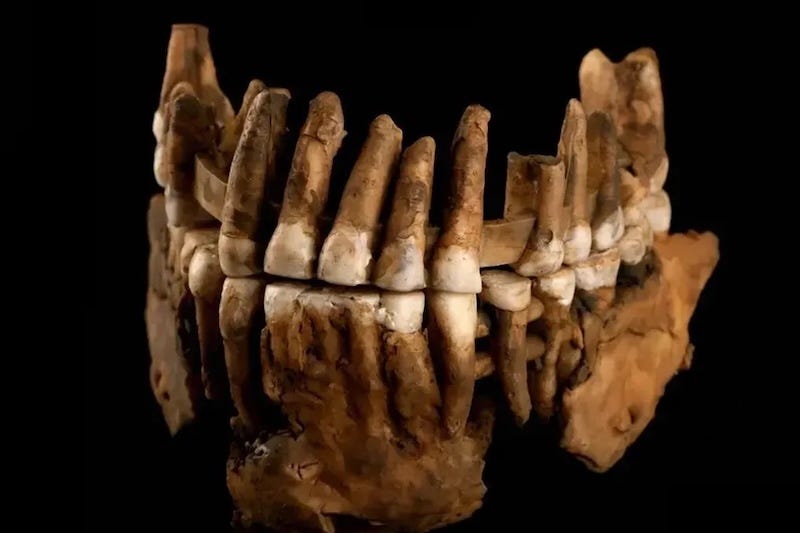
The newly identified Neanderthal individual known as Thorin, discovered at Grotte Mandrin in France. Credit: Ludovic Slimak.
The study, published in Cell Genomics in 2024, was led by Ludovic Slimak, Tharsika Vimala, Andaine Seguin-Orlando, Martin Sikora, and colleagues. It focuses on remains recovered from Grotte Mandrin, a rock shelter in the Rhône Valley of southeastern France.
The discovery is important because it changes how researchers understand the last Neanderthals in Europe. For years, many late European Neanderthals were thought to belong broadly to one connected population. Thorin shows that the reality was more complex. Near the end of their existence, at least some Neanderthal groups may have lived in small, separate communities with little genetic exchange between them.
A Neanderthal from Grotte Mandrin
Thorin was discovered at Grotte Mandrin, near Malataverne in the Drôme region of southeastern France. The site is one of the most important Paleolithic rock shelters in Europe because it preserves a long sequence of human occupation.
Grotte Mandrin has yielded evidence of both Neanderthals and early Homo sapiens, though not necessarily living there at the same time. The site has been excavated for decades and has become central to debates about the final Neanderthals, the arrival of early modern humans in Europe, and the transitions between Middle and Upper Paleolithic technologies.
The remains of Thorin were found in deposits linked to the final Neanderthal occupation of the cave. Archaeologists initially placed him around 40,000 to 45,000 years ago based on the sedimentary context. This would make him a late Neanderthal, living close to the time when Neanderthals disappeared from Europe.
The fossils include jaw and dental remains, along with other skeletal material gradually recovered during excavation. Because ancient DNA can be fragile and easily contaminated, the team used careful sampling and genetic methods to investigate who Thorin was and how he related to other known Neanderthals.
Why the name “Thorin”?
The researchers named the individual Thorin after Thorin Oakenshield, the dwarf king from J. R. R. Tolkien’s The Hobbit. The name was chosen because the fossil seemed to represent the last member of an ancient line.
For Ludovic Slimak, the name carried symbolic weight. Thorin the Neanderthal was not simply another fossil individual. He represented a lineage that had survived for tens of thousands of years, separated from other known Neanderthal populations, and then vanished near the time of the species’ final disappearance.
The name also reflects the emotional force of the discovery. This was not only a genetic result. It was the recognition of a lost branch of humanity, preserved in a cave system where different human groups had passed through across deep time.
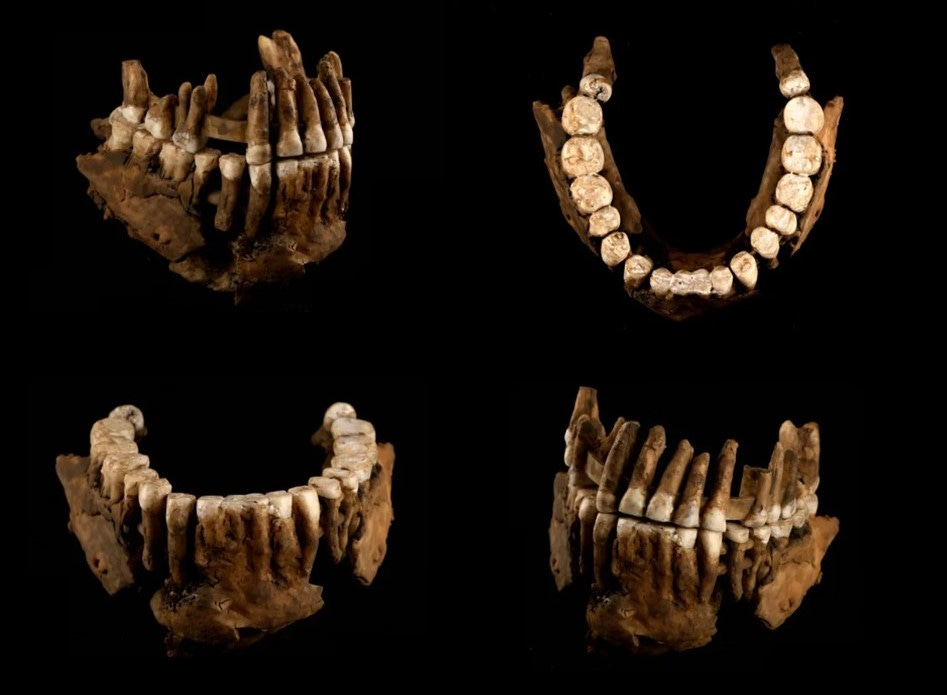
Reconstruction of Thorin's jaw and teeth. Credit: Ludovic Slimak
The genetic surprise
When researchers sequenced Thorin’s genome, they encountered a problem.
Archaeology suggested that he was a late Neanderthal, living roughly 42,000 to 50,000 years ago. But his DNA looked much older in evolutionary terms. Instead of closely matching other late Neanderthals from Europe, his genome was more similar to earlier Neanderthal lineages that had diverged far earlier.
This mismatch forced the team to test whether the archaeological dating or the genetic interpretation was wrong. If Thorin really lived late, why did his genome look as if it belonged to a much older branch?
The answer was isolation.
The genome showed that Thorin’s lineage had separated from the line leading to other late Neanderthals around 105,000 years ago. After that split, his population appears to have remained apart for approximately 50,000 years, with little or no detectable genetic exchange with other known late European Neanderthals.
This is what makes Thorin so important. He was late in time, but genetically he belonged to a deeply separated Neanderthal branch.
Confirming his age through isotope analysis
To resolve the contradiction between the archaeological context and the genetic signal, researchers turned to isotope analysis.
Isotopes preserved in bones and teeth can provide information about diet, environment, and climate. In Thorin’s case, the researchers used isotopic evidence to understand the type of climate he lived in.
This mattered because earlier Neanderthals lived during warmer climatic conditions, while late Neanderthals lived in colder Ice Age environments. If Thorin’s isotopes indicated a cold climate, that would support the archaeological interpretation that he was a late Neanderthal.
The analysis showed that Thorin lived in a very cold environment. This confirmed that he belonged to the late Neanderthal world, even though his genome carried the signature of a much older separated lineage.
In other words, the fossil was not misplaced by archaeology. The genetic result was real: Thorin was a late Neanderthal from an ancient isolated population.
A split around 105,000 years ago
The study estimates that Thorin’s lineage diverged from other late Neanderthal lineages around 105,000 years ago.
That is a major separation. In evolutionary terms, 50,000 years of isolation is long enough for two populations to become significantly different through genetic drift, small population size, limited contact, and separate demographic histories.
Slimak used a striking comparison to explain the scale of the separation, saying that 50,000 years of divergence is comparable to the distance between a small domestic dog and a wolf. The point is not that Neanderthals had become different species, but that the split was deep enough to matter.
Thorin’s population was not simply a local branch with minor variation. It represented a previously unknown Neanderthal lineage with a long independent history.
Two Neanderthal worlds living near each other
One of the most puzzling aspects of the discovery is geography.
The research suggests that Thorin’s population lived near other Neanderthal groups but remained genetically separate from them. Slimak described this as two Neanderthal populations living roughly ten days’ walk apart while apparently avoiding gene exchange for tens of thousands of years.
For modern humans, such long separation between nearby groups is difficult to imagine. Human populations tend to exchange genes, objects, stories, partners, techniques, and ideas across landscapes. Even small groups usually form wider social networks over time.
The Thorin evidence suggests that some Neanderthal communities may have operated differently. They may have lived in smaller, more local, more socially restricted groups. Their networks may have been narrower, and their opportunities for contact and exchange may have been limited.
This does not mean Neanderthals were incapable of complex behavior. Archaeology already shows that they made tools, used fire, hunted large animals, adapted to different environments, and had symbolic capacities in some contexts. But Thorin suggests that their social organization may have differed from that of expanding Homo sapiens populations.
A possible Mediterranean Neanderthal lineage
Thorin’s genome also shows a connection with Neanderthal remains from Gibraltar. This has led researchers to suggest that his population may have belonged to a wider Mediterranean Neanderthal lineage.
If this interpretation is correct, the lineage may once have extended from the western end of Europe toward the Rhône Valley in southeastern France. The evidence is still limited because very few late Neanderthal genomes are available from many parts of Europe.
This is why Thorin is so valuable. Every new Neanderthal genome can change the map of late Neanderthal population structure. A single individual can reveal an entire branch that was previously invisible.
Future genomes from France, Spain, Italy, the Balkans, and other regions may show whether Thorin was part of a broader Mediterranean pattern or a more localized isolated group.
Small populations and limited gene flow
The study indicates that Thorin came from a small population. Small groups are especially vulnerable to genetic isolation because they can lose diversity over time.
When groups remain isolated for many generations, they have fewer opportunities to bring in new genetic variation. This can increase the effects of inbreeding and reduce the ability of a population to respond to changing conditions.
In evolutionary terms, contact with other populations can be beneficial. It can introduce new genetic variants, reduce harmful effects of inbreeding, and allow groups to share knowledge, technologies, and survival strategies.
Tharsika Vimala, one of the study’s lead authors, emphasized that long-term isolation can limit both genetic and social flexibility. A population with fewer connections may have less capacity to adapt to changing climates, new pathogens, resource stress, or demographic decline.
This is one reason Thorin matters for the question of Neanderthal extinction.
What Thorin may tell us about Neanderthal extinction
The disappearance of the Neanderthals remains one of the major questions in human evolution. Researchers have proposed many explanations, including climate instability, small population size, competition with Homo sapiens, interbreeding, ecological pressure, disease, and demographic collapse.
Thorin does not solve the entire question, but he adds an important piece.
His genome shows that at least some late Neanderthals were deeply isolated. This could have made them more vulnerable. If multiple Neanderthal groups lived in small and separated communities, they may have had fewer chances to recover from population losses or environmental stress.
This contrasts with early Homo sapiens, whose archaeological and genetic record often points to wider social networks, long-distance exchange, and intergroup connections. Such networks can be crucial for survival because they allow people to find partners, exchange resources, share technologies, and maintain cultural resilience.
The Thorin discovery therefore supports the idea that Neanderthal extinction may have involved not only external pressures, but also internal demographic structure.
Isolation as a social question
The title of the study refers to both genetic and social isolation. The genetic part is clearer: Thorin’s genome shows long separation from other known late Neanderthals.
The social interpretation is more cautious but important. If populations living within a relatively reachable distance exchanged little or no genetic material, this likely reflects limited social contact or restricted social networks.
That raises deeper questions about how Neanderthals understood territory, group identity, movement, and interaction. Did they avoid neighboring groups? Were their mating networks very local? Did cultural or ecological boundaries separate them? Were populations so small and scattered that encounters were rare?
The current evidence cannot answer all of these questions. But it shows that Neanderthal society may have been more regionally fragmented than previously assumed.
Not one final Neanderthal population
Before this discovery, the dominant genetic picture suggested that late European Neanderthals formed something close to a single broad metapopulation, with limited evidence for strong population structure.
Thorin changes that picture.
He shows that at least two distinct Neanderthal populations existed near the end of the species’ history. One belonged to the better-known late European Neanderthal lineages. The other, represented by Thorin, had been separated for tens of thousands of years.
This means the final Neanderthals were not genetically uniform. Europe may have contained multiple isolated or semi-isolated groups, some of which are still missing from the fossil and genetic record.
The discovery therefore makes the final Neanderthal world more complex. Their extinction was not the disappearance of one simple population, but the fading of multiple lineages with different histories.
The importance of Grotte Mandrin
Grotte Mandrin has become one of the key sites for studying the final Neanderthals and the arrival of Homo sapiens in western Europe.
The rock shelter overlooks the Rhône Valley, a natural corridor linking Mediterranean and continental Europe. For tens of thousands of years, this corridor would have been important for animal movement, human movement, and access to resources.
The cave preserves evidence of repeated occupation, stone tool traditions, animal remains, and human fossils. Its stratigraphy has allowed researchers to study changes in technology and population over a long period.
Because both Neanderthals and early Homo sapiens used the site at different times, Grotte Mandrin offers a rare view of the transition between human groups in Europe.
Thorin adds another layer to this story. He shows that even among the final Neanderthals at the site, there was hidden genetic complexity.
A fossil still being studied
Thorin’s remains have been recovered gradually. CNRS reports that years of work at the site revealed bones, teeth, phalanges, parts of the skull, and jaw fragments.
The study also notes unusual dental features, including rare distomolars, or additional molars behind the normal molar row. These features are part of the broader anatomical picture of the individual and may help researchers understand his development, population background, and biological variation.
The careful excavation is continuing because the remains are delicate, fragmentary, and scientifically valuable. Each additional element can provide new information about Thorin’s anatomy, health, age, diet, environment, and relationship to other Neanderthals.
This is also why ancient DNA analysis is so important. Fossil bones alone may not reveal the full population story. Genomics can expose deep ancestry that is invisible from morphology alone.
What remains uncertain
Although the Thorin study is important, researchers are careful about the limits of the evidence.
Only a small number of late Neanderthal genomes have been sequenced. That means every new genome can strongly affect interpretations. Thorin may represent a broader pattern, or he may represent a rare surviving branch.
Some specialists have also noted that more genetic data from Thorin’s lineage would be needed to fully understand the scale of isolation, inbreeding, and demographic history.
The social interpretation also remains open. Genetic isolation strongly suggests limited contact, but it does not tell researchers exactly why contact was limited. The cause could involve geography, population density, social boundaries, ecological differences, cultural traditions, or simple chance.
For now, the best conclusion is that Thorin reveals a previously unknown Neanderthal lineage that was deeply separated from other late Neanderthals, and that this separation may have shaped the final Neanderthal story.
A new view of the last Neanderthals
Thorin’s genome turns one fossil individual into evidence for an entire lost population.
He lived near the end of the Neanderthal timeline, but his ancestry reached back to an earlier split. His group survived for tens of thousands of years beside other Neanderthals while remaining genetically separate. When that population disappeared, it left almost no trace until the remains at Grotte Mandrin were found and sequenced.
This discovery changes the way the final Neanderthals are imagined. They were not simply one disappearing group across Europe. They included distinct lineages, some deeply isolated, some perhaps connected across Mediterranean routes, and some still unknown.
Thorin therefore gives researchers a rare view of Neanderthal diversity just before extinction.
Sources:
The main study is Slimak, L., Vimala, T., Seguin-Orlando, A., Metz, L., Zanolli, C., Joannes-Boyau, R., and colleagues, “Long genetic and social isolation in Neanderthals before their extinction,” published in Cell Genomics in 2024. The University of Manchester research record summarizes the paper’s key findings: Thorin came from Grotte Mandrin, his lineage diverged from other late Neanderthals around 105,000 years ago, and his population showed about 50,000 years of genetic isolation.
Cell Press’s release through EurekAlert explains that Thorin lived between about 42,000 and 50,000 years ago, belonged to a previously undescribed Neanderthal lineage, and showed no detectable genetic exchange with other known late European Neanderthals despite geographic proximity.
IFLScience provides the popular-science version used by Arkeofili, including Slimak’s comparison of 50,000 years of divergence, the Hobbit reference behind the name Thorin, the Grotte Mandrin context, and the statement that two Neanderthal populations may have lived within roughly ten days’ walk while remaining separate.
CNRS News provides field context from Grotte Mandrin, noting that the Rhône Valley was a major natural corridor and that the cave has yielded evidence of both Homo sapiens and Neanderthal occupation across a long sequence. It also describes the slow recovery of Thorin’s remains, including teeth, phalanges, palate, skull parts, and other fragments.