


Red figures cover the limestone cliffs above the Zuojiang river in Guangxi, in southern China near the Vietnamese border. They were painted between roughly the fifth century BC and the second century AD, and the valley has thrown typhoons, torrential rain and summer heat above 38 degrees at them ever since. They are still there, and still red, which is a problem, because no natural organic binder lasts two thousand years in that climate.
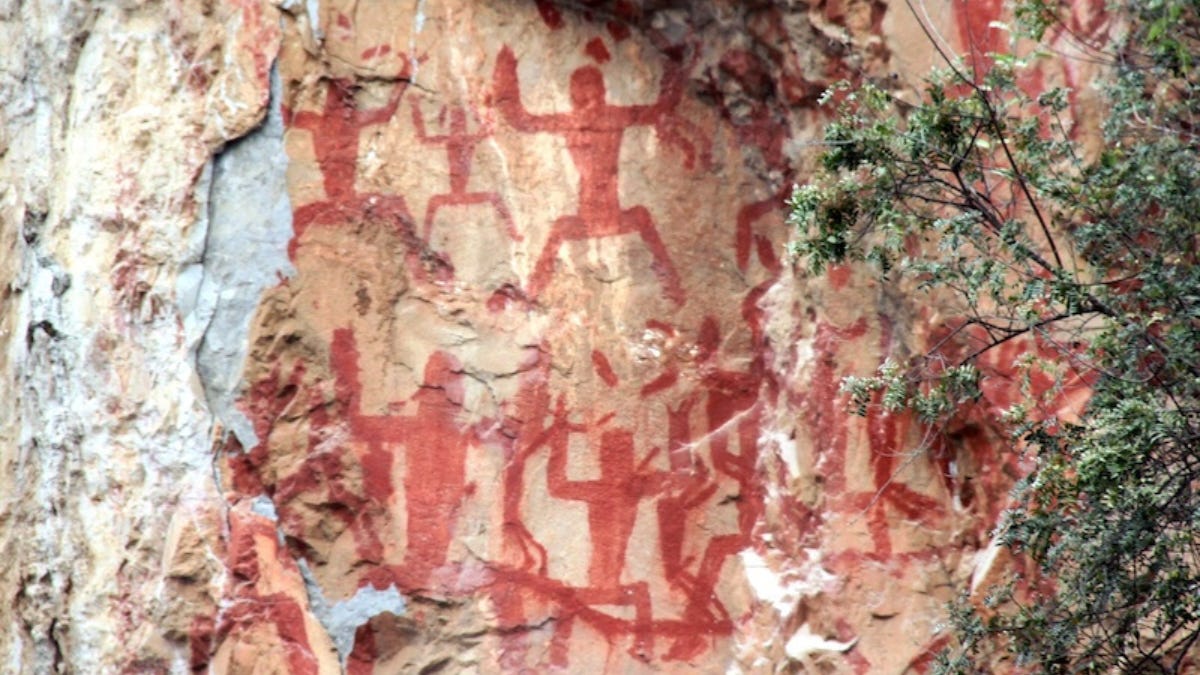
A study in the Journal of Archaeological Science by Wu Mingming, Hu Ping, Zhai Kai, Wang Quanyu and colleagues offers an answer. The pigment was bound to the rock with blood, and at one of the sites they sampled, that blood was between 97 and 99 percent human.
What the analysis found in the paint
The team had to drill for their samples, which was the first indication of how firmly the paint was attached. What the analysis showed was that the paintings had been laid down in two stages. The artists began with a ground layer, made by burning animal bone, bird droppings, limestone and shell together to produce calcium phosphate and quicklime, then slaking that with water and blood into a mortar. They spread it on the cliff, let it start to set, and painted over it with red pigment made from local clay rich in iron oxide.
The blood was doing chemistry. Its proteins biomineralised the calcium carbonate in the mortar, and biomineralised calcium carbonate is, in effect, limestone. The ground layer became the same material as the cliff it was sitting on, with the pigment particles sealed inside it. Not paint adhering to rock, but paint that had become rock.
The human proportion in the mortar varied. One sample was 61 percent human and 39 percent cattle, with the remainder at the first site made up of one to three percent from various herbivores. When the researchers looked more closely at the human blood, they found prolactin-induced protein and lactotransferrin. Both are close to absent in most people and both rise steeply in women late in pregnancy and in women who are breastfeeding.
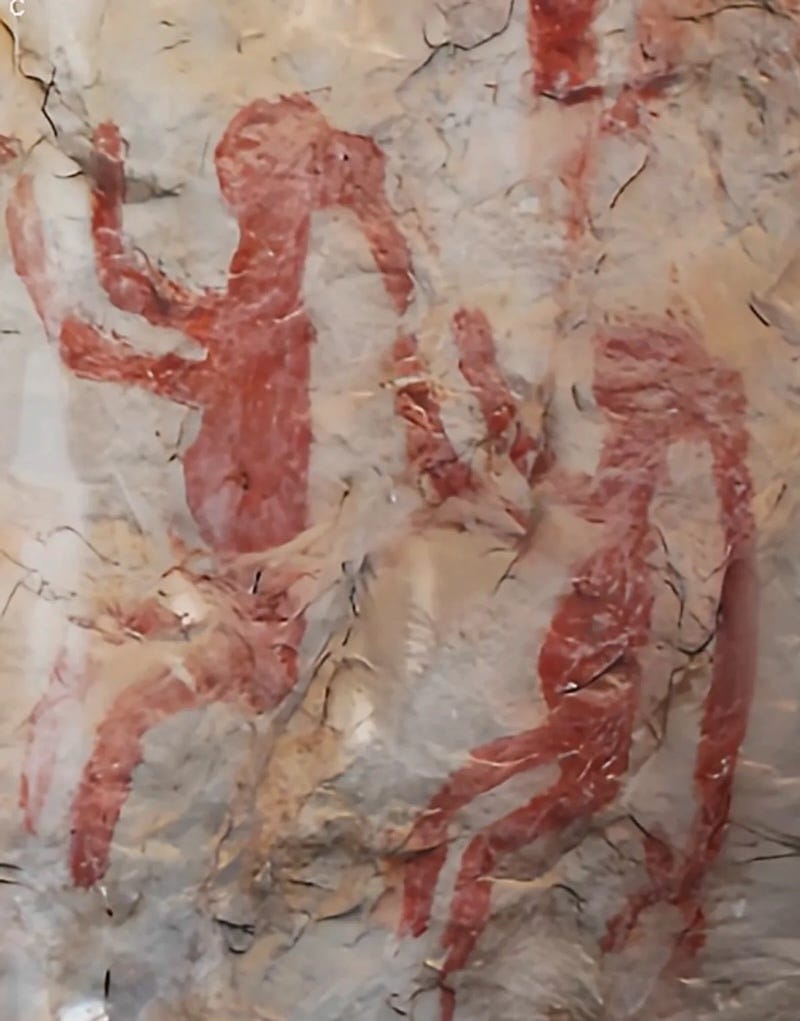
That is where the paper moves from chemistry to argument. The Huashan images include copulation scenes, pregnant women and phallic figures, and the Luoyue who painted them are generally described as a matrilineal fishing and hunting society. The authors put those things together and suggest the blood was collected during childbirth and added to the paintings as a fertility rite. The proteins are a laboratory result. What the blood was doing on the cliff is a reading of the pictures.
The cliffs along the Zuojiang
The site itself is enormous. UNESCO inscribed it in 2016 as thirty-eight locations spread over about 105 kilometres of the Zuojiang and its tributary the Mingjiang, holding more than five thousand images in some three hundred groups. The largest panel, at Ningming, runs 221 metres along a cliff 140 metres high, with the paintings sitting between 30 and 90 metres above the water. That height has kept them safe from people as effectively as the blood has kept them safe from rain.
Among the figures are bronze drums, knives, swords, bells and boats, and a great many humans in a squatting posture, the largest such concentration known anywhere. Scholars have read the squatting as ritual, or as an imitation of frogs, which carry fertility associations in the rice-growing cultures of the region. Nobody is certain. Almost nothing survives of the Luoyue apart from this, and UNESCO describes the landscape as the only remaining witness to their tradition.
Thanks for reading. Support Independent Ancient Content. Your support helps me create more archaeology posts, articles, and mini history videos:

Sources: Wu, M., Hu, P., Zhai, K., Weng, X., Wang, Y., Chen, H., and Wang, Q., et al. (2026). "Blood-Induced Biomineralized Calcium Carbonate Used for Binding in the Huashan Rock Art of Guangxi, Southern China." Journal of Archaeological Science 193, 106650. Reported by IFLScience, 14 August 2026. Site details from UNESCO World Heritage listing 1508.
This is fascinating because it makes those ancient paintings feel suddenly, almost startlingly, human. We usually look at cave art across this enormous gulf of time and think about “prehistoric people” as an abstraction. But finding human DNA on or near those walls shrinks that distance.
Someone stood there. Someone touched that stone. Someone may have mixed pigment, pressed a hand against the wall, or simply steadied themselves in the darkness. Thousands of years later, a trace of that person can still remain.
That is what I love about archaeology. Every once in a while, history stops being dates and artifacts and becomes a person again. And somehow a fingerprint, a brushstroke, or a bit of DNA can whisper louder than an entire textbook.
It’s kinda weird but interesting. 🤔