


Archaeologists at Pompeii have published the excavation of a wooden wardrobe in house IX 11, 7, on Via dell’Abbondanza. It held a necklace of 24 miniature pendants, a clump of 38 bronze coins, toilet implements, lead weights, and bronze, glass and ceramic vessels. The report appeared on 29 October 2026 as number 11 of the Park’s E-Journal degli Scavi di Pompei. Gabriel Zuchtriegel and six co-authors wrote it.
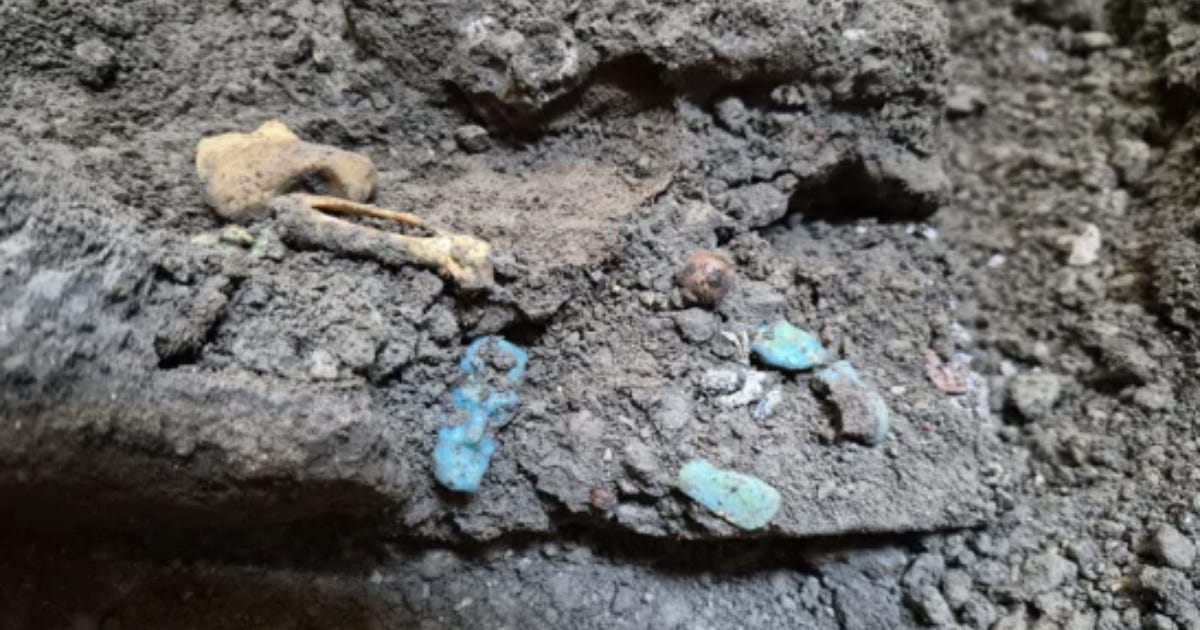
Pendants and bag traces in situ, house IX 11. Credit: Parco Archeologico di Pompei
The wood has not survived. The wardrobe is known from the cavity it left in the volcanic deposit, from post holes in the walls, and from objects that fell with its upper shelves when the roof came down.
A slope cut back for the Insula dei Casti Amanti project exposed the rooms
The work belongs to the second lot of the restoration project for the Insula dei Casti Amanti. Teams reduced the slope west of the alley that separates insulae 11 and 12 of Regio IX by about 2.50 m, down to roughly 1.50 m above the pavement. The façade of the house was excavated in 1912, and the name Cornelius Maximus was attached to it from inscriptions that are no longer visible. The authors call that attribution highly doubtful.
They label the rooms A to E. Room B, which they think plausibly a triclinium, measures at most 4.30 m by 3.85 m. Its walls carry Fourth Style decoration with a yellow main zone, a black socle, peacocks, birds and stylised dolphins. The authors attribute it to the painters’ workshop of Via di Castricio. The floor is signinum scutulatum set with white limestone chips, which points to a second-century BCE phase of the house. Room B and the adjoining B1 were being redecorated in 79 CE, since the ceiling decoration was still unfinished.
The cavity in the ash records a wardrobe with two arms and an iron-footed frame
The wardrobe stood in the south-east corner of room B in two sections, one along the south wall and one along the east wall. Each was about 2.00 m long. The south section was roughly 0.90 m deep and the east section 0.70 m. Post holes about 1.60 m above the floor mark where it was fixed to the wall. The authors describe overlapping planks for the outer structure, interior shelving, a base of wide boards, and two tall iron feet.
The roof of room B held under the falling lapilli and collapsed when the pyroclastic flow arrived from the north-west. The collapse broke the upper part of the wardrobe and let the flow fill it, which preserved more than half its height.
Two tunnels cut by earlier explorers, whose date the authors cannot fix, crossed this area. One ran along the east wall and left the outer part of the fill intact. Some of the contents lay on the floor along the tunnel’s route. The authors judge that earlier explorers moved them there, probably to collect later, and that these include the bronze vessels the diggers wanted most. Those items have lost their original position.
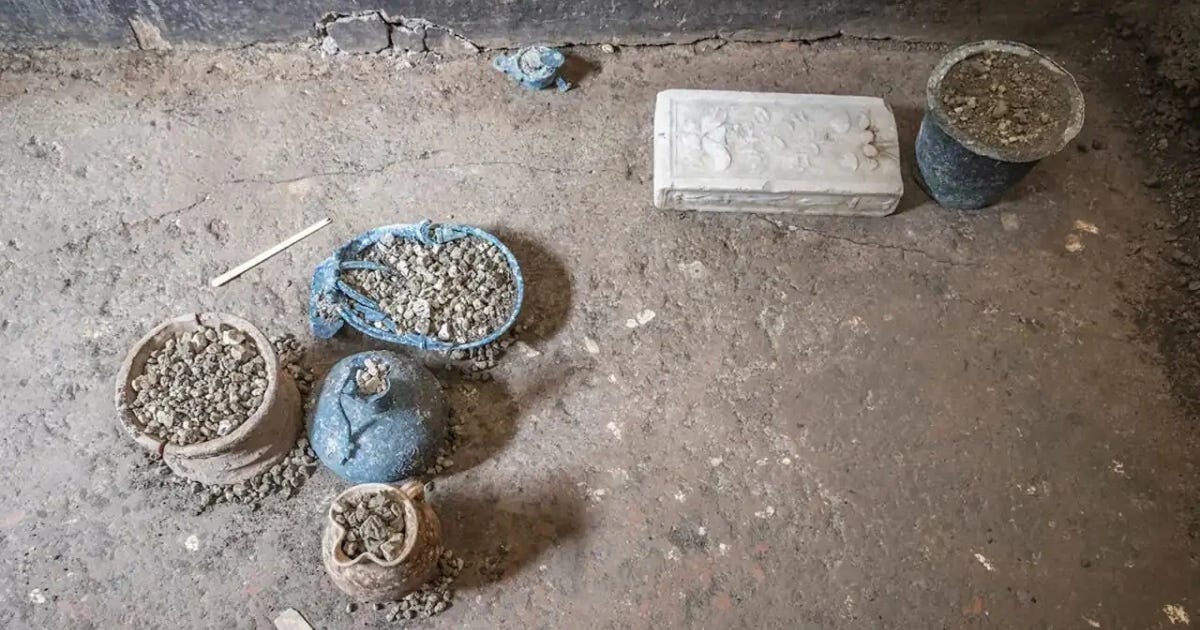
Some of the vessels and objects from the wardrobe, house IX 11, Pompeii. Photo, Parco Archeologico di Pompei
The shelves held vessels, toilet equipment, lead weights and a marble relief
The upper shelves fell into the collapse. They yielded a calyx-shaped censer, five one-handled jugs, three two-handled urcei, five flasks, a lid, a cooking dish and two pots. They also held a handleless beaker decorated with pine-cone scales, a one-handled cup with roulette decoration, fragments of thin-walled Baetican eggshell ware and the base of a glass dish.
The material from the floor includes bronze vessels, a one-nozzled bronze lamp, a jug, a handleless bucket, a basket-shaped vessel and an elliptical cup. There are two bone spatulas, a tubular glass balsamarium, bronze tweezers and a slate palette for mixing pigments. The authors suggest that some of these items could point to a female sphere, since they served both medicine and cosmetics. They also record a white marble pilaster carved in relief on four sides and pierced lengthwise, comparable to one reused at the Villa of Poppaea at Oplontis. Nothing in the report says where it stood in the house.
The south arm of the wardrobe gave the only finds still in their original position. At floor level in its eastern part lay traces of a small wooden box with a bronze fastening. It held eight lead weights, six with iron fittings. The authors call them potentially compatible with commercial activity, though they could also belong to a more professional setting than a household.
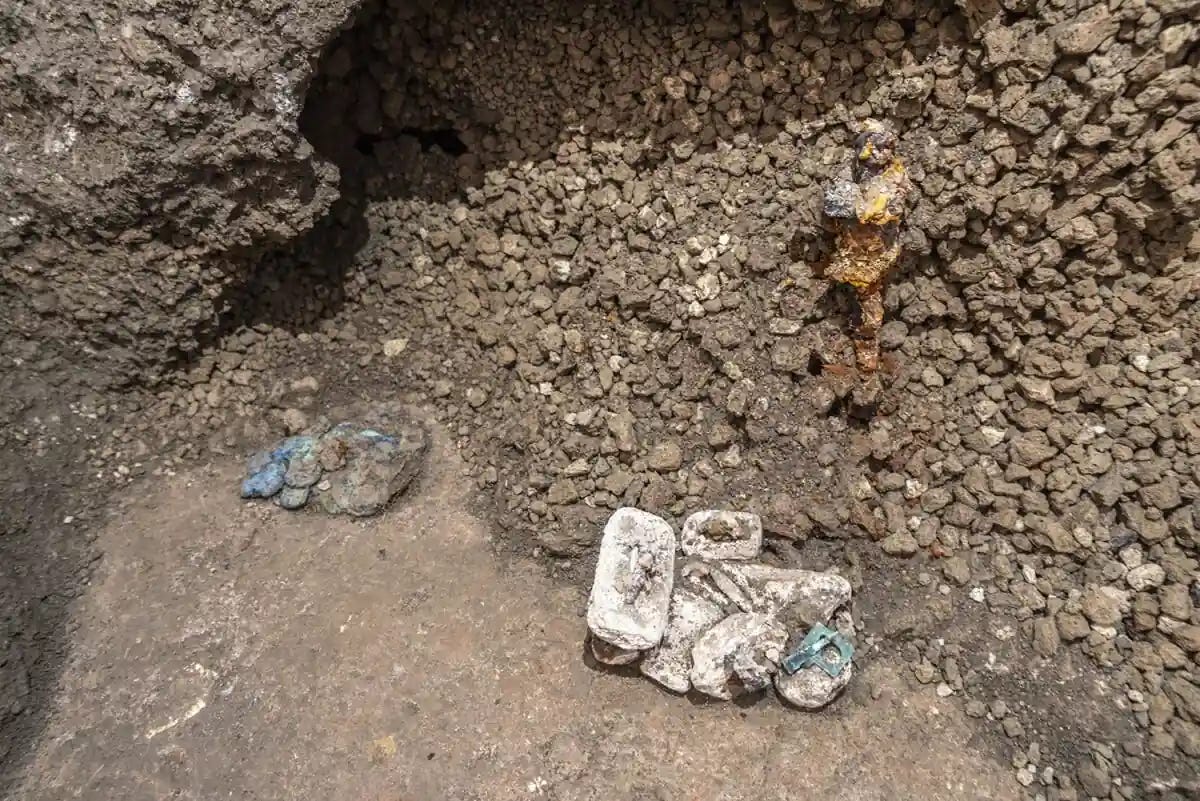
Bronze coins and lead weights as found, house IX 11, Pompeii. Photo: Parco Archeologico di Pompei
Thirty-eight bronze coins lay in a plaited basket, 20 centimetres from the weights
About 20 cm south of the box was a lump of 38 bronze coins inside the remains of a basket. Only part of the base survives, about 0.12 m across. Two of the coins are older and heavily worn, a unit of Ebusus and a sestertius of Claudius issued in the name of Germanicus. The other 36 were struck under Nero, comprising 3 sestertii, 7 dupondii and 26 asses. They come from issues of 64 to 67 CE, with 21 dated to 65 CE.
The team lifted the basket without consolidating it, took it to the Park’s applied research laboratory and examined it under a stereomicroscope. The fibre is a monocotyledon. The authors suggest esparto grass as a possible identification, and the plaiting resembles the technique they call a canniccio. They compare Latin terms for woven containers (cistella, fiscus) and say the difference between them rests on function more than size. They read the coins as a small reserve of low-value money, perhaps for daily expenses.
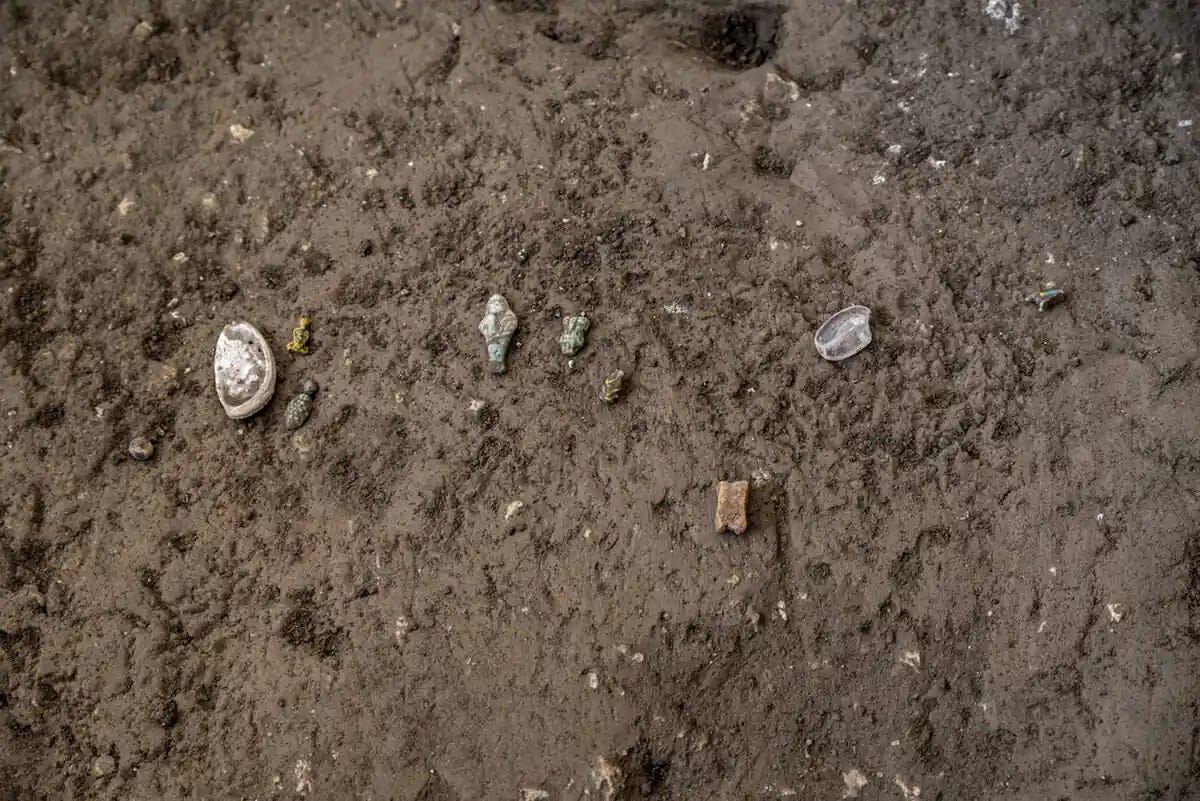
Miniature pendants from the wardrobe in house IX 11, Pompeii. Photo: Parco Archeologico di Pompei
Twenty-four pierced miniatures lay inside a cloth bag on a middle shelf
Near the middle of the south arm, along the inner south wall, excavators found 24 miniature objects of faience, bone, glass paste and rock crystal. All have suspension holes. The authors identify Bes and Mercury, hands, feet, pine cones or grapes, bead-like elements, a knucklebone pendant and a pendant shaped as a winged sandal.
Traces of cloth show that they were kept in a bag, probably on a middle shelf. A structural post fell inward during the roof collapse, struck the shelf and pushed the bag towards the south wall, where it split. Some pendants were then dragged by the flow. A sample of the sediment with textile traces went to the laboratory. Under magnification the weave has a regular rhythm of about 1 mm.
The authors place the group among crepundia, children’s charms that Roman writers mention. They treat the find as probably a necklace, certainly a protective ornament, received in early childhood and kept through life. They cite comparable sets from the House of Helvius Severus (I 13, 2) and from the House of the Garden in Regio V. At Porta Nocera, the Barbidii tomb 15 ES held a cremation burial of an adult woman, possibly Pithia Rufilla, whose offerings included amber, rock crystal and glass pendants. The authors caution against treating the stage convention of recognition tokens in Plautus as proof of a universal social practice.
Two young wood mice left 117 bone fragments in an amphora on the B1 mezzanine
Room B1 had a wooden mezzanine, shown by seven post holes about 2.00 m above the floor. When the beam fell, the mezzanine sank only about ten centimetres. It carried an amphora of North African type Ostia LIX, several jugs, bowls, lids, cooking pots and a larger storage vessel.
Residue at the bottom of the amphora was sieved and yielded 117 bone fragments of small rodents. Archaeozoologist Younes Naime, one of the authors, found at least two individuals, both not fully mature. The characters fit the wood mouse, Apodemus sylvaticus, which the authors call the most likely identification at present. The mice may have entered by accident or been drawn by organic residue, and the evidence does not settle which. The Park has recorded rodents in the servants’ quarters of the Civita Giuliana villa and in the Herculaneum drains.
The owners’ fate stays open in the report
The authors suggest the objects were left because the household could not retrieve them before the eruption. If the residents were in the area they may have tried to flee and failed to return, or they may have died in the catastrophe. The authors say the evidence does not allow a choice between the two.
Both the report and the Park’s press release invoke Tacitus and the rules for property left without heirs. The report adds that this reference needs philological and legal-historical study before it is tied to the owners of this house. The measure I could trace is in Suetonius, Life of Titus 8.4, which assigns the property of those who died at Vesuvius without heirs to restoring the buried towns.
The textile traces from the bag and the basket remain to be studied by specialists.
Subscribe for a few dollars a month and get every long read, the short documentaries and the full archive. Cancel anytime.
Sources
Zuchtriegel, G., Comegna, C., De Rosa, S., Esposito, D., Naime, Y., Scarpati, G., Trapani, A. 2026. “Lo scavo di una domus nell’insula IX 11: il rinvenimento di un armarium con crepundia.” E-Journal degli Scavi di Pompei 11, 29 October 2026, ISSN 3103-9340, 37 pp. https://pompeiisites.org/wp-content/uploads/E-Journal_2026_11_Armadio.pdf (no DOI).
Parco Archeologico di Pompei. 2026. Press release “L’armadio di una donna che non tornò più”, 29 October 2026. https://pompeiisites.org/comunicati/larmadio-di-una-donna-che-non-torno-piu/
Balmer, C. 2026. “Pompeii cupboard opens window onto life before Vesuvius erupted.” Reuters, 29 October 2026 (syndicated). https://kelo.com/2026/10/29/pompeii-cupboard-opens-window-onto-life-before-vesuvius-erupted/
Suetonius, Life of Titus 8 (trans. J. C. Rolfe). https://lexundria.com/suet_tit/8/r
Parco Archeologico di Pompei, “Pompeii after the eruption.” https://pompeiisites.org/en/pompeii-map/analysis/pompeii-after-the-eruption/
Zuchtriegel, G., Corbino, C.A. 2023. “Of Mice and Men.” E-Journal degli Scavi di Pompei 5. https://pompeiisites.org/wp-content/uploads/E-Journal_5-1.pdf
It's the ordinary things that fascinate me most about Pompeii. Coins in a basket, personal jewelry, cosmetics, and a wardrobe full of possessions. Two thousand years later, we're still finding the things people put away and presumably expected to use again. I find that much more moving than discovering another statue or grand building. And the little necklace, possibly kept since childhood, is especially touching.