


The smallest piece of Ice Age art ever recovered from the caves of the Swabian Jura is a bird with its wings spread, two centimeters long and weighing 0.7 grams. It was carved from mammoth ivory around forty thousand years ago, and a Tübingen archaeological team pulled it out of the ground at Hohle Fels alongside a second bird figurine, this one apparently at rest.
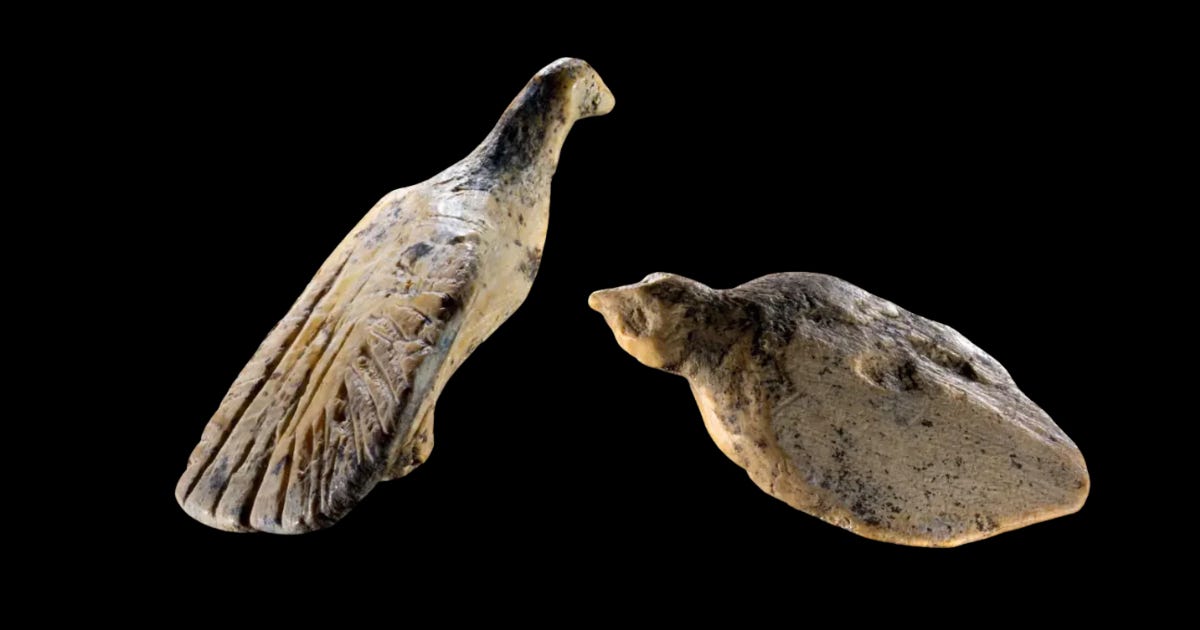
Two Ice Age bird figurines from the UNESCO World Heritage Site of Hohle Fels, dating to around 40,000 years ago. Credit: Ralf Ehmann / Universität Tübingen / urmu
The two carvings were presented on July 29, 2026, in Blaubeuren, where they were named find of the year. They come from the lower Aurignacian layers of the cave, the deposits that have made this stretch of southwestern Germany the richest source of the earliest figurative art known anywhere.
Small enough to lose in a pocket
Most Ice Age figurines from the region measure between three and nine centimetres. These do not. The bird with outstretched wings is two centimetres long, one centimetre wide, and half a centimetre high. Its companion is comparably tiny. Together they weigh roughly 1.3 grams and 0.7 grams.
Nicholas Conard, the Tübingen prehistorian who leads the excavations, calls them genuine featherweights, and notes that despite the scale nothing about the carving is simplified. The resting bird has pronounced round eyes. The other has a distinct beak and parallel incisions across the wings that render plumage. In Conard’s assessment, this is not a generic bird shape wrestled out of a mammoth tusk. It is precise observation of nature translated into a figure detailed enough that researchers can seriously debate which species is depicted and what the animal is doing.
Birds caught in the act
That second point is what separates these from most Ice Age animal carvings, which typically show their subjects in static poses.
The resting bird is flattened and rounded, its head drawn tightly to the body and its legs tucked in. Conard’s team reads that posture as possibly brooding, sitting on a nest. The second bird, with wings fanned wide and neck extended, admits several readings, flying, landing on water, threatening, or displaying in courtship.
The species is no easier to settle than the behaviour. Ptarmigan are one candidate, since their bones turn up frequently in excavations across the region. The researchers also consider other galliform birds such as capercaillie, and certain birds of prey.
The two figurines were found in the same layer but about a metre and a half apart, which leaves open whether one person carved both or whether they were made generations apart. What the pair does demonstrate, Conard says, is that the carvers of the world’s oldest art could depict birds in varied and extremely delicate ways, and that particular motifs appear to be specific to particular sites.
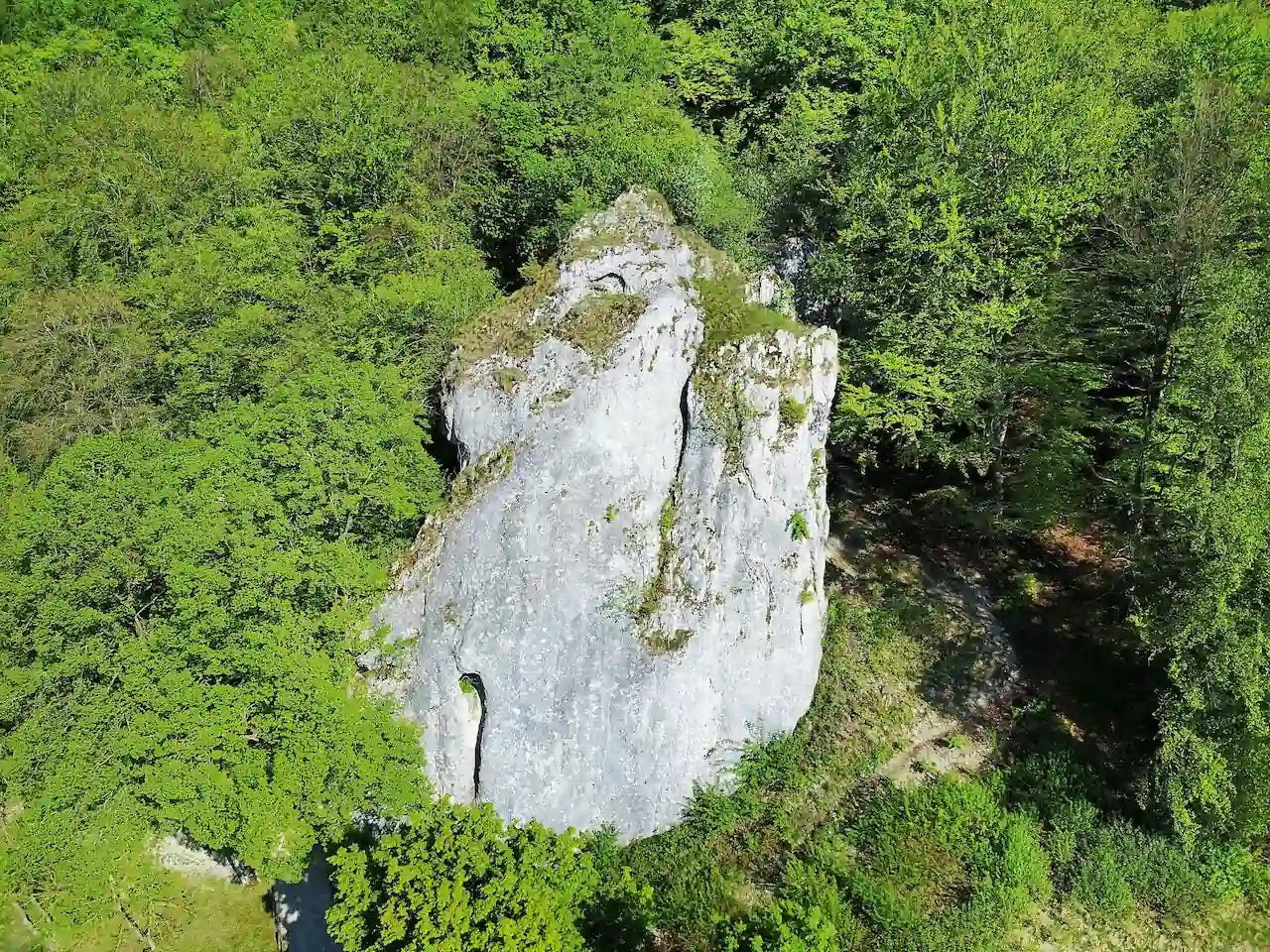
Entrance of Hohle Fels Cave, one of the most significant Ice Age archaeological sites in Europe. Credit: Jens Burkert / Weltkultursprung
A signature unique to one cave
That last observation is the substantive claim behind the find, and it rests on a comparison across the wider region.
Hohle Fels now holds three bird depictions, counting the waterbird excavated there a quarter of a century ago. The other three Ice Age art sites within the UNESCO World Heritage area have produced an impressive range of animal figures, mammoth, cave lion, wild horse, but not a single bird between them.
Conard draws the conclusion carefully. The pattern suggests people were making individual works and drawing on different motifs depending on which ivory workshop they belonged to, so that each site carries its own distinctive signature. Why the people at Hohle Fels, in the Ach valley near Schelklingen, were preoccupied with birds forty thousand years ago remains unexplained.
So does what the objects meant to the people who made them. Conard sets out the open question plainly, whether they functioned as personal talismans or as group symbols carrying a shared identity. Objects this small and this carefully made were clearly not casual, but the archaeology cannot say more than that.
Birds in a landscape that still has them
Stefanie Kölbl, managing director of the Museum of Prehistory and Ice Age Art in Blaubeuren, makes the connection to the living landscape. The area has always supported a wide variety of bird species, and today includes a European bird protection area at the Schmiechener See. Forty thousand years ago birds were a constant presence too, greeting the day with song, signalling the turn of the seasons with their migrations, warning of danger when a flock scattered. People imitated their calls on bone flutes. That they also shaped these creatures so vividly in ivory strikes her as remarkable.
The figurines are on display near where they were found, at the Blaubeuren museum, in an exhibition running until April 4, 2027 whose German title plays on the birds being light as a feather and heavy on research questions. The museum sits among the Stone Age caves that UNESCO designated a World Heritage Site in 2017 under the listing Caves and Ice Age Art in the Swabian Jura, and its best known object is the original Venus of Hohle Fels.
Sources: Universität Tübingen, press release, July 29, 2026. Regierungspräsidium Stuttgart. Conard, N.J., Janas, A., and Zeidi, M., “Hochwertige Funde aus dem Mittelpaläolithikum und zwei aurignacienzeitliche Vogeldarstellungen aus dem Hohle Fels bei Schelklingen,” in Archäologische Ausgrabungen in Baden-Württemberg 2025, July 2026, 46 to 52.
So amazing! Beautiful artistic creations from 40,000 years ago.
Absolutely beautiful! What a wondrous discovery!