


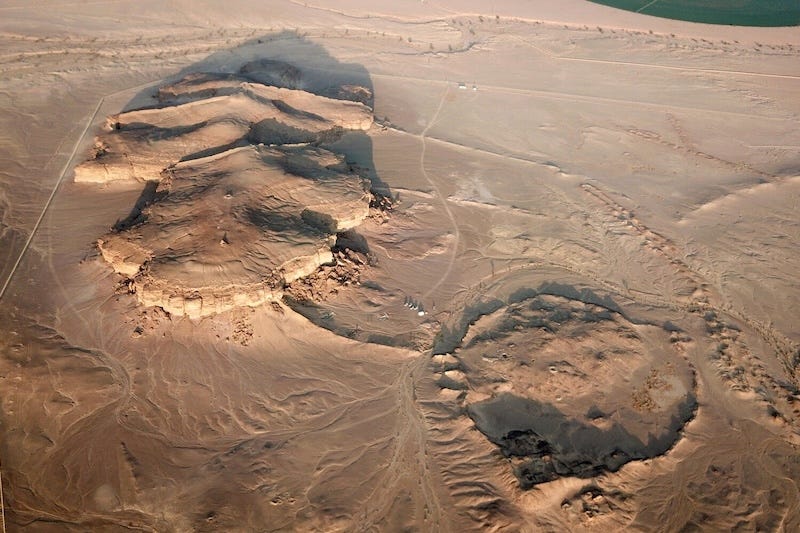
A team led by Marta Luciani at the University of Vienna has analyzed several dozen Bronze Age vessels from the oasis of Qurayyah in northwest Arabia and established, for the first time, that the pottery known as Qurayyah Painted Ware was actually made there. The study appears in PLOS ONE.
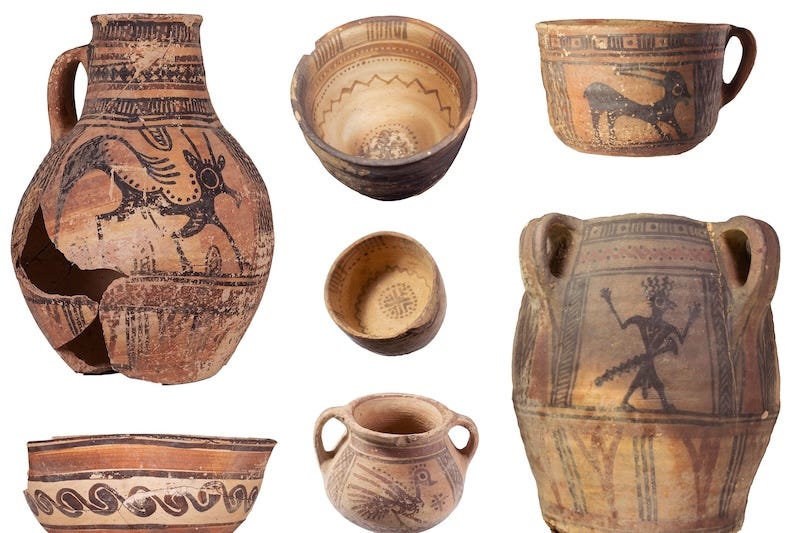
The work was carried out with Pamela Fragnoli of the Austrian Archaeological Institute and Johannes Sterba of TU Wien, as part of a joint project between the Heritage Commission of the Saudi Ministry of Culture and the University of Vienna.
It was called Midianite pottery for fifty years
The name came from Peter Parr and colleagues in 1970, after painted sherds turned up at Qurayyah and at sites across northwest Saudi Arabia. Qurayyah sits in the region that historical sources place as Midian, so the pottery became Midianite pottery.
Benno Rothenberg then found large quantities of it at Timna in the southern Negev, including in the Egyptian temple of Hathor, and read the copper industry there as run by Midianite tribes working under Egyptian control. The label stuck, and it carried a biblical charge, since Midian is where Moses is said to have fled and where he met Jethro.
Parr himself warned against it in 1988. There was no established connection between Qurayyah and the Midianites, and attaching an ethnic name to a pottery style was a bad habit. He proposed Qurayyah Painted Ware, which is what specialists have used since, though the older name persists in popular accounts.
What nobody had done was prove the pottery came from Qurayyah at all.
Neutron activation and thin sections
Two techniques answered that.
Sterba’s laboratory ran neutron activation analysis, which gives a chemical fingerprint down to trace element level and can be matched against clay sources. Fragnoli’s team cut thin sections and examined them under a polarising microscope, reading the mineral inclusions in the fabric, and studied how the vessels were formed alongside the stratified material from the excavation.
The two lines converge on Qurayyah.
The production ran far longer than anyone thought
This is where the chronology shifts. Doralice Klainscek, a doctoral candidate at Vienna and a co-author, reports that the first group of Qurayyah Painted Ware was made around 3,600 years ago.
That is several centuries before the conventional dating, which was built on the Egyptian finds at Timna and put the ware in the thirteenth to mid-twelfth centuries BC. The Levantine evidence had been dating the pottery by where it ended up rather than where it started.
Klainscek describes continuous evolution rather than a fixed style. Around 3,200 years ago, four hundred years into the sequence, the potters developed the rich repertoire of painted animals and human ritual scenes that the ware is known for. Production at the oasis then carried on for roughly another thousand years, to the end of the Iron Age.
Eight things that make a brand
The framing the study uses is that this qualifies as a brand, and the useful part is that the authors set out what they mean by that rather than asserting it.
Their criteria are visual identity, material consistency, technological continuity, centralised production, circulation through export, imitation by others, deliberate commercial reach, and cultural prestige. Qurayyah Painted Ware meets all of them.
Luciani’s wider point concerns where this happened. Desert oases are short of the things pottery production needs, which is clay, water and fuel. The communities at Qurayyah were nonetheless connected to technological networks shared with the southern Levant and Syria, and inventive enough to develop a repertoire of their own, which they kept at home and eventually exported.
Where the pots ended up
North, several hundred kilometres, to the southern Levant and sites such as Tell el-Kheleifeh, and to the Hathor temple at Timna. South, into northern Arabia.
The Timna vessels are worth a note. Rothenberg observed that the painted pottery from the temple was of noticeably better quality and greater variety than what turned up elsewhere in the valley, which he took as a sign these were votive offerings rather than everyday ware. On the new reading, someone was carrying the good stuff a long way to leave it in an Egyptian shrine.
A note to readers. Ancient Content is written and researched independently, and paid subscribers are what keep it that way.
If these pieces are worth your time, consider subscribing. For a few dollars a month you get:
A researched piece every day, checked against the primary sources
Short documentaries, and the full video archive
The complete written archive
Notes on what the coverage gets wrong, and why.
Sources: Luciani, M., Fragnoli, P., Gilstrap, W.D., Sterba, J.H., Klainscek, D., Greene, J.A., and Donnelly, P. (2026). “Creating a Brand. Genesis, Transformation and Diffusion of Qurayyah Painted Ware.” PLOS ONE 21(8), e0351296. University of Vienna announcement, 19 August 2026. Background on the naming from Parr et al. (1970), Parr (1988), and Rothenberg and Glass (1983).
This is why I love that we keep studying, keep learning, and always remain fascinated by the objects and people of the past. Parr was correct in his warning—and yes, that is a long way to carry a piece of pottery, even a beautiful piece.