


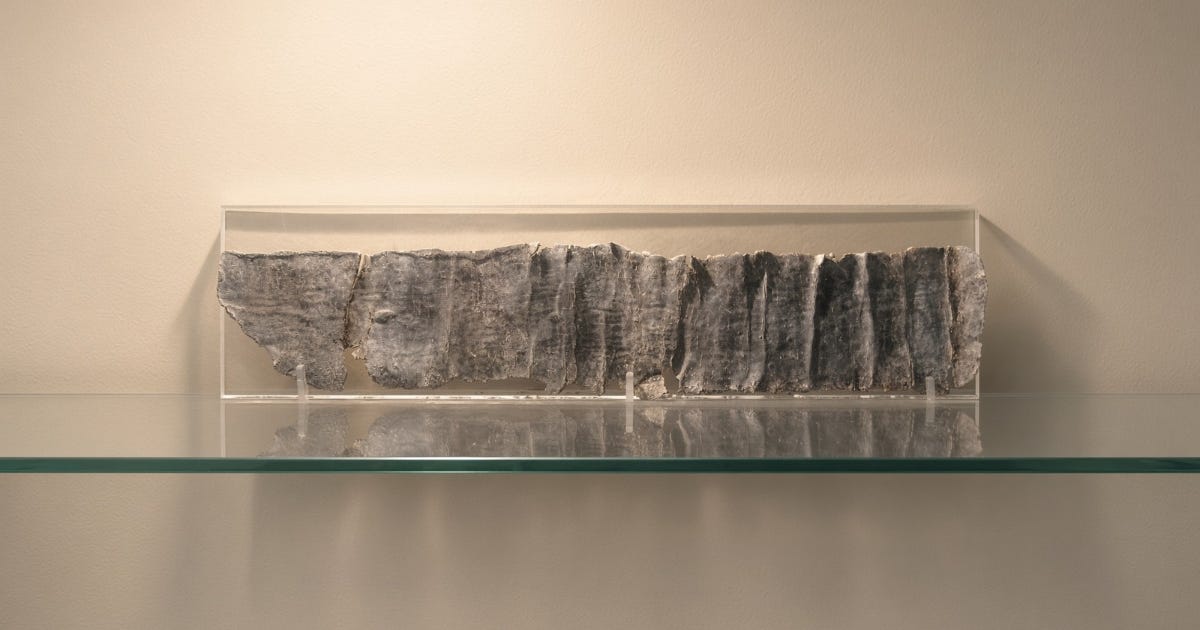
In August 1986 excavators at Pella, the capital of ancient Macedon, found a tightly rolled sheet of lead in a tomb. Its nine lines of Greek, cut around 380 to 350 BCE, record a woman’s spell against the wedding of Thetima and Dionysophon. She binds the marriage, asks to keep Dionysophon for herself and closes with a wish to grow old beside him. Linguists study the tablet for its Doric dialect, and the debate over what that dialect says about the language of ancient Macedon continues.
Ancient Content, November 12, 2026.
A rolled lead sheet lay in a Pella tomb
Voutiras, who published the tablet, reports that it came to light in August 1986 in a tomb from a cemetery near the ancient agora of Pella. The cemetery stayed in use until about 320 BCE, when the growing city abandoned it. According to Voutiras, the excavator dated the tomb to 380 to 350 BCE on stratigraphic grounds, and he places the tablet before the last two decades of the fourth century. The lead sheet measures roughly 20 by 5 centimetres and was found tightly rolled. Wikipedia’s summary says the tablet was deposited with the body of a dead man. The tablet is held in the Archaeological Museum of Pella.
Other dates appear in print. Wikipedia reports that David Jordan’s 2000 survey gives the middle of the fourth century or slightly earlier, and that Engels gives the middle to early fourth century. A World History Encyclopedia caption reads first half of the 4th century BCE.
The first line names a bride and a groom
The text opens with the words “ΘΕΤΙΜΑΣ ΚΑΙ ΔΙΟΝΥΣΟΦΩΝΤΟΣ ΤΟ ΤΕΛΟΣ ΚΑΙ ΤΟΝ ΓΑΜΟΝ ΚΑΤΑΓΡΑΦΩ”. In English the line reads roughly “I register the wedding rite and the marriage of Thetima and Dionysophon.” Wikipedia explains Thetima as a Doric form of the name Theotime. Dionysophon is the groom, and Voutiras leaves open whether the writer was his wife, his concubine or a hetaira.
Voutiras reads the ninth and last line as unreadable because of corrosion, and he notes that the main gaps fall in lines 6 to 9.
The rest of the spell is for paid subscribers. Read what the writer asked of Makron and the daimones, why her name is still debated and what the Doric dialect means for ancient Macedon. Upgrade to continue.
