


A small clay tablet in the Ashmolean Museum in Oxford, catalogued by Assyriologists as MAD 5, 8, carries roughly forty lines of Old Akkadian text. It is among the oldest surviving pieces of love magic anywhere in the world. It is also, read closely, a considerably less charming object than its usual internet framing suggests.
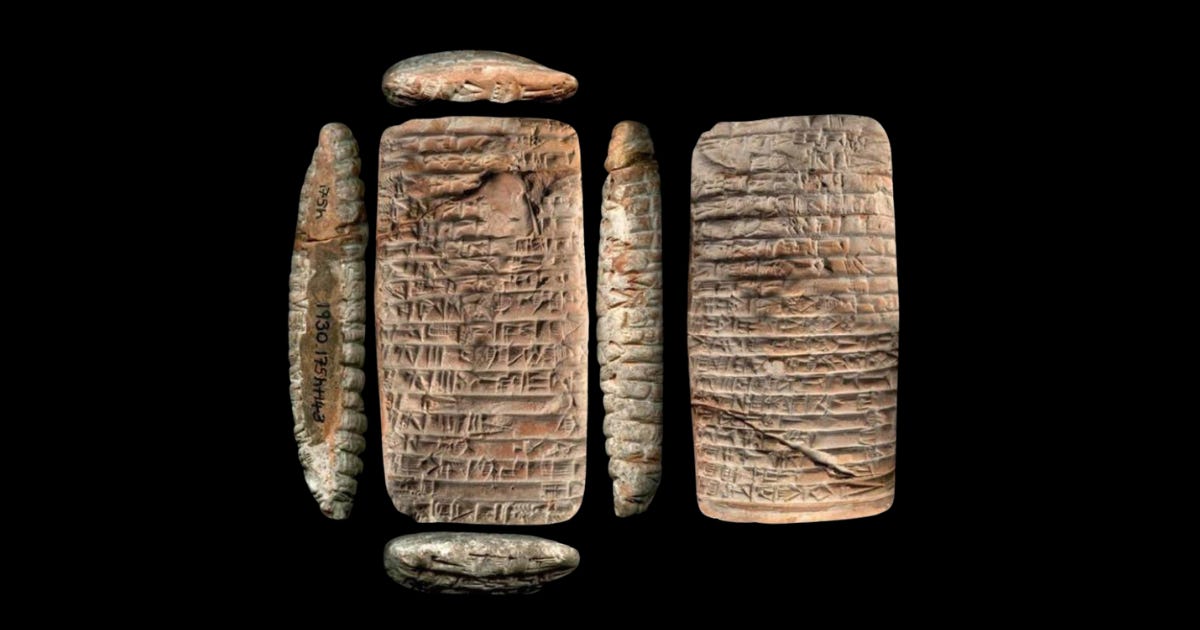
Old Akkadian love incantation on clay, about 2340 to 2200 BC, from Tell Ingharra at Kish in modern Iraq. Shown from six sides. Ashmolean Museum, Oxford. Catalogued as MAD 5, 8.
The tablet came out of Tell Ingharra, the eastern mound of the sprawling city of Kish in what is now central Iraq, excavated between 1923 and 1933 by a joint expedition of the Field Museum in Chicago and the University of Oxford. The finds were divided between the two institutions, which is how this one reached the Ashmolean. Its precise findspot is unknown, and that is not unusual for this dig. Even by the standards of the day, the expedition’s documentation of provenance was poor, a problem compounded when the principal excavators died within a few years of one another and the Second World War interrupted publication.
What can be established comes from the writing itself. The script is a fine Old Akkadian hand, which places the tablet somewhere in the Sargonic period, roughly 2340 to 2200 BC. Very few incantations survive from that period at all, which makes this one significant regardless of its subject.
The title the scholars gave it
Joan Goodnick Westenholz and Aage Westenholz published the definitive edition in the journal Orientalia in 1977. Their title was direct. They called the article “Help for Rejected Suitors.”
The text’s function follows from that. It is an incantation intended to overcome a young woman’s resistance to a man’s advances. Someone commissioned it, someone recited it, and the intended result was that a named individual’s feelings would be changed against her stated position. It is not a private lament or a poem about longing. It is an instrument, and its target is another person’s will.
This tends to get softened when the tablet circulates online, usually as a warm story about lovesickness before dating apps. The softening is understandable and it is worth resisting, because the accurate version is the more interesting one. A man in the third millennium BC encountered refusal, and the technology available to him for overriding refusal was ritual. He used it, or paid someone to use it on his behalf.
Written in the language of love poetry
The genuinely arresting feature of the text is its register. The composition works through the imagery of a fertile garden, one of the standard figures of Mesopotamian love literature. In Sumerian love poetry and in the Dumuzi and Inanna cycle, the beloved is repeatedly a garden or an orchard, a place of date palms and running water and growing things, while the lover is the one who enters or waters or tends. The same figure reappears more than a millennium later in the Song of Songs, where the woman is a garden enclosed and the man comes into his garden to gather spices.
The incantation borrows that vocabulary. It also dwells on the body with a directness that surprised its modern editors, attending closely to the mouth and to the eyes. One line describes the lips as oil and a harp. Scholars working on the history of intimacy have cited the text precisely because of this attention to the mouth as an object of desire.
The result is a document that sits awkwardly between categories. It is written like a love song and it functions like a binding spell, and Assyriologists have disagreed about which side of that line it belongs on since it was first published. That ambiguity is not a flaw in the text. It is a feature of how this kind of magic worked, using the language of desire in an attempt to manufacture desire.
The gods who enforce it
Mesopotamian love magic draws on a small and consistent set of powers.
Ishtar, Inanna in Sumerian, is the most prominent, goddess of love and war and fertility, associated with the planet Venus, worshipped from at least the Uruk period and eventually across the whole of Mesopotamia. She is also, in the mythology, a figure who responds badly to refusal. When Gilgamesh declines her proposal, she goes to her father and demands the Bull of Heaven be released to destroy him.
Alongside her stand Ishara, a goddess connected with love and with oaths, and Ea, god of wisdom, fresh water, and incantation, the deity you invoke when the magic needs to work. Related Akkadian love charms make the mechanism explicit, with formulas conjuring the target by Ishtar and Ishara, seizing the mouth, the eyes, the body.
The significant detail is that this is oath language. Ishara’s association with oaths matters, because a spell that binds a person by the authority of these gods is not making a request. It is applying the same category of force that made a contract enforceable, and directing it at someone’s private feelings.
A demand that never went away
The Kish tablet is early but far from isolated. Love incantations recur across Mesopotamian history. Claus Wilcke published a group from Isin several centuries later. Robert Biggs edited the corpus known as ŠÀ.ZI.GA, a genre concerned with male potency rather than female consent. Nathan Wasserman has published an Old Babylonian spell that binds love magic to the preparation of kohl, so that the black eye paint carries something with it when the woman looks.
Read as a sequence, these texts document a persistent market. Across two thousand years of literate civilization, someone was reliably willing to write a spell of this kind, and someone else was reliably willing to pay for it.
The demand did not stop at Mesopotamia’s borders either. The Greek magical papyri from Egypt contain numerous binding spells aimed at named women. Theocritus built an entire poem around a woman working love magic on the man who left her. European trial records from the medieval and early modern periods are full of the same material. The Kish tablet is the earliest surviving link in a chain that has never fully broken.
What the tablet does not contain
There is a reading of this object in which it is simply poignant. A young man, an unreturned attachment, a bit of superstition, a moment of recognition across four thousand years.
There is another reading in which the woman at the centre of the text holds a position, that position is refusal, and the object exists to defeat it. She commissioned nothing. She left no tablet. Her name is not recorded and will not be recovered. What survives is his account of the situation, fired into clay and preserved by accident for more than four millennia, while whatever she thought about it went into the ground with her.
Both readings are accurate, and the second is the one that makes the object worth examining carefully. It is small, finely written, and genuinely poetic, and its purpose is to override another person’s will. Mesopotamia left us its law codes and its king lists and its astronomical observations. It also left this, which records something those documents never will.
A note to readers. Ancient Content is written and researched independently, and paid subscribers are what keep it that way.
If these pieces are worth your time, consider subscribing. For a few dollars a month you get:
A researched piece every day, checked against the primary sources
Short documentaries, and the full video archive
The complete written archive
Notes on what the coverage gets wrong, and why.
Sources: Westenholz, J.G., and Westenholz, Aa. (1977). “Help for Rejected Suitors, The Old Akkadian Love Incantation MAD V 8.” Orientalia, New Series 46/2, 198 to 219. Kogan, L.E., and Nurullin, R.M., “Old Akkadian Love Incantation MAD 5, 8, Introduction, Translation and Commentary,” Vestnik Drevnei Istorii. Wilcke, C. (1985). “Liebesbeschwörungen aus Isin.” Zeitschrift für Assyriologie 75/2, 188 to 209. Biggs, R.D. (1962). “The ŠÀ.ZI.GA Incantations, Sumerian and Akkadian Love Charms.” Cunningham, G. (1997). Deliver Me From Evil, Mesopotamian Incantations 2500 to 1500 BC. Moorey, P.R.S. (1978). Kish Excavations 1923 to 1933.
Sounds too threatening not to be correct. A woman’s refusal of a man still results in threats too often.
"The more things change, the more they are the same."- Alphonse Karr, 1848