


On a page of Leonardo da Vinci’s notes about rivers and moving water, drawn around 1503 or 1504, sits a beetle with no wings. A new paper by the entomologists Marco A. Bologna of Roma Tre University and Alberto Zilli identifies it as an oil beetle of the genus Meloe, an insect best known across two thousand years of medicine as a source of a sexual stimulant.
The study appears in npj Heritage Science.
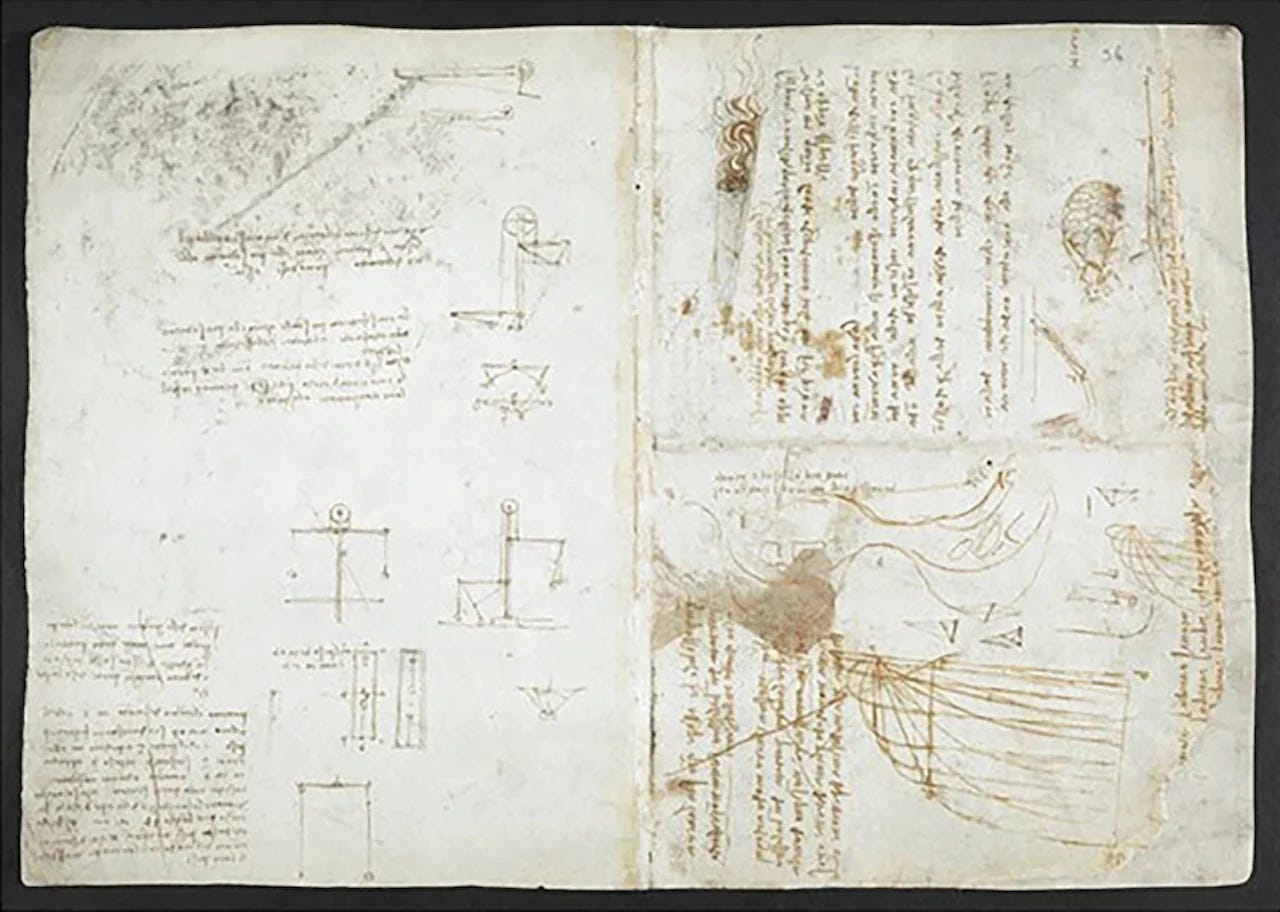
Codex Arundel MS 263, folio 36-recto. Credit: British Library Board
A page otherwise given over to flowing water
The drawing is on folio 36 recto of the Codex Arundel, a bound collection of Leonardo’s loose sheets held at the British Library as Arundel MS 263. The volume covers hydraulics, geometry and a scatter of other subjects.
Carlo Vecce, one of the leading specialists on Leonardo, dates the sketch to the artist’s second stay in Florence. Those were years in which Leonardo was thinking hard about water, including the scheme to divert the Arno, and the rest of the page is taken up with notes on fluvial dynamics. The beetle is the only thing on it that has nothing to do with rivers.
A female Meloe, probably from the Florentine lowlands
Leonardo drew it carefully enough for two specialists to name it five centuries later.
Oil beetles of both sexes have no flight wings, short wing cases and a swollen abdomen, and the form of the antennae marks this one as a female. Two Meloe species live in the part of Tuscany where Leonardo was working. One is confined to the Alps and the Apennines. The other, Meloe proscarabaeus, also ranges through the lowlands around Florence, and Bologna and Zilli take it as the likelier match.
The name oil beetle comes from the insect’s defense. When disturbed it bleeds an oily yellow fluid from its leg joints, and that fluid carries cantharidin, the compound that raises blisters on skin.
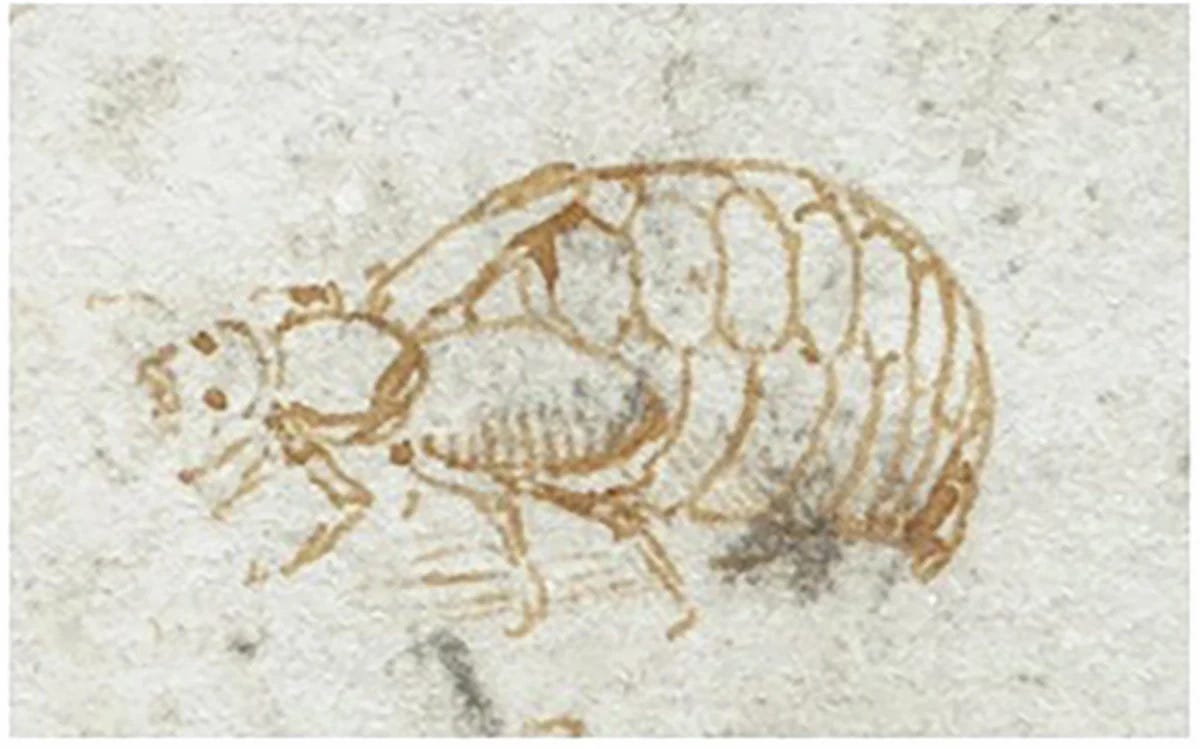
Detail of the Meloe beetle depicted in Codex Arundel, MS 263, folio 36r. Credit: British Library Board
Why draw a wingless insect at all
Leonardo’s notebooks are full of insects, and nearly all of them fly. Dragonflies, bees, wasps and butterflies feed into his long study of wing mechanics and his designs for flying machines.
He did draw a few that stay on the ground. There is a crab, some worker ants, and what researchers now take to be Morimus asper, a flightless longhorn beetle common in Tuscany. The Meloe joins that short list.
Bologna and Zilli set out three possible reasons for it. He may have noticed the beetle in the grass during fieldwork and drawn it from plain curiosity. He may have wanted a flightless insect to set against the flying ones he was studying, the same instinct behind the longhorn beetle. Or he may have known exactly what the beetle was for. The first two can sit together.
Two thousand years of cantharidin
The third possibility is the one the paper explores most fully.
Cantharidin comes from two related beetle families, and cultures in China, Peru, South Africa and the Mediterranean all put it to use independently for at least two thousand years. It served as an aphrodisiac, an anti-inflammatory and a treatment for warts and tumours, and in larger doses as a poison.
In Greek and Roman medicine its use as a male stimulant is recorded by Hippocrates, Aristotle, Dioscorides, Pliny the Elder and Galen. It stayed in Italian folk medicine through the Middle Ages and the Renaissance and on into the nineteenth century. The species most tied to the practice is Lytta vesicatoria, still called Spanish fly, though Meloe was used too.
What cantharidin actually does is inflame the urinary tract, and the effect people mistook for arousal came from that irritation. It is dangerous in small quantities and has killed a good many of the people who took it.
Leonardo had the book, and the interest
Vecce notes that Leonardo owned a copy of the Hortus Sanitatis, an early printed encyclopedia of natural history published in Mainz in 1491 by Jacob Meydenbach. Its section on animals describes blister beetles as both irritants and aphrodisiacs.
The subject also fits Leonardo’s wider notes. He wrote and drew in detail about the anatomy of the penis and the part blood flow plays in erection, in the Windsor collection at folio 2 verso, and elsewhere he set down an aphrodisiac recipe, in the Codex Atlanticus at folio 482 recto.
The authors leave the question open
Bologna and Zilli choose not to settle on one explanation. A single isolated drawing on an unrelated page carries too little context to decide it, and Meloe is an unusual insect for anyone to sketch.
Their point is a wider one. Following the most plausible leads from one small beetle opens other overlooked corners of the notebooks, and adds to the picture of a mind that found almost everything worth recording.
For a few dollars a month you will get stories like this one every day, from Leonardo's notebooks to newly deciphered tablets, plus short documentaries and the full archive. Subscribe and keep Ancient Content going.
Sources: Bologna, M.A., and Zilli, A. (2026). “On Leonardo’s Choice to Depict a Wingless Blister Beetle Producing a Sexual Stimulant.” npj Heritage Science 14, 407. doi.org/10.1038/s40494-026-02896-8
That’s really fascinating!
This may be the most Leonardo thing imaginable.
A page full of notes about rivers and moving water, and right in the middle of it: “Oh, look, an interesting beetle.”
And 500 years later we're still trying to work out whether he drew it because it couldn't fly, because he'd read about its medicinal uses, or simply because he saw the damned thing and wanted to draw it.
I actually love that we don't know. Somehow “he found almost everything worth recording” feels like the best explanation of all.