


Penn Museum object CBS 14221 is a clay tablet from Nippur, 15.4 by 9.3 centimeters and 2.8 thick, ruled into three columns and written in Sumerian. The reverse survives in good condition. The obverse is damaged and mostly illegible. On it are about fifteen medical prescriptions.
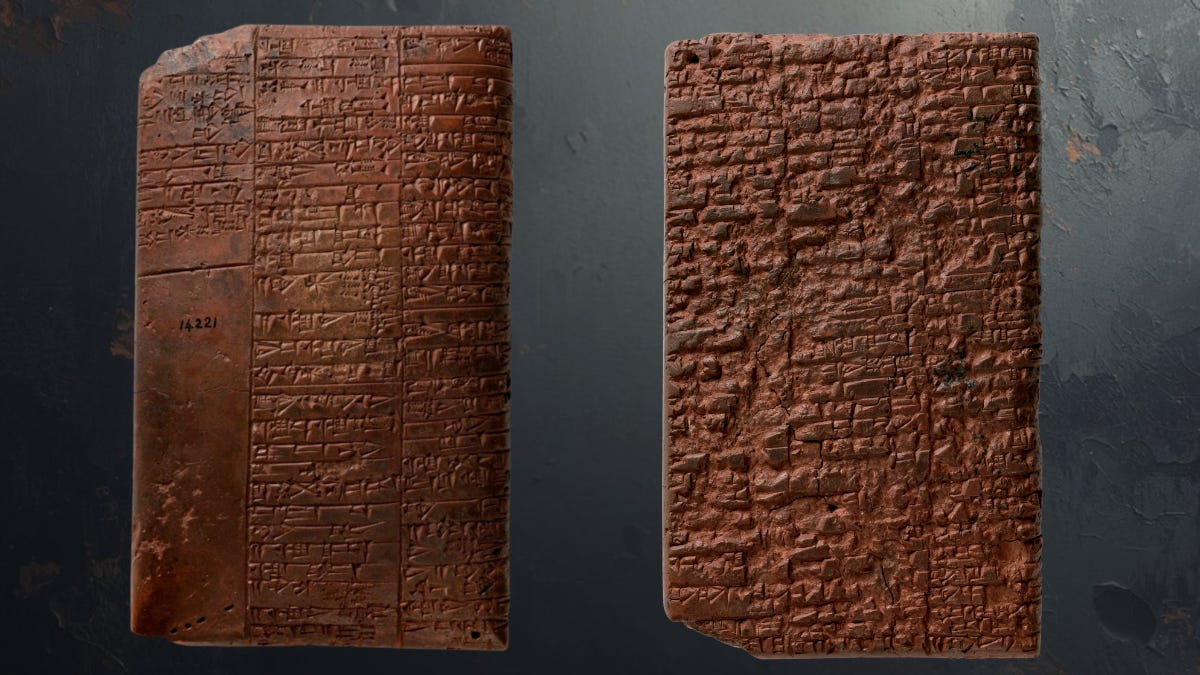
It was excavated during the University of Pennsylvania’s Babylonian Expedition, which ran from 1888 to 1900, and it is on display in the museum’s Middle East Galleries.
Nobody agrees on when it was written
Penn dates the tablet to Early Dynastic IIIB, 2500 to 2340 BC.
Other dates circulate. The commonest is 2100 BC with an attribution to the Ur III period, and 2400, 2200 and 2600 all appear in print. The museum’s own catalogue shows where this comes from. The original register entry calls the tablet pre-Sargonic and describes it as a ritual text. A later hand crossed out ritual, wrote in medical text, and added Old Akkadian and Ur III as alternative periods.
Ground to powder, dissolved in beer, applied
Fifteen of them, and none says what it is for. No illness is named anywhere on the tablet.
The ingredients come from plants, animals and minerals. Thyme, mustard, plum, pear, fig, willow, fir and pine appear on the botanical side, along with beer and wine. Turtle shell and water snake are among the animal materials. Salt and saltpetre are among the mineral ones.
The method is consistent. Ingredients are ground to powder, dissolved in beer or wine, and applied. One prescription washes a wound with alkali and oil, which is the chemistry of soap, and is often cited as among the earliest instances of it on record.
There is no magic. No incantations, no gods invoked, no ghosts or demons held responsible for illness. Later Mesopotamian medical texts routinely carry all of this alongside the prescriptions.
Most of what circulates about it comes from gift shops
A quantity of embellishment attaches to this tablet, most of it repeated by sellers of reproductions and by content sites working from them.
The usual version says Penn scholars translated it in 2005 and found cannabis, opium and aloe vera in it, and that it records the first known use of aspirin. Samuel Noah Kramer and the chemist Martin Levey published a translation in the 1950s. The aspirin claim comes from willow bark, which contains salicin, though the tablet does not say what the willow was for and salicin is not aspirin. Identifications of cannabis and opium in Sumerian plant vocabulary are disputed, and a good many of the plant names in these texts have never been identified at all.
Thanks for reading. Support Independent Ancient Content. Your support helps me create more archaeology posts, articles, and mini history videos:

Sources: Penn Museum, object CBS 14221, including the CBS register entry. CDLI P269190. Kramer, S.N., History Begins at Sumer. Levey, M., on Sumerian pharmacology. Penn Museum Bulletin VIII, no. 1 (January 1940), “Nippur Old Drugstore.”