


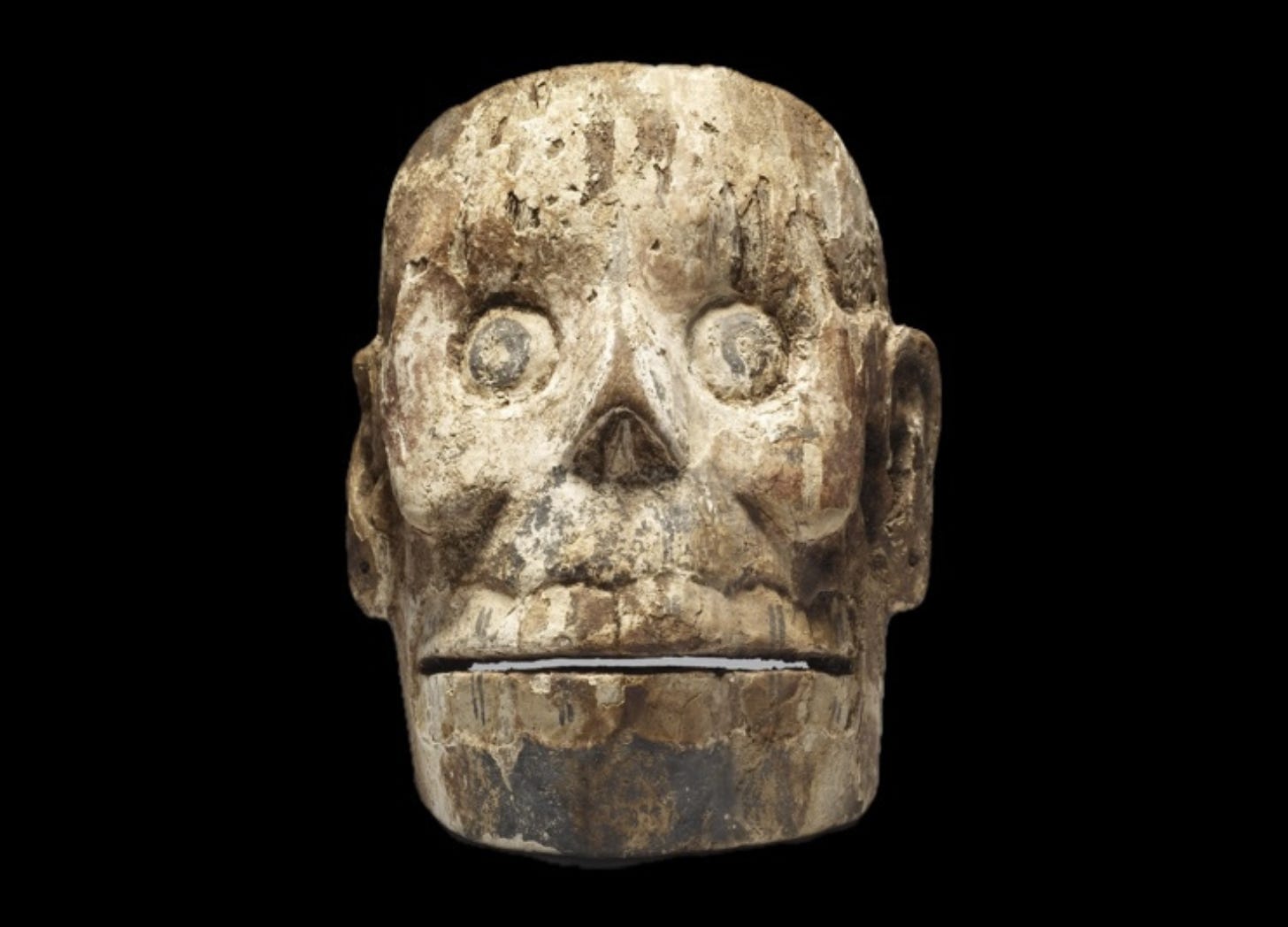
A painted wooden Aztec mask of Mictlantecuhtli, the god of the underworld. Credit: The Walters Art Museum.
Known today as the Mask of Mictlantecuhtli, the artifact is held by The Walters Art Museum in Baltimore. It dates to around AD 1450–1521, the final period of Mexica power before the Spanish conquest. The mask is made of wood, ground, and paint, and measures 17.2 by 14 by 7.2 centimeters.
Although it is called a mask, the object was probably designed as a sculptural or devotional element rather than as something worn over a human face. Its lack of eye openings suggests that it was likely attached to a wooden figure, statue, post, or ritual image representing the god.
A wooden face of death
The mask shows Mictlantecuhtli with a skeletal face, one of his most recognizable features in Aztec religious art. The sunken eyes, black pupils, triangular nose, and exposed teeth create the impression of a skull rather than a living face.
The teeth are marked with vertical black lines, while the cheeks preserve traces of small reddish circles. These red marks are thought to represent decay, a visual feature associated with the death god in other Mexica images, including representations in painted manuscripts such as the Codex Borgia.
Both ears appear to have been pierced. This detail matters because Mictlantecuhtli was often shown wearing ear ornaments connected with bones or human remains. The mask therefore does more than show a skull. It presents a specific divine identity, using details that would have been recognizable within Mexica religious imagery.
The object is especially valuable because surviving Aztec wooden masks are rare. Organic materials such as wood often decay over time, and many ritual objects were destroyed, repurposed, or lost after the conquest. This mask’s survival makes it an important piece of Mexica devotional material culture.
Mictlantecuhtli and the underworld
Mictlantecuhtli was one of the major death deities of the Aztec pantheon. His name is usually translated as “Lord of Mictlan.” Together with his wife, Mictecacihuatl, he ruled the underworld realm associated with the dead.
In Mexica belief, the fate of the dead depended on the manner of death. Different categories of death could lead to different afterlife destinations. Mictlan was the underworld realm ruled by Mictlantecuhtli, often described as a place reached through a difficult journey across several levels or regions.
Later summaries of Aztec religion describe Mictlan as a multi-stage underworld, sometimes described as having nine levels. The journey of the dead could take years and involved trials before the soul reached its final resting place. In this context, Mictlantecuhtli was both a ruler of death and a guardian of the boundary between the living and the ancestral dead.
Mictlantecuhtli was usually portrayed with a skull-like head or skeletal body. Full-body images often show him with raised arms, a posture associated with his role as a fearsome underworld lord. Some descriptions also connect him with gruesome attributes, including necklaces of human eyes or ornaments made from bones.
Masks and ritual transformation
Masks played an important role in Mesoamerican religious life. They could be worn in ceremonies, used in reenactments of myths, or attached to sacred images. By changing the face, the wearer or object could become a divine being, ancestor, mythic figure, or supernatural force.
The Walters Art Museum explains that in Mesoamerican ritual thought, the face was deeply connected with identity. To cover or replace the face was to cross an ordinary human boundary. In ritual performance, a person could temporarily assume the presence of a god or mythic being.
Skeletal masks were especially important because death occupied a central place in Mexica religion. Death was one of the twenty day signs in the calendar, and it formed part of a wider cosmic cycle of destruction, renewal, and rebirth.
The Mictlantecuhtli mask belongs to this religious world. Its form suggests it was made for ritual display or attachment to a sacred figure. Rather than functioning as a simple costume piece, it likely formed part of a larger image of the god.
Death and regeneration
To modern viewers, the mask may first appear as a grim image of death. In Mexica thought, death also carried a connection with renewal. The underworld was frightening, but it was also a place where the materials of new life could be found.
One important myth illustrates this idea. In the story, Ehecatl, the wind aspect of Quetzalcoatl, descends into Mictlan to retrieve the bones of earlier humans. These bones are needed to create the present human race.
Mictlantecuhtli first agrees to surrender the bones, then changes his mind and tries to prevent their removal. In one version of the myth, the underworld lord gives Quetzalcoatl a shell without holes and sets him a task involving a shell trumpet. Quetzalcoatl succeeds through cleverness and eventually escapes with the bones.
The recovered bones are then ground and placed in a sacred vessel. The gods shed their blood into the bone powder, and from this act the current generation of humans is created.
This myth shows why Mictlantecuhtli was more than a simple god of death. He was connected to the deep structure of existence: the dead, the ancestors, the underworld, and the raw material from which new human life could emerge.
A rare devotional object
The Mask of Mictlantecuhtli is important because it preserves several layers of Mexica religious meaning in a single object. Its skeletal form identifies the death god. Its painted details evoke decay and the body after death. Its pierced ears connect it to known iconography of Mictlantecuhtli. Its probable attachment to a statue or figure places it within ritual display rather than ordinary use.
The mask also shows the artistic skill of Mexica woodworkers. With simple but precise carving, the maker created a face that is both human and skeletal, physical and divine. The black pupils, red cheek marks, and lined teeth would have made the object visually powerful in a ceremonial setting.
Because masks of this type have survived only in small numbers, the object offers rare evidence for how wooden ritual images may have looked in the Aztec world. Stone sculptures, codices, and colonial descriptions preserve many details of Mexica religion, but wood, paint, and other organic materials give a different view of ritual practice.
The mask today
The mask entered The Walters Art Museum as a gift from John Bourne in 2009. Its recorded provenance includes Throckmorton Fine Arts in New York and John G. Bourne’s collection in the 1990s. The museum identifies it as an Aztec, or Mexica, work from Mexico, dating to the Late Postclassic period.
Today, the mask is studied as both an artwork and a religious object. It belongs to a world in which gods could be made present through image, performance, costume, and ritual. For the Mexica, death was a divine force woven into the cosmic order.
The face of Mictlantecuhtli therefore represents fear, power, ancestry, and renewal at the same time. More than 500 years after it was carved, the mask still carries the visual force of a deity who ruled the underworld and guarded one of the most important boundaries in Aztec belief: the passage between death and life.
Sources:
Live Science’s report by Kristina Killgrove gives the object’s basic details: name, material, Aztec origin, date range of AD 1450–1521, description of the painted features, and the interpretation that the mask was likely attached to a figure because it lacks eye holes.
The Walters Art Museum’s object record identifies the piece as “Mask of Mictlantecuhtli, Lord of the Underworld,” an Aztec/Mexica Late Postclassic object made of wood, ground, and paint, and gives its measurements, provenance, and interpretive description.
Britannica summarizes Mictlantecuhtli as the Aztec god of the dead, usually shown with a skull face, ruling Mictlan with Mictecacihuatl and associated with the underworld journey of the dead.