


Fifteen Neolithic stone masks are known from the Judean Hills and the desert below them. Carved from limestone and chalk, they date to the phase archaeologists call Pre-Pottery Neolithic B, around nine thousand years ago. Each weighs between one and two kilograms. Most have hollow eyes, a short nose, carved teeth and small perforations around the rim.
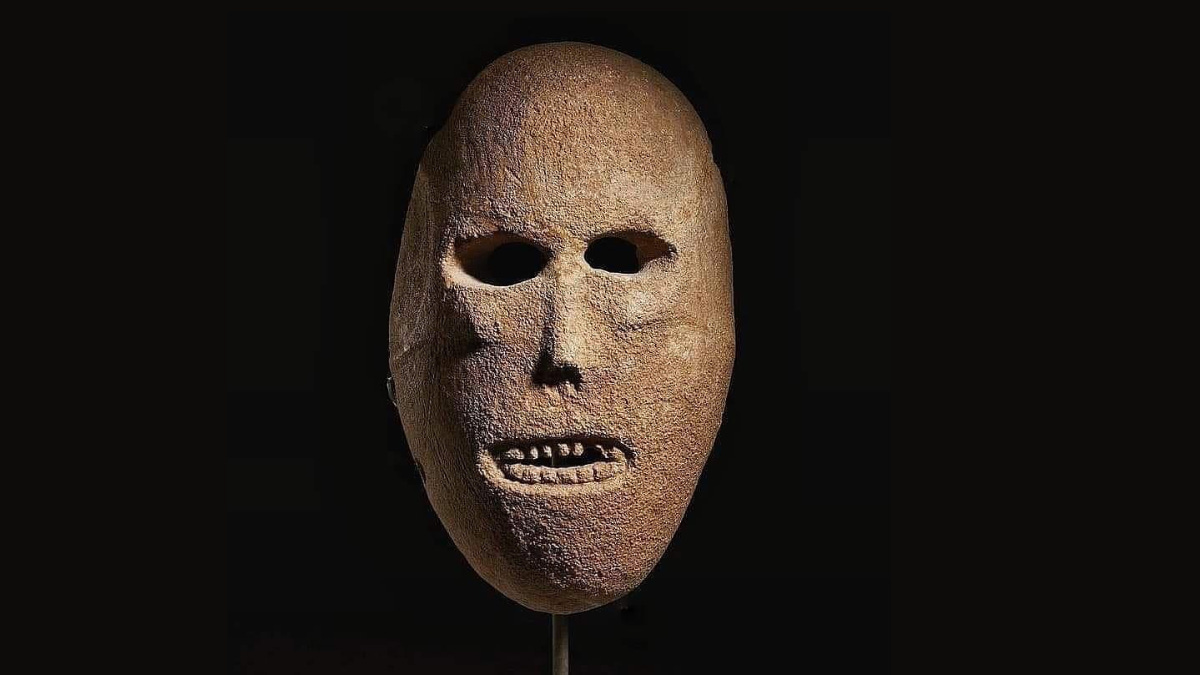
Only two of these were actually excavated. One was recovered by Ofer Bar-Yosef from Nahal Hemar in 1983, a cave above the Dead Sea that also contained basketry, beads, and what is generally considered the oldest known glue. The second came from Horvat Duma, near Hebron.
Both are now in the Israel Museum. One is still designated as the Moshe Dayan specimen because it was donated by him.
The other 13 have a very different story. None were found in archaeological excavations, and most were once part of the private collection of New York collectors Judy and Michael Steinhardt.
The study
For almost a decade, archaeologist and curator of prehistory Debby Hershman at Jerusalem’s Israel Museum has been studying these groups and was the organizer in 2014 of a show that grouped together twelve for the exhibition Face to Face-one of the first times that any of them had all been together in the one space. The stone type and any patination and use were studied by Yuval Goren at Tel Aviv University, who was able to show that all fifteen are from the one area, within approximately 50 kilometers of each other. Given that there is no information about Where the find was made, for one group of artifacts that would be as strong as this project can probably ever yield because it suggests a geographical unity without the input of an excavator’s field information.
3D models were generated by the computer archaeology unit of Jerusalem’s Hebrew University showing that most masks could be comfortably worn on the face of a man.
Portraits of the dead
Hershman’s interpretation is that the masks are portraits of particular individuals. The faces differ from one another, some reading as old and some as young, which she takes as individual likeness rather than a generic type. Many of them, in her words, look like dead people.
On that basis she proposes an ancestor cult, with the masks worn during ceremonies by shamans or tribal chiefs, and notes that masks used in West African ancestor cults today weigh as much or more.
What cannot be checked
There’s no written source to tell us anything about them. Writing only reaches the region several thousand years after these masks were carved.
And for 13 of the 15 masks, there’s very little archaeological context to work with. We don’t know whether they were found in an occupation layer, buried with the dead, or deliberately placed somewhere as a cache. For the masks that came onto the market, we don’t even know where they were originally found.
Their dates are largely based on how closely they resemble the two masks that were actually excavated.
Hershman has also been quite open about the fact that she doesn’t know whether future examples might be found in special buildings or other specific contexts.
The Steinhardt case
In December 2021, Michael Steinhardt handed over 180 looted antiquities, valued at around $70 million, to the Manhattan District Attorney’s Office. He also agreed to an unprecedented lifetime ban on acquiring antiquities.
The investigation, which began in 2017, examined thousands of objects Steinhardt had bought and sold since 1987. Investigators traced many of them through a network of antiquities traffickers operating across 11 countries, including Israel.
Steinhardt was never arrested. He maintained that he had not known the objects he purchased were stolen.
Sources: Israel Museum, Jerusalem, Face to Face, The Oldest Masks in the World, 11 March to 13 September 2014, curated by Debby Hershman. Reporting by the Times of Israel, Live Science, National Geographic and the Biblical Archaeology Society, March to June 2014. Manhattan District Attorney's Office, statement of 6 December 2021, as reported by the Art Newspaper, CNBC and Forbes.
They knew they were looted, hence the agreement
People like Steinhardt are the reason antiquities are stolen. And they are the same people who make sure the government serves them and not the people.