


For two decades, the tiny extinct human species nicknamed the hobbit has stood as a puzzle at the edge of our family tree, small enough to have stood about a meter tall, yet apparently clever enough to hunt formidable prey and control fire.
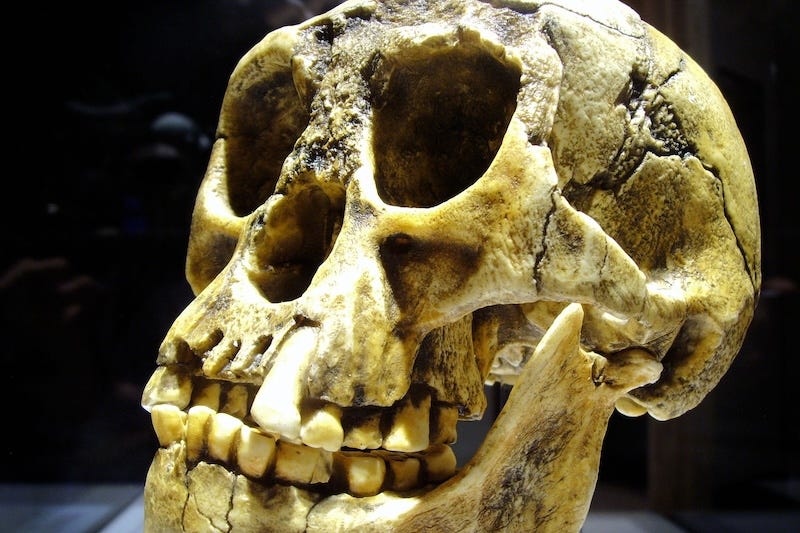
According to a new study, the extinct human species Homo floresiensis, commonly known as the “hobbit,” may have been a scavenger. Credit: Wikimedia Commons
A new study of ancient animal bones from the species’ cave home on the Indonesian island of Flores now overturns that picture. Homo floresiensis, the research suggests, was not a hunter at all. It was a scavenger, picking over the leftovers that the island’s fearsome Komodo dragons left behind, and it shows no convincing evidence of ever having tamed fire.
The study, led by paleoanthropologist Elizabeth Grace Veatch of the Smithsonian Institution’s Human Origins Program and the Cluster of Excellence in Human Origins at the University of Tübingen, was published on July 3, 2026, in the journal Science Advances.
A hobbit with a giant reputation
Homo floresiensis was first uncovered in 2003 in the limestone cave of Liang Bua on Flores, a species whose ancestors are thought to have reached the island at least 700,000 years ago. Standing an average of about 106 centimeters tall, with a brain only slightly larger than a chimpanzee’s, prominent teeth, and notably large feet, the species quickly earned its hobbit nickname. Alongside its bones, archaeologists found stone tools, animal bones bearing cut marks, and bones that appeared charred, a combination that seemed to point toward the sophisticated behaviors associated with our own genus Homo. The hobbits vanished around 50,000 years ago, roughly when Homo sapiens began spreading across Southeast Asia.
Veatch wanted to test that inherited assumption directly. As she put it, she wanted to see whether the evidence could really show that Homo floresiensis was the hunter it had long been portrayed as.
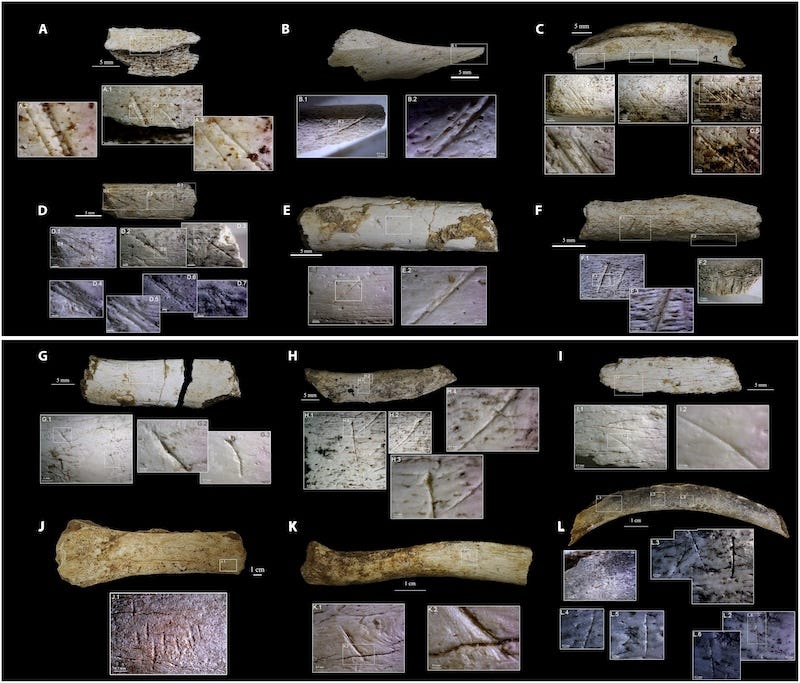
Selected bone fragments showing marks left by Homo floresiensis and Komodo dragons. Credit: E. Grace Veatch et al. (2026)
Teaching a dragon to testify
The obstacle was that Flores’ Stegodon, a dwarf elephant relative, is extinct, and there was no way to run a hunting experiment on a living one. So the team turned to the island’s other apex predator, the Komodo dragon, the world’s largest living lizard, which still stalks the same landscape. Researchers fed a goat carcass to a captive Komodo dragon named Rinca at Zoo Atlanta, then recovered the goat’s skeleton and used 3D scanning to painstakingly document every pit, notch, furrow, and tooth score the dragon’s bite had left behind. The pattern was clear. The dragon’s teeth concentrated heavily on the meatiest cuts, the fore and hind quarters, exactly the parts a hungry predator would prioritize.
With that reference library of dragon bite marks in hand, the team turned to the real evidence, examining more than 3,000 Stegodon bone fragments from Liang Bua alongside a broader sample that totaled over 10,000 bones and stone artifacts from the site. They found 54 cut marks made by hobbit stone tools and almost twice as many Komodo dragon tooth marks on the same Stegodon remains. The locations told the real story. The dragon marks clustered on high-meat areas, just as in the goat experiment, while the human cut marks turned up mostly on low-utility parts, the skull, neck, and feet, places with comparatively little to eat.
Second in line at the carcass
Taken together, the researchers argue, the distribution of marks points to Komodo dragons having primary access to Stegodon carcasses, with Homo floresiensis arriving second to scavenge whatever scraps were left. The likely scenario echoes how Komodo dragons hunt large prey such as water buffalo today, delivering a venomous bite and then tracking the weakening animal, sometimes for kilometers, using their extraordinary sense of smell to find a carcass. Once the dragons had eaten their fill, the hobbits appear to have moved in with their stone tools to cut whatever meat remained from the bones the dragons had left behind.
No fire in the ashes
The second pillar of the hobbits’ supposed sophistication was fire, and it fared no better under scrutiny. The team searched for burn traces across the Stegodon bone assemblage and found essentially none, one single bone out of more than 3,000 showed any sign of heat exposure, and that specimen most likely came from a disturbed section of the deposit. The researchers also examined roughly 7,000 bones of giant rats from later, more recent layers of the cave associated with Homo sapiens, looking for the same fire signatures across a combined sample of about 10,000 bones. What earlier researchers had taken for evidence of burning on some remains, the team now concludes, was most likely natural manganese staining rather than the residue of a hearth.
Study co-author Briana Pobiner, a paleoanthropologist at the Smithsonian, noted that thousands of stone tools were found alongside Homo floresiensis remains, tools apparently crafted from local chert specifically to strip meat from bone. That toolmaking skill was real. What appears to be missing is the pairing of hunting and cooking that anchors so much thinking about advanced hominin behavior. The hobbits, the researchers suggest, most likely ate their scavenged meat raw, alongside plants and insects, and may have survived alongside the island’s dragons in part through group living and caution, since even modern Komodo dragons rarely attack people without provocation.
What it means for the hobbit’s ancestry
The absence of hunting and fire technology reopens the question of where Homo floresiensis actually came from. Veatch suggests it is entirely possible that the ancestor of the hobbits split off from the genus Homo before hunting and the control of fire had become established behaviors at all. As she frames it, the findings underline the importance of weighing behavior alongside anatomy in these debates, and point toward an ancestor that did not depend on hunting and cooking as subsistence strategies, perhaps an early form of Homo rather than a more advanced one.
Two competing hypotheses for the hobbits’ origin remain in play. One holds that they descended from a larger-bodied species, evolving smaller body size over many generations through island dwarfism driven by limited resources. The other proposes they descended from an already small-bodied, more primitive Homo species. The new study does not settle that argument outright, since so little is known about the behavior of early hominins elsewhere in Southeast Asia, including Homo erectus on Java, or across the wider region once known as Sundaland, the landmass between the South China Sea and the Indian Ocean that has been intermittently exposed and submerged over the last 2.6 million years. If Homo floresiensis really did descend from Homo erectus, it would imply a substantial reversal of established behaviors somewhere along the way.
Adam Brumm, an archaeologist at Griffith University in Australia who was not involved in the study, sees that possibility as entirely plausible for a hominin lineage cut off on an island. Such a transition, he suggests, may have involved not only the well-known anatomical shifts of shrinking body size and brain volume, but behavioral adaptations as well. Flores, in his view, was a genuinely unpredictable place in the story of early human evolution, the kind of setting where almost anything could happen, including the loss of hominin behaviors as deeply rooted as hunting and the use of fire.
Sources. Live Science (July 3, 2026); CNN; National Geographic. Article, E. Grace Veatch et al. (2026), "Taphonomic analysis at Liang Bua reveals the behavioral and technological capabilities of Homo floresiensis," Science Advances 12, doi.org/10.1126/sciadv.aeb7219.
The story is a fantasy. The Komodo dragon has a very toxic saliva. Ita highly unlikely they v would have scavenged their leftovers.