


On the walls of an Assyrian palace, winged figures stand in pairs with a small pail in one hand and a cone in the other. Online, the pail has become “the handbag of the gods”, a symbol said to appear from Mesopotamia to Göbekli Tepe to Mexico. Cuneiform ritual texts name the objects, say what they held and even specify which hand carried them.
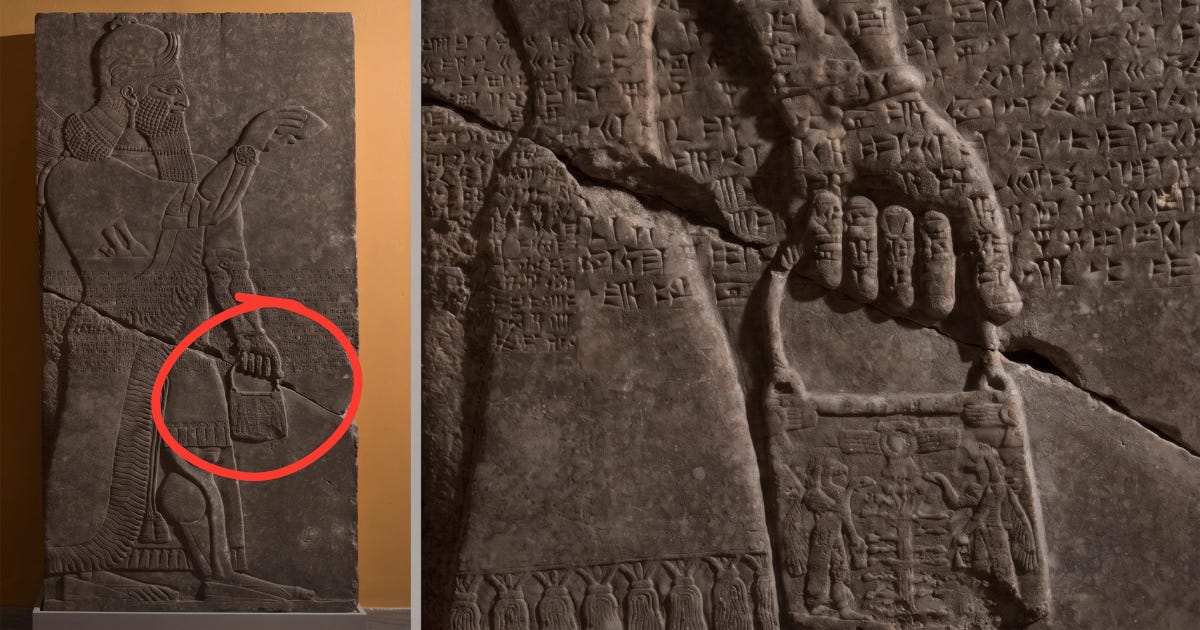
An apkallu with cone and bucket, from the palace of Ashurnasirpal II at Nimrud, ca. 883 to 859 BC. Apkallu-figure with Armlets, Assyrian, ca. 883–859 B.C.E. Gypsum stone, pigment. Brooklyn Museum, Purchased with funds given by Hagop Kevorkian and the Kevorkian Foundation, 55.145. Photo: Brooklyn Museum, CC BY.
Layard uncovered the reliefs at Nimrud in 1845
The story starts on the Tigris. Austen Henry Layard began excavating at Nimrud in November 1845, believing he had found Nineveh. The site was actually Kalhu, capital of the Assyrian king Ashurnasirpal II, who ruled from 883 to 859 BC. Layard’s two-volume Nineveh and Its Remains appeared in 1848 and 1849 and became an immediate bestseller.
Ashurnasirpal’s North-West Palace is the earliest surviving Assyrian royal residence, and its gateway figures and reliefs caused a sensation in the West when they were found. Ashurnasirpal was the first Assyrian king to decorate his palace extensively with carved stone, a practice his successors followed.
The winged figures are apkallu, protective sages
Museums that hold these reliefs identify the figures consistently. The Fitzwilliam Museum in Cambridge describes its winged man as an apkallu, meaning “sage”, one of several benevolent semi-divine beings believed to counsel and protect the Assyrian king. Images of apkallu were placed near the entrances to rooms in the palace to ward off evil spirits.
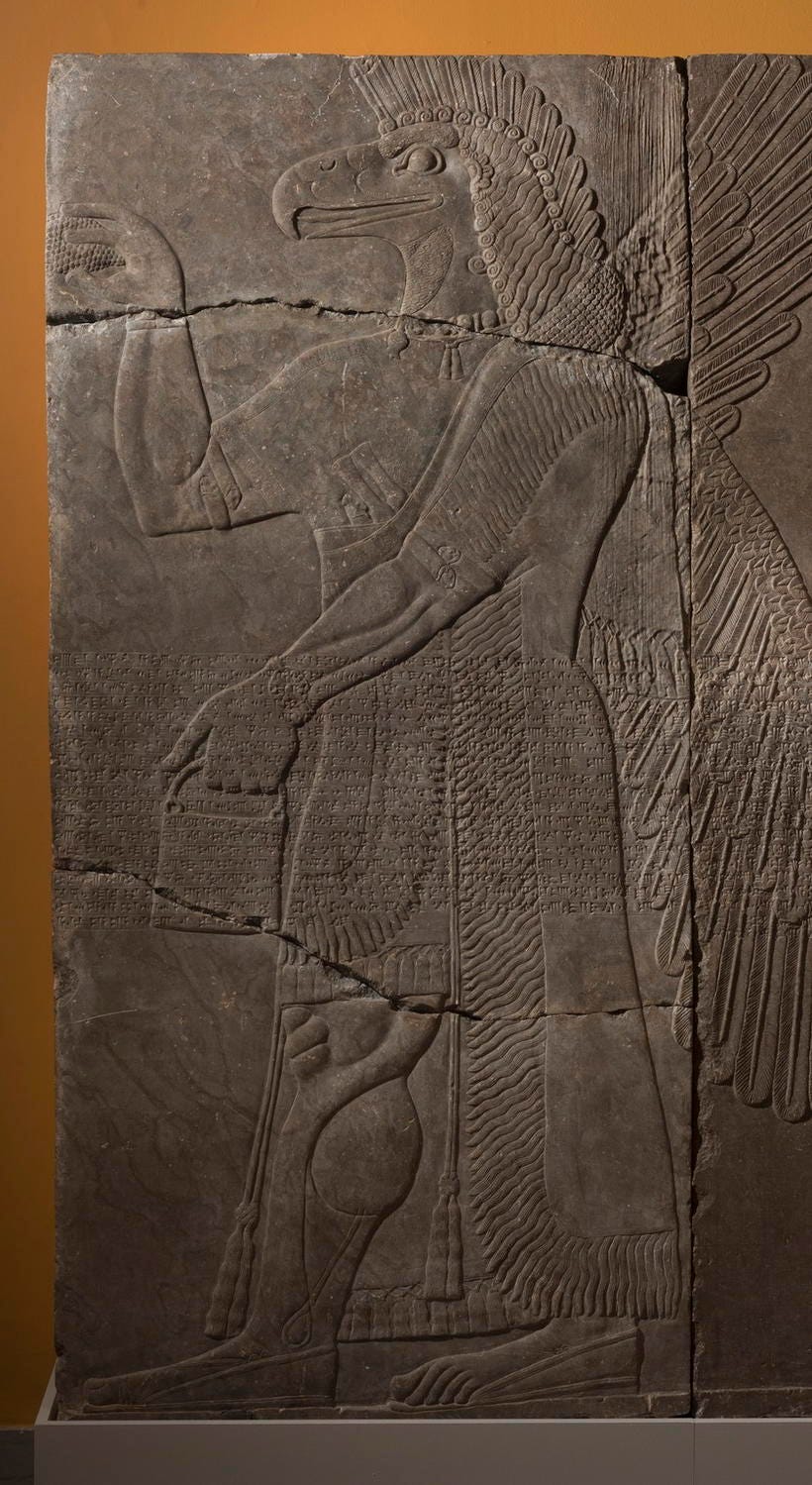
An eagle-headed apkallu with cone and bucket, from Ashurnasirpal II's palace at Nimrud, ca. 883 to 859 BC. Apkallu-figure, Assyrian, ca. 883–859 B.C.E. Gypsum stone, pigment. Brooklyn Museum, Purchased with funds given by Hagop Kevorkian and the Kevorkian Foundation, 55.149. Photo Credit: Brooklyn Museum
The Fitzwilliam’s figure holds a banduddu, a pail, and a mullilu, a sprinkler, from which he dispenses water for purification. He wears a horned crown, a sign of divine status. Apkallu appear in several forms. Some are winged men, some have eagle heads, and some wear a fish cloak.
