


In the forest not far from the banks of the Amur River in Khabarovsk Krai, archaeologists have uncovered what they are calling the burial of an ancient god. Around two thousand years ago, near the present-day Nanai village of Sikachi-Alyan, someone carried a sacred stone image away from the river, painted it red, burned it in a fire, and raised a mound of boulders beside it.
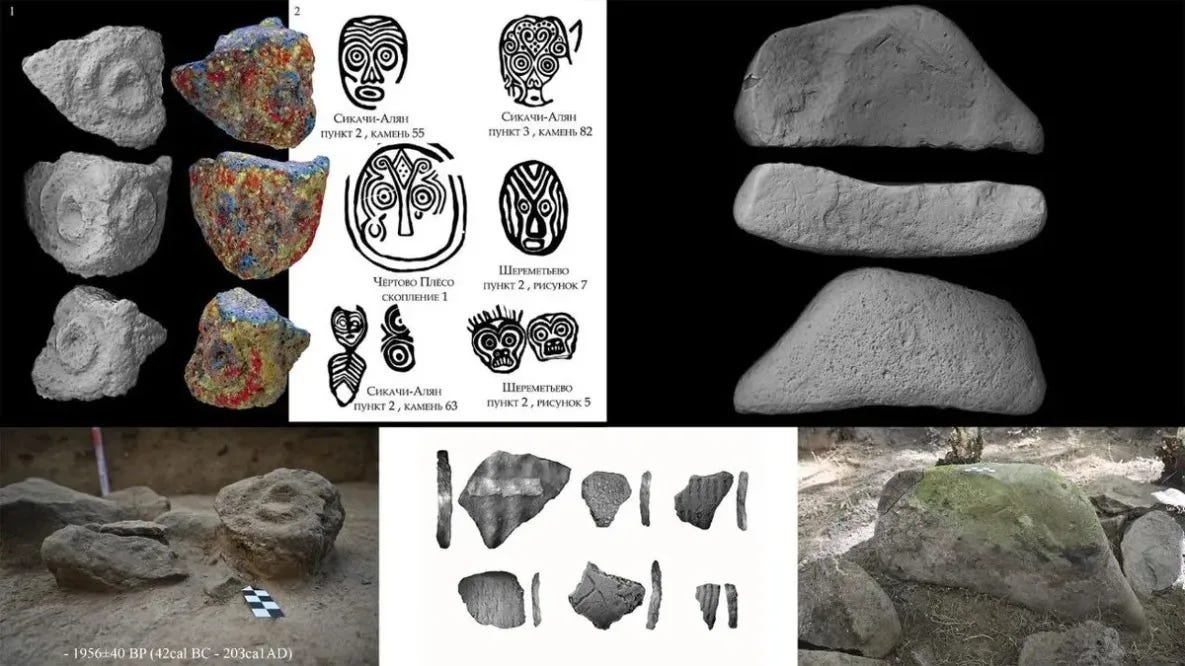
The Grave of an Ancient God Found Near Sikachi-Alyan in Russia’s Far East. Image credit: Khabarovsk Krai Today
The meaning of that mysterious rite is still to be deciphered, but the find is already being described as unique, the first time a petroglyph has ever been discovered underground.
The discovery was presented publicly at the conference “Russia and China, History and Prospects of Cooperation,” held in Blagoveshchensk and continued across the border at universities in the Chinese cities of Heihe and Mudanjiang. The gathering drew specialists well beyond archaeology, including physicians, physicists, chemists, and economists from leading institutes in Moscow, Saint Petersburg, and other cities, along with Chinese colleagues. A report titled “A Ritual Complex of the Early Iron Age in the Sacred Landscape of Sikachi-Alyan” drew keen interest from the scientific community of both countries, according to Evgeny Chernikov, head of the archaeology department of the Khabarovsk Regional Center for the Protection of Historical and Cultural Monuments.
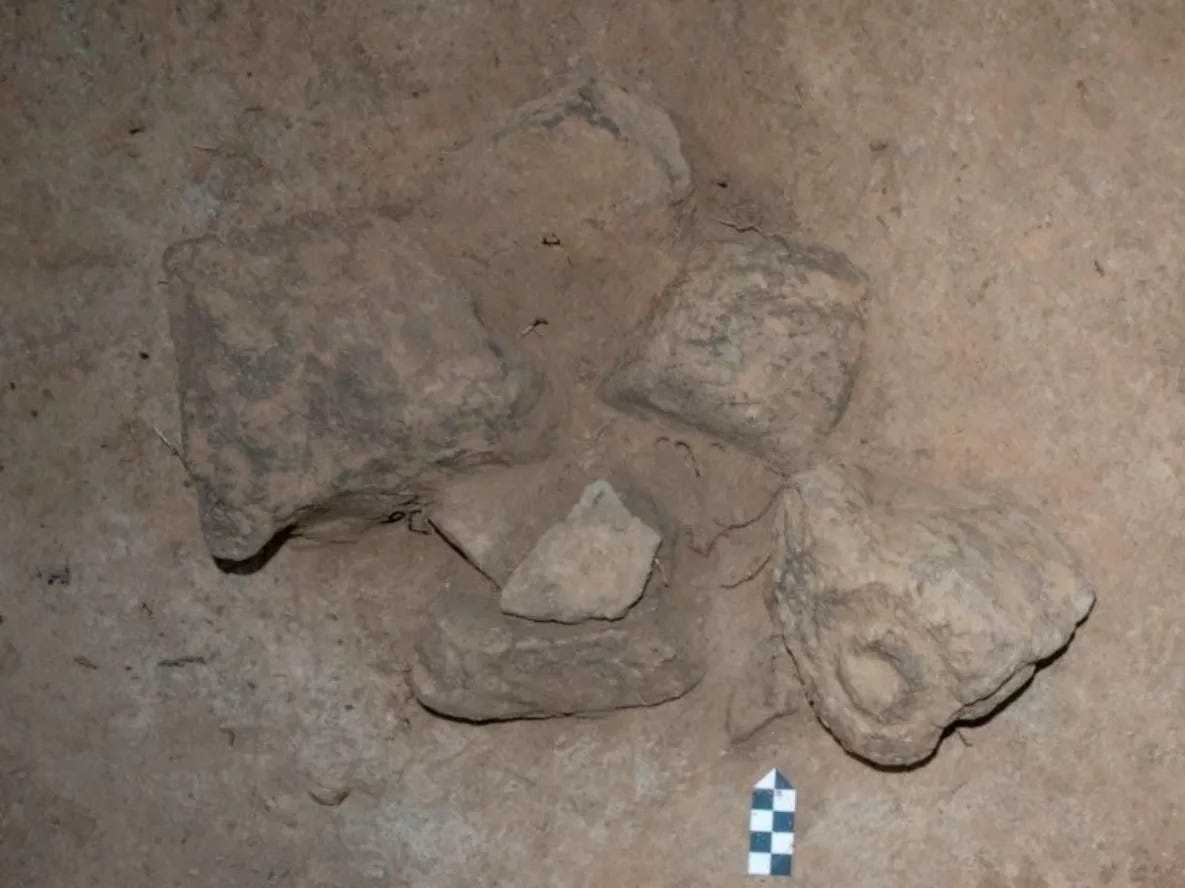
The cluster of stones uncovered in the test pit near Sikachi-Alyan, part of a mound-like ritual structure raised in the early Iron Age. Photo Khabarovsk Regional Center for the Protection of Historical and Cultural Monuments.
They stumbled over a stone
The story began in the autumn of 2025, during the routine work of defining the boundaries of archaeological heritage sites. As often happens in science, the breakthrough came entirely by accident. The archaeologists literally tripped over a boulder protruding from the ground. Looking closer, they saw parallel cut marks on its surface, an unmistakable sign of human modification, since no animal is capable of making such traces.
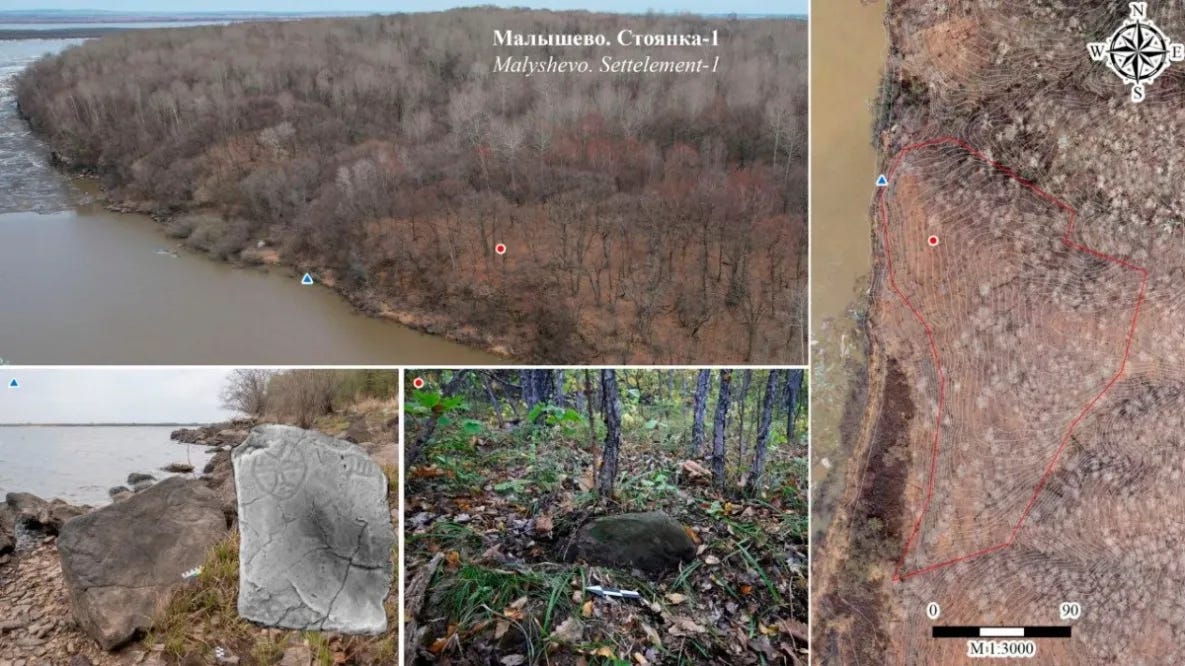
Where it all began. The stone in the forest, the carved boulder on the shore, and the site that connects them, near Sikachi-Alyan on the Amur. Credit: Khabarovsk Regional Center for the Protection of Historical and Cultural Monuments.
The strange boulder proved to be only the first piece of the puzzle. The team opened a test pit and, within a small area, uncovered a whole heap of stones piled together. The stones had probably been carried up from the riverbank, where the famous basalt boulders of Sikachi-Alyan lie, including one on which previously unknown images were identified not long ago. As the excavation continued, it became clear that the heap had once been part of a surface structure resembling a burial mound. At its base lay a dark, humus-stained patch, the trace of a hearth. And at the bottom of the hearth pit, among a cluster of small stones, the archaeologists found a fragment of an anthropomorphic image pecked into stone.
A Neolithic face in an Iron Age fire
Here the history takes its strange turn. The fragment belongs to a mask-face, or lichina, of the type famous at Sikachi-Alyan, and dates to the Neolithic, making it at least 4,500 to 5,000 years old. The hearth, however, turned out to be far younger. Radiocarbon analysis of charcoal from its fill showed that the fire went out about two thousand years ago, in the early Iron Age. The carved image, in other words, ended up in the fire at least two millennia after it was made.
The sequence the archaeologists reconstruct is remarkable. The image was moved from the riverbank into the forest, painted with red pigment, burned in a fire, and a mound of boulders was heaped up nearby. As Chernikov stressed, there is no practical reason to burn a stone. What the evidence points to is symbolic action.
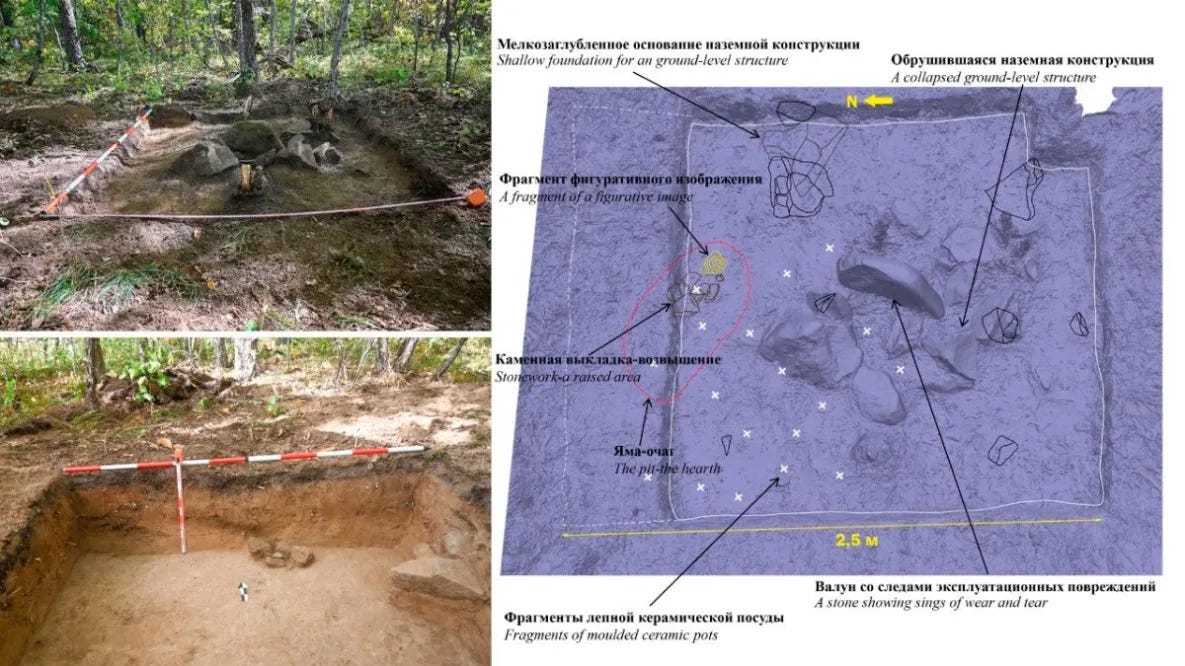
The ritual complex at Malyshevo Settlement-1 under excavation. Field photographs of the trench beside an annotated 3D plan showing the collapsed stone structure, the raised stonework with its hearth pit, the fragment of a carved figurative image in yellow, and scattered sherds of hand-molded pottery across the 2.5-meter excavation. Image Khabarovsk Regional Center for the Protection of Historical and Cultural Monuments.
A rite wrapped in mystery
The deeper context makes the scene even more evocative. The Neolithic on the Lower Amur came to an unexpected end around three and a half thousand years ago, in the first half of the second millennium BC, for reasons still unknown, with climate change among the suspected causes. The river country stood largely empty for a long stretch, until new people settled the territory centuries later at the dawn of the early Iron Age. The burned mask thus belonged to one cultural tradition, and the fire to a completely different one.
Chernikov suggests the fragment was deliberately taken, or perhaps stumbled upon, by these later inhabitants, and that the burning may have been a way of resolving some problem connected with the image. It could, for instance, have been a source of anxiety, a powerful relic of vanished people that demanded ritual treatment. He is careful to note that a full reconstruction of the rite is impossible, since the data are too scarce. What is clear is that the complex served no utilitarian purpose and took shape through ceremonial, ritual actions.
Not everyone is convinced. Among the experts at the conference, opinions on the interpretation split. Some congratulated the team on a discovery, while skeptics proposed a plainer scenario, in which people two thousand years ago simply picked up the stone from the bank along with others, never recognized the face carved on it, and put it to ordinary practical use.
An open ending
One question may remain open forever. Will the rest of the mask ever be found? The team has already looked. In the spring of 2026, during monitoring of the ice drift at the especially valuable heritage site “Sikachi-Alyan. Petroglyphs,” they re-examined the shoreline near the spot where the complex was found, and came up empty.
Chernikov is not discouraged. More than 400 images are already recorded near the villages of Sikachi-Alyan and Malyshevo, and new ones are constantly coming to light. The boulder bearing the rest of the face may simply be buried in sand, and a major flood could one day wash it clean and leave it on the surface. Perhaaps other archaeologists will find it many years from now, he reflects, or perhaps it will be his own team, simply on the next visit. Time will tell.
Source: Khabarovsk Krai Today (todaykhv.ru), interview with Evgeny Chernikov, Khabarovsk Regional Center for the Protection of Historical and Cultural Monuments.