King Kashyapa built his palace on top of a 200-meter granite column because he knew exactly what was coming out of the forest. His brother. It took eighteen years, but he came.
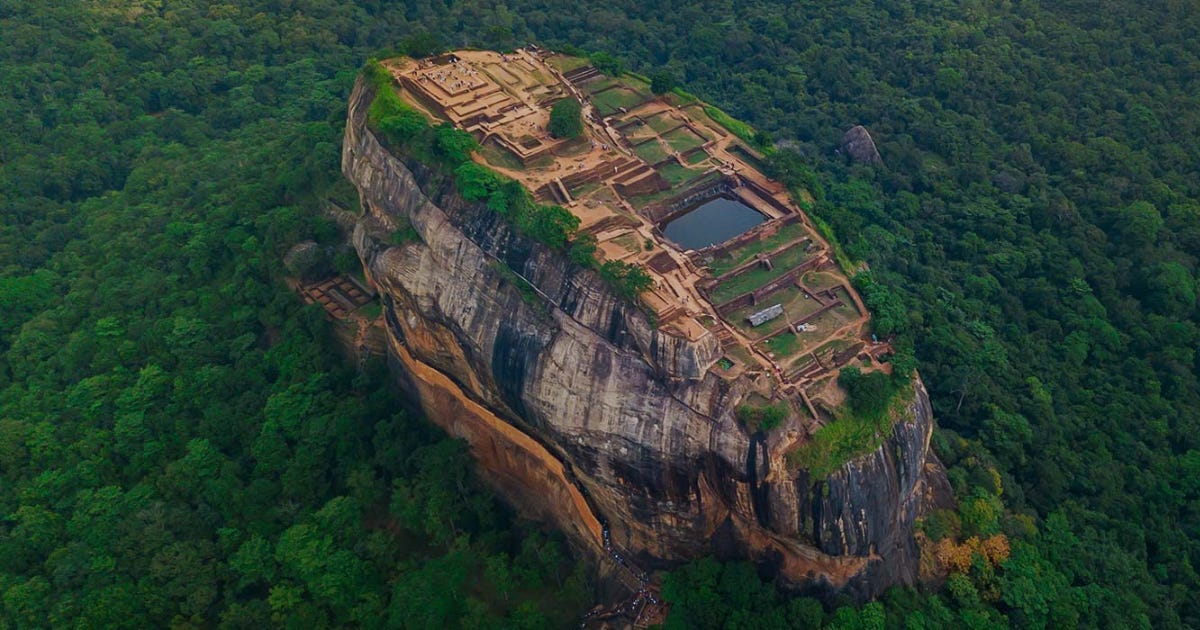
Sigiriya Rock Fortress. Image credit: Love Sri Lanka
The story begins with a family already soaked in blood. Kashyapa was the son of King Dhatusena of Anuradhapura, born to a consort of lower rank. The throne belonged by right to his half-brother Moggallana, son of the chief queen. But the army commander Migara carried a private grudge against the old king, and in Kashyapa he found a willing weapon. In 477 AD they seized the palace together. When the captive Dhatusena was ordered to reveal his hidden treasure, the old king led his son to Kala Wewa, the great reservoir he had spent his reign building, scooped up its water, and said this was all the wealth he possessed. Kashyapa had him walled up alive.
Sigiriya Rock Fortress. Image credit: Sigiriya Rock Jungles
Moggallana, the rightful heir, escaped to South India swearing revenge. So Kashyapa built the perfect refuge, a palace in the sky at Sigiriya. Symmetrical water gardens spread out below, fed by hydraulic channels so precise that some fountains still run in the rainy season, fifteen centuries later. Halfway up the rock face, painters covered the stone with frescoes of celestial women. Beside them ran the Mirror Wall, plastered and polished until a king could watch his own reflection as he climbed. At the top of the stairway crouched a colossal lion carved from the rock itself, its open mouth the only way in. The chronicles say Kashyapa lived up there like Kuvera, the god of wealth, in his mythical palace of Alakamanda.
In 495 AD, Moggallana returned with his army. And here is the twist the fortress never planned for. Kashyapa came down to fight in the open plain. Mid-battle, his war elephant swerved to avoid a stretch of marsh, his troops read the turn as retreat and fled, and the abandoned king drew his dagger and cut his own throat. The chronicle adds one last detail. He raised the blade high, sheathed it, and only then fell.
Moggallana took the throne, moved the capital back to Anuradhapura, and handed the rock to Buddhist monks. The palace in the sky became a quiet monastery, then a ruin, then a legend swallowed by jungle until archaeologists cut their way back to it in the nineteenth century.
The impregnable fortress was never taken. Its builder simply stepped outside.
Paranoia built the walls. Pride walked out of them.
Thanks for reading. Support Independent Ancient Content. Your support helps me create more archaeology posts, articles, and mini history videos:
Sources for further reading:
Culavamsa (chapters 38–39), the Pali chronicle that records Dhatusena’s murder, Kashyapa’s reign, and the battle of 495 AD. Wilhelm Geiger’s English translation (1929) is the standard edition and is available online through archive.org.
Scholarly works
Senake Bandaranayake, Sigiriya: City, Palace, Gardens, Monasteries, Painting (2005). Bandaranayake led excavations at the site for decades and this is the most authoritative single volume.
Senani Ponnamperuma, The Story of Sigiriya (2013). Accessible but well-researched account covering the history, the frescoes, and the graffiti on the Mirror Wall.
R.H. de Silva, Sigiriya (Department of Archaeology, Sri Lanka). Older official monograph, useful for the excavation history.


