


The National Museum of Denmark calls it a folding chair, and so does the archaeological literature, though it has no back and an English speaker would probably say stool. It is made of ash, its frames are carved with patterns inlaid in black pitch, and the seat was otter skin, of which one fragment survives.
It is the only completely preserved chair of any kind from Bronze Age Europe.
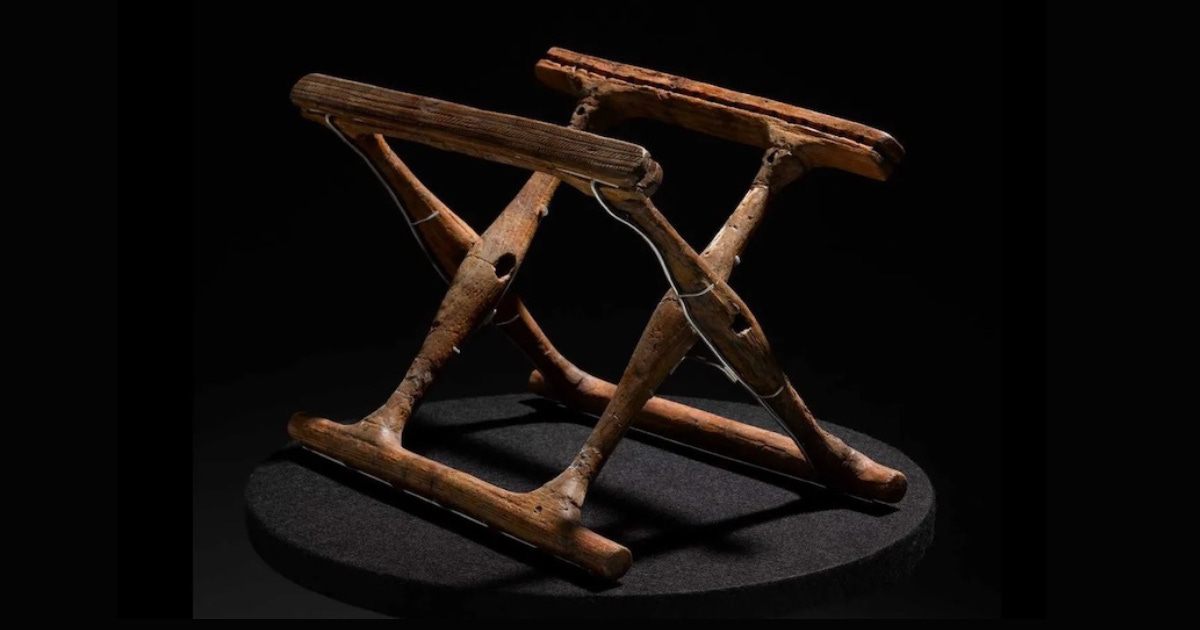
The Guldhøj folding chair, made in Denmark around 1389 BC and the only complete example from Bronze Age Europe. Credit: National Museum of Denmark
It was lying at a man’s feet in an oak coffin
Guldhøj, Gold Hill, is a large barrow near Vamdrup in southern Jutland. It was excavated in 1891, under Vilhelm Boye, and held three Bronze Age oak coffins.
One belonged to an adult and had been robbed. One held a child, lined with black goatskin, and by the time it was opened the body had gone to what the excavator called a reddish gruel. With the child were fragments of woven clothing, an arrow shaft and two dried apples.
The third held a man, and the chair was at his feet. His coffin has been dendrochronologically dated to 1389 BC. He wore woven wool and there are fragments of two round-crowned hats. Buried with him were a bronze dagger in a wooden scabbard, a bronze axe, a bronze brooch, two wooden vessels, one studded with tin tacks, a bark bucket and a spoon of horn.
Kirsten Prangsgaard’s 1999 study set out the construction. Two frames, each around thirty-three centimetres high, opening to forty-five degrees to give a seat about twenty-four centimetres from the ground. Bronze rivets probably held it together at first, and appear to have been taken out before it was buried.
Almost nothing organic survives from this period and then there are the oak coffins
Several hundred Danish Bronze Age graves have been dug. In nearly all of them the wood and the cloth are long gone.
Roughly twenty are different, and they are the reason this object exists. Hollowed oak trunks, sealed inside mounds where the conditions turned waterlogged and airless, preserved organic material that would have vanished anywhere else. The group includes the Egtved Girl, buried in 1370 BC with her string skirt, along with Muldbjerg Man, Skrydstrup Woman, Trindhøj and Borum Eshøj. Bones frequently dissolved in the acid while hair, skin and textile came through.
Tutankhamun had one made of ebony and ivory
Folding chairs of this form were used across the Mediterranean in the city and palace cultures of the fifteenth to thirteenth centuries BC, and turn up as grave goods in the richest burials. One stood in Tutankhamun’s tomb, made of ebony and ivory with gold fittings. He died in 1327 BC. Another survives from Thebes, dated to around 1400 BC.
Folding chairs appear in northern Europe from roughly the same moment, around 1400 BC.
The museum’s position on what that means is precise and worth quoting the shape of. The chair itself did not travel from the Mediterranean to Denmark. The design did. Guldhøj is a domestic product made after a distant model.
In both places the object marked the rank of whoever sat on it during ceremonies. Prangsgaard and colleagues observe that in Scandinavia the chairs seem to belong specifically to the warrior graves of the Early Bronze Age. Guldhøj is not the only northern example, only the complete one. Fragments have come from Store Høj in western Jutland and from sites in Sweden and northern Germany.
Two Danish designers have put it back into production
In 1934 Ole Wanscher made a version, the PJ-2000, working from the Egyptian folding chair rather than the Danish one.
Later, Poul Hundevad produced his Guldhøj stool from the Bronze Age design, changing very little. He worked in Vamdrup, the town the barrow sits beside. It became the piece he was known for, and it still trades second-hand in oak and leather, filed under mid-century Danish modern.
The original is in Room 9 of the National Museum in Copenhagen.
Thanks for reading. A note to readers: Ancient Content is written and researched independently, and paid subscribers are what keep it that way. If these pieces are worth your time, consider subscribing. For a few dollars a month you get
A researched piece every day, checked against the primary sources
Short documentaries, and the full video archive
The complete written archive
Notes on what the coverage gets wrong, and why.
Sources: National Museum of Denmark, on the folding chair from Guldhøj, the graves from Guldhøj, the chair as status symbol, and design through the ages. Prangsgaard, K., et al. (1999). Live Science, 7 September 2026.
My first thought when I saw the photo was the one from KV62. This is really fascinating stuff. To be back there and see the exchange of goods and ideas would be amazing
Contact between any number of seafaring peoples may account for the commonality of design, across regions, even those that are far from one another.