


Two intact burials have now been excavated at Göbeklitepe, the first from the site in thirty years of digging. Julia Gresky and Lee Clare of the German Archaeological Institute argue in PLOS ONE that they explain something that has puzzled everyone working there.
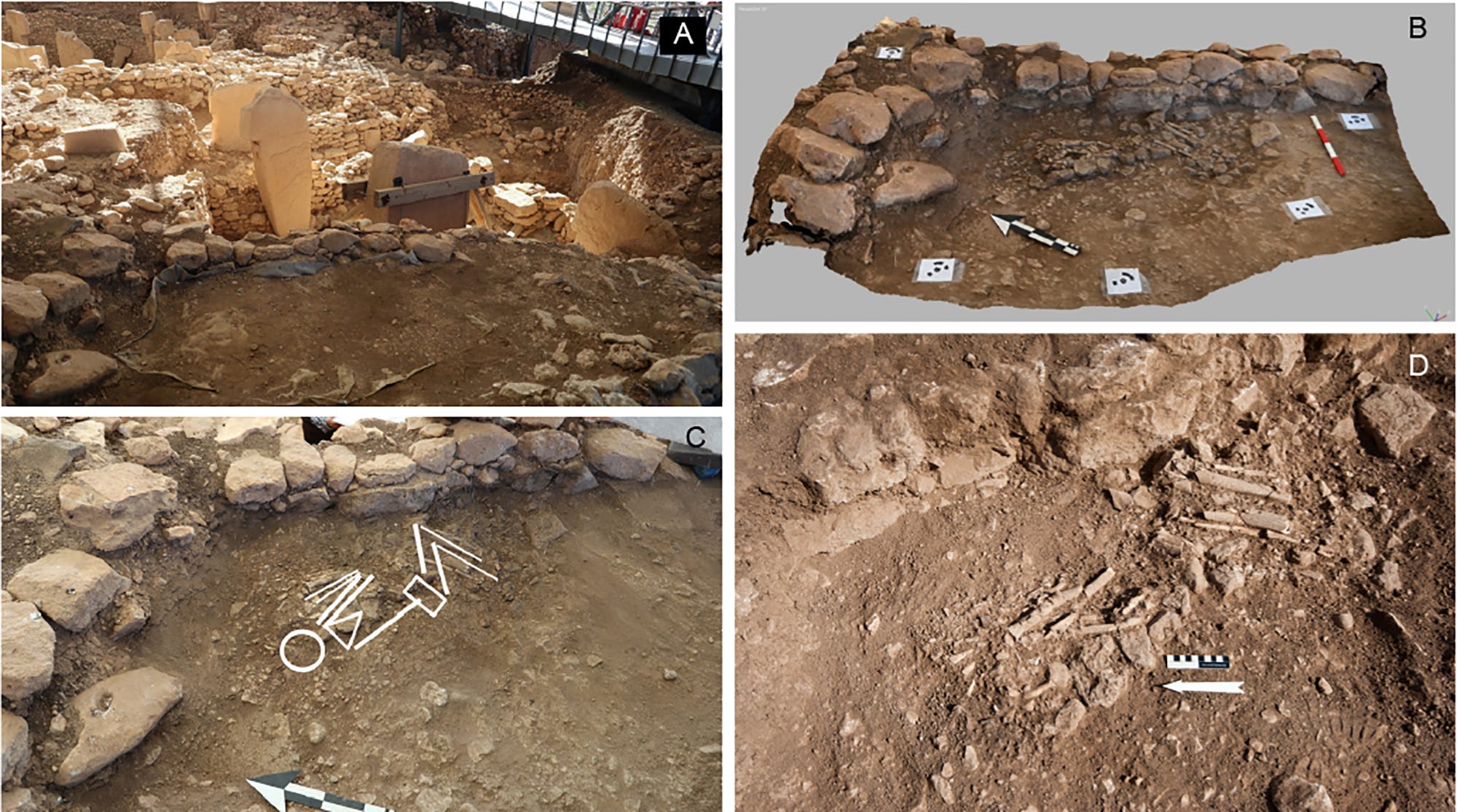
The single burial in trench L09-65, beside Special Building A at Göbeklitepe. The white lines in panel C reconstruct the position of the body, flexed on its left side facing east. Credit: Gresky and Clare, PLOS ONE 2026, CC BY. Photographs J. Gresky, orthophoto B. Waszk, German Archaeological Institute.
Nine hundred and twenty-eight bone fragments with no context
Since excavation began in 1995, human bone has been coming out of Göbeklitepe in pieces. The assemblage now runs to 928 fragments, mostly unrelated to one another, from males and females of every age.
They turn up in the fill of the monumental buildings and in the soil between the structures, scattered across three thousand square meters of the main excavation area and through every stratigraphic layer to a depth of several meters. Most were found singly. None could be assigned reliably to individuals.
Cranial fragments outnumber postcranial ones, 408 against 283.
Two explanations, one of them attractive
The first is that somebody put them there. Secondary and tertiary burial practices are well documented across Neolithic eastern Anatolia, and Göbeklitepe already has evidence of deliberate treatment of the dead. Gresky’s 2017 work identified deep incisions running along the midline of crania, now recognised on five individuals, which she and colleagues described as a previously unknown form of skull cult.
The iconography points the same way. Pillar 43 in Special Building D carries a headless human figure. Stone heads have been found detached from statues. Sculptures from Nevalı Çori and Karahantepe show animals and birds gripping human heads. Corvids, which scavenge, appear in the animal bone at Göbeklitepe at four times the frequency recorded at other sites of the period, which has been read as a possible trace of excarnation in the open.
The neighbours reinforce it. At Sefertepe a skull was set into the floor plaster of a niche, and a small cell now called the skull chamber held at least twenty-one skulls placed on their bases with nearly all facing southeast. Çayönü Tepesi has its Skull Building, with around seventy skulls in its later phases. At Karahantepe some seventy fragments show cutting, incising, scraping and burning. At Sayburç, crania and long bones from at least nineteen individuals were found on and in front of a stone bench in a dwelling, some burnt.
The second explanation is duller. Burials placed under house floors higher up the mound slid downhill and ended up in the fill.
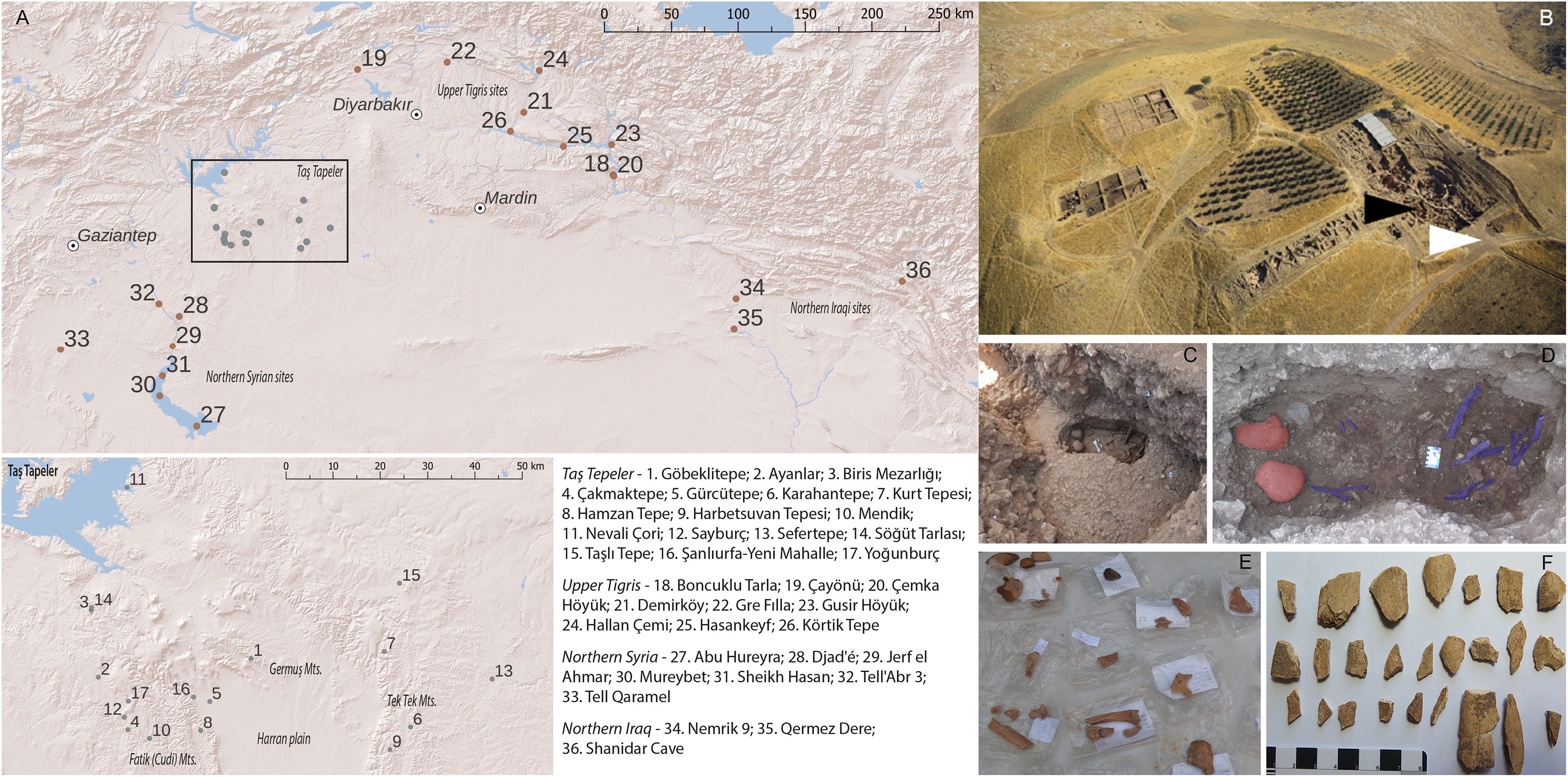
The site and the two burials, with the collective grave in panels C and D and the scattered bone fragments from the building fill in panels E and F. Credit: Gresky and Clare, PLOS ONE 2026, CC BY. Photographs E. Küçük, C. Lelek-Tvetmarken and J. Gresky, German Archaeological Institute, Göbeklitepe Research Project.
What the two burials look like
The first came to light in 2017 during construction of a drainage channel for the shelter that now covers the main excavation area. A kidney-shaped pit had been cut through the plaster floor of a rectangular building, and it held at least three people and possibly four.
Almost nothing remained in place. The crania had been gathered in the southeastern corner, the postcranial bones piled toward the centre, some long bones laid along the western wall. Only the lower part of one left arm survived in anatomical position, resting on an older plaster floor beneath.
The three are a woman of at least thirty-five, a man of twenty to thirty, and a girl of eleven to fourteen. Gresky and Clare read the arrangement as sequential use. Complete bodies went in, were pushed aside to make room for the next, and were tidied once more before the grave was closed. The presence of hand and foot bones shows whole bodies rather than prepared remains, and no cut marks appear anywhere.
The second burial was found in 2012, sealed again for want of time, and excavated in 2022. It lay against the eastern wall of a small space immediately west of Special Building A. A young woman had been placed flexed on her left side, facing east, on a layer of fist-sized stones with no cut pit around her.
The fragmentation happened in the ground
This is the part that settles the argument, and it turns on unglamorous evidence.
Both burials show the same alterations found across the scattered assemblage. Heavy postmortem fragmentation, with the ends of the long bones broken off and missing. Calcareous deposits covering most surfaces, which in this soil penetrate the bone and crack it apart, and which affect large bones worst. Rodent gnawing. Serrated fracture edges from soil pressure.
Because the second burial is a clear primary inhumation that was never moved, those changes must have occurred inside the grave. The breakage is not somebody smashing bones.
That similarity supports the erosion reading. Buildings higher on the mound held subfloor burials, slope slides carried the deposits down into the hollows where the special buildings sit, and the bones arrived mixed and broken. An uneven scatter across three thousand square metres is what that process produces.
The distribution argues against deliberate placement on its own terms. Anyone depositing selected bones would concentrate them somewhere, and skull fragments at Göbeklitepe are mixed with postcranial bone from both sexes and every age group.
The temple reading keeps receding
Göbeklitepe spent two decades being described as a ritual centre without significant permanent occupation, largely following Klaus Schmidt. That interpretation has been under revision for years as evidence for dwellings and domestic activity accumulated throughout the sequence.
Burials under house floors are ordinary practice across the Pre-Pottery Neolithic in Anatolia and the Levant, and finding them here is another mark in the domestic column. Gresky and Clare say as much directly.
What stays open
The paper does not claim erosion accounts for everything, and the authors are careful about it.
The incised crania remain unexplained by slope movement, and they cannot yet be assigned to the earlier or later phase of the site. The corvid numbers are still unusual. The practices at Sefertepe, Karahantepe, Sayburç and Çayönü are real and nearby.
What has changed is the default. The scattered bone no longer needs a ritual explanation, because a geological one now fits the evidence. Anything else at Göbeklitepe has to be argued for on its own.
Just incredible!
Thirty years of digging, 928 random pieces of people, and FINALLY they find two burials. I love archaeology!
And after all the theories about what happened to those bones, I love that at least part of the answer may simply be: they slid downhill.
Although I'm very happy the weird skull business is still weird. I don't want everything explained away!