


Among the tablets recovered from the Library of Ashurbanipal at Nineveh is a single treatise devoted entirely to ailments of the ear. It belongs to a much larger compilation that scholars now call the Nineveh Medical Encyclopaedia, assembled in the seventh century BC, and it sits within a body of Mesopotamian medical writing in which noises heard inside the head were understood as the work of the dead.
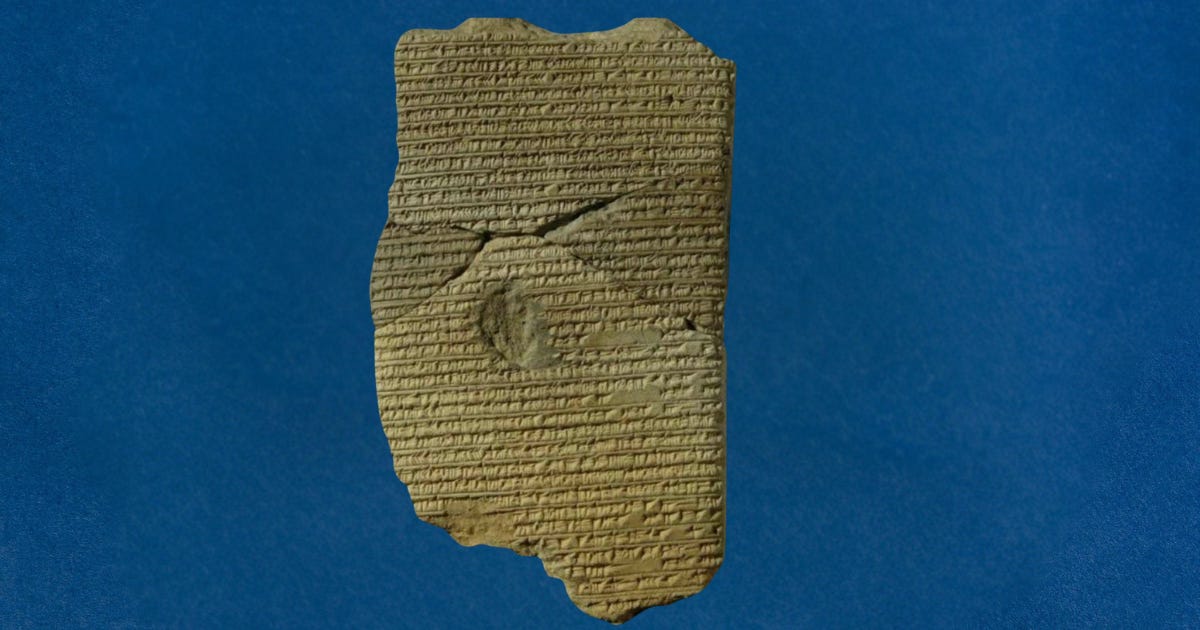
A library and a medical handbook
Ashurbanipal ruled Assyria from 669 to around 631 BC and set out to collect all knowledge in one place. He commissioned specialists to gather medical texts from across the empire and bring them to Nineveh, where scribes compiled them into a single structured work.
The result is the earliest known systematized handbook of therapeutic medicine. The British Museum describes it as the most standardized and structured collection of medical literature anywhere before Galen, who wrote in the second century AD. Each tablet ran to at least 250 lines, and the whole came to more than 10,000.
Its organisation is anatomical and moves down the body. The opening section covers diseases of the head across five tablets, treating the scalp, eyes, ears and nose in general terms. Then come treatises on individual parts in detail, four tablets for the eyes, six for the neck, two for the teeth, one each for the nose and the ears. After the head the Encyclopaedia works through the torso, the legs and the feet.
Nineveh burned in about 612 BC. Fire destroys papyrus but bakes clay, which is why these tablets are among the best preserved documents to survive from Mesopotamia. The library was excavated in stages between 1851 and 1932 and produced more than 30,000 tablets and fragments, of which roughly 660 medical tablets are now in the British Museum.
Ringing, whispering, roaring
Babylonian and Assyrian tablets record noises in the ear using terms translated as ringing, whispering and roaring. A review published in the Journal of Neurology in February 2026, surveying descriptions of tinnitus across ancient Egypt, Mesopotamia, India, Greece, Rome and China, notes that these references are common and that they were frequently understood as evidence of interference by the dead.
The mechanism invoked was the hand of a ghost. In Akkadian medical texts a wide range of conditions were attributed to this cause, and treatments varied while the underlying diagnosis stayed the same. Reginald Campbell Thompson published a set of these prescriptions in the Journal of the Royal Asiatic Society in 1929 under exactly that title.
JoAnn Scurlock and Burton Andersen, whose Diagnoses in Assyrian and Babylonian Medicine remains the standard reference, point out that the reasoning was consistent with how strange noises were treated outside medicine as well. Unexplained sounds in a house were held to come from ghosts. A sound heard by a patient with no external source fell into the same category.
Whether the specific ear treatise in the Encyclopaedia frames its cases this way is a separate question from whether the association existed in Assyrian medicine generally. The association is well documented. Reading it onto any single tablet requires the text.
Prescription and ritual together
The Encyclopaedia does not separate what a modern reader would call medicine from what a modern reader would call magic. Therapeutic prescriptions and ritual elements appear together in the same texts, and the compilation is now cited in arguments against treating the two as opposed categories in Mesopotamian practice.
Assyrian healing involved two distinct professions, the asû, who prepared and administered drugs, and the āšipu, who dealt with the causes of illness through incantation and ritual. Their work overlapped rather than competed. A prescription of oils, plants and minerals poured into the ear canal and an incantation addressed to the ghost responsible were part of the same treatment.
How the texts reached print
Campbell Thompson published the medical tablets from Ashurbanipal’s library in facsimile in 1923 as Assyrian Medical Texts. Franz Köcher produced six volumes between 1963 and 1980 under the title Die babylonisch-assyrische Medizin in Texten und Untersuchungen, the first four covering material from sites other than Nineveh and the last two adding new joins of broken fragments and further Nineveh material.
The British Museum’s own project, Introducing Assyrian Medicine, has since reconstructed the Encyclopedia and translated it into English, which for the first time makes the corpus accessible outside a small circle of specialists.
Thanks for reading. Support Independent Ancient Content. Your support helps me create more archaeology posts, articles, and mini history videos:
Sources: British Museum, Reconstructing a 2,500 Year Old Medical Encyclopaedia, and Ancient Healthcare Fit for a King. Huppert, D., Gerb, J., and Filippopulos, F. (2026). "Tinnitus, Well Known in Antiquity, Highly Relevant Today." Journal of Neurology 273, article 142. Scurlock, J.A., and Andersen, B. (2005). Diagnoses in Assyrian and Babylonian Medicine. University of Illinois Press. Thompson, R.C. (1929). "Assyrian Prescriptions for the Hand of a Ghost." Journal of the Royal Asiatic Society. Thompson, R.C. (1923). Assyrian Medical Texts. Köcher, F. (1963 to 1980). Die babylonisch-assyrische Medizin in Texten und Untersuchungen.
Who knew tinnitus has been around that long. It would be interesting to compare these old text with what we know today
I wonder if this is why my mother would pour warm olive oil in my ears when I was a kid & secure with a small cotton ball to prevent leakage? I grew up with several old school remedies which worked & I still practice today.