


For nearly as long as researchers have studied ancient DNA, they’ve gone looking for it in the obvious places: bones, teeth, soil, and the odd worked artifact pulled from a dig site.
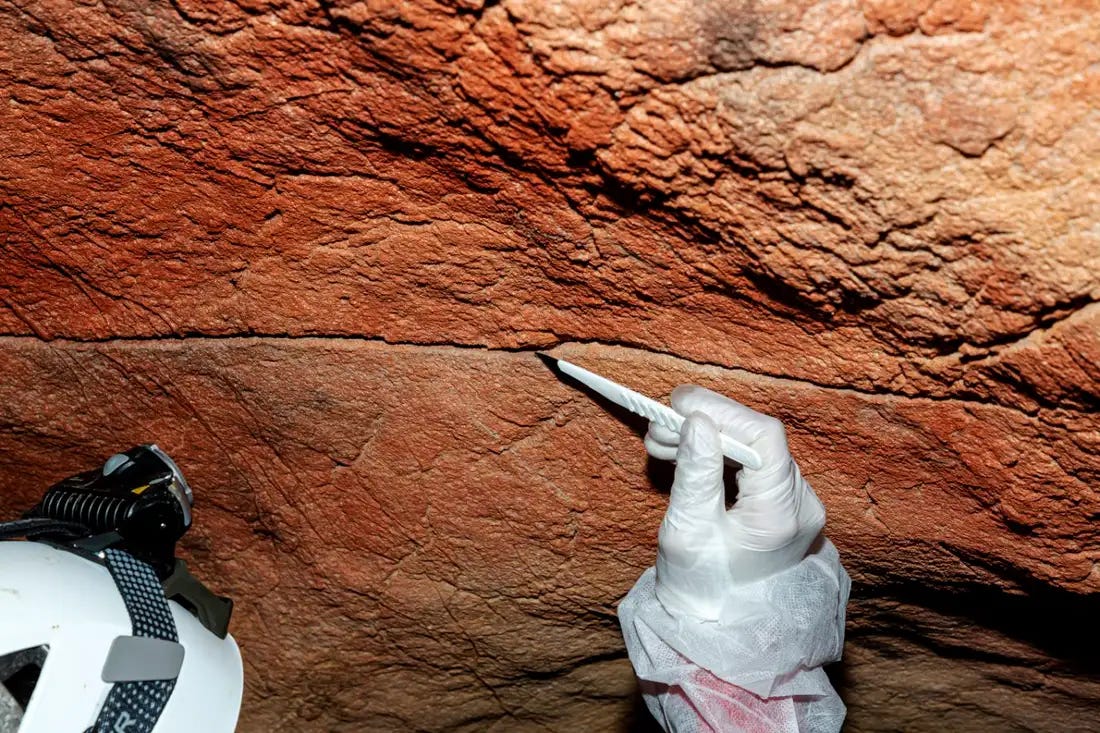
A sample is collected from a rock art figure in Tebellín, Spain. Credit: ABAMIA ARKEOS-ALBERTO MARTÍNEZ VILLA
A new study flips that assumption on its head by showing that the walls of painted caves themselves can hold onto traces of the people who once stood in front of them — sometimes for thousands of years.
A genetic survey of Ice Age art
The research, published on June 23 in the journal Nature Communications, was carried out by an international team working under the banner of the First Art project, a collaboration centered on dating Europe’s oldest cave paintings and figuring out what they’re made of. Researchers from Spain, Portugal, the United Kingdom, China, and Germany contributed to the work, with the genetic analysis led by Alba Bossoms Mesa of the Max Planck Institute for Evolutionary Anthropology in Leipzig.
The team didn’t limit itself to one site. They examined material from 24 separate rock art panels spread across 11 caves on the Iberian Peninsula, sampling everything from simple painted marks and hand stencils to loose pigment that had flaked off some of the famous figurative artwork at Altamira. For comparison, they also swabbed nearby stretches of bare cave wall that had never been painted at all.
Working with sterile scalpels and double gloves to avoid contaminating the samples with their own DNA, the researchers wanted to find out whether the simple act of touching a wall thousands of years ago could leave a genetic fingerprint behind. As project organizer Hipólito Collado Giraldo, an archaeologist with the Extremadura regional government in Spain, put it: given how sensitive modern ancient-DNA techniques have become, the team suspected that even brief contact with a wall might leave something detectable — potentially genetic information about the very people who made the art.
A red dot with a secret
Out of all 24 painted panels, only one delivered. It came from a small, otherwise unremarkable red dot in Escoural Cave, Portugal, cataloged as “Panel 11.” What made that sample special wasn’t the pigment itself, but a thin coating of calcite — a mineral that slowly crystallizes out of dripping cave water — that had sealed over the paint like an insect trapped in amber, shielding it from later contamination.
Beneath that mineral seal, the team recovered genetic material from a Homo sapiens individual who lived at least 4,000 to 5,000 years ago, likely older still. Notably, the sample contained human DNA but no detectable animal DNA, hinting that it was deposited through direct contact with the wall rather than carried in on dirt or sediment.
Two more unpainted samples from the same general area also turned up ancient human DNA — one from a male, one from a female, both apparently from a similar time period. That second finding mattered because it suggested the artists weren’t the only ones leaving genetic traces behind — anyone who touched the walls could have, whether or not they were painting at the time.
Other samples, taken from Covarón Cave in northern Spain, told a messier story. There, human DNA showed up mixed with genetic material from wild cats, rabbits, and various large herbivores — a combination the researchers attribute to sediment that people likely tracked in on their hands and feet as they moved through the cave. Genetic analysis tied this human DNA to ancient Western hunter-gatherer populations that lived in Europe thousands of years ago.
The rule, not the exception, is finding nothing
It’s worth being upfront about the odds here: this kind of discovery is rare. Out of the 24 panels tested, ancient DNA turned up in just one, plus two nearby unpainted spots. The researchers think this scarcity reflects how seldom painted surfaces hold onto enough genetic material to survive millennia, especially when they aren’t protected by a mineral crust or sealed off from the environment in some other way. As Bossoms Mesa noted, preservation of human DNA on cave walls varies enormously — but on the rare occasions it does survive, it can tell a remarkably detailed story.
The team also tried a different angle at Altamira, testing a bird bone that may once have been used as a blowpipe for applying pigment to the cave’s famous polychrome ceiling. No ancient DNA turned up on it.
What it doesn’t prove — and what it opens up
It’s important not to overstate the result. Finding human DNA near a painting doesn’t prove that DNA belonged to whoever painted it — people could have touched a wall long after the art was made, or for reasons unrelated to art at all. What the study does establish is more modest but still significant: cave walls can act as an unexpected genetic archive, preserving evidence of human presence in places where bones, tools, and sediment layers are absent or have already been picked clean by previous excavations.
Senior author Matthias Meyer, also of the Max Planck Institute, framed the implications broadly: “This study fundamentally changes how we think about where ancient DNA can be found. We were surprised to see that ancient DNA can be recovered not only from pigmented samples, but also from cave walls that show no visible evidence of past human activity. We can now ask new questions.”
That’s the real headline here — not a single red dot in a Portuguese cave, but a new tool for archaeologists. If a smear of paint or a bare patch of limestone can hold a genetic record going back thousands of years, then caves that have already been studied for decades might still have stories left to tell, written not in bone, but in rock.
Source: Bossoms Mesa et al., Nature Communications (2026); press materials from the Max Planck Institute for Evolutionary Anthropology.