


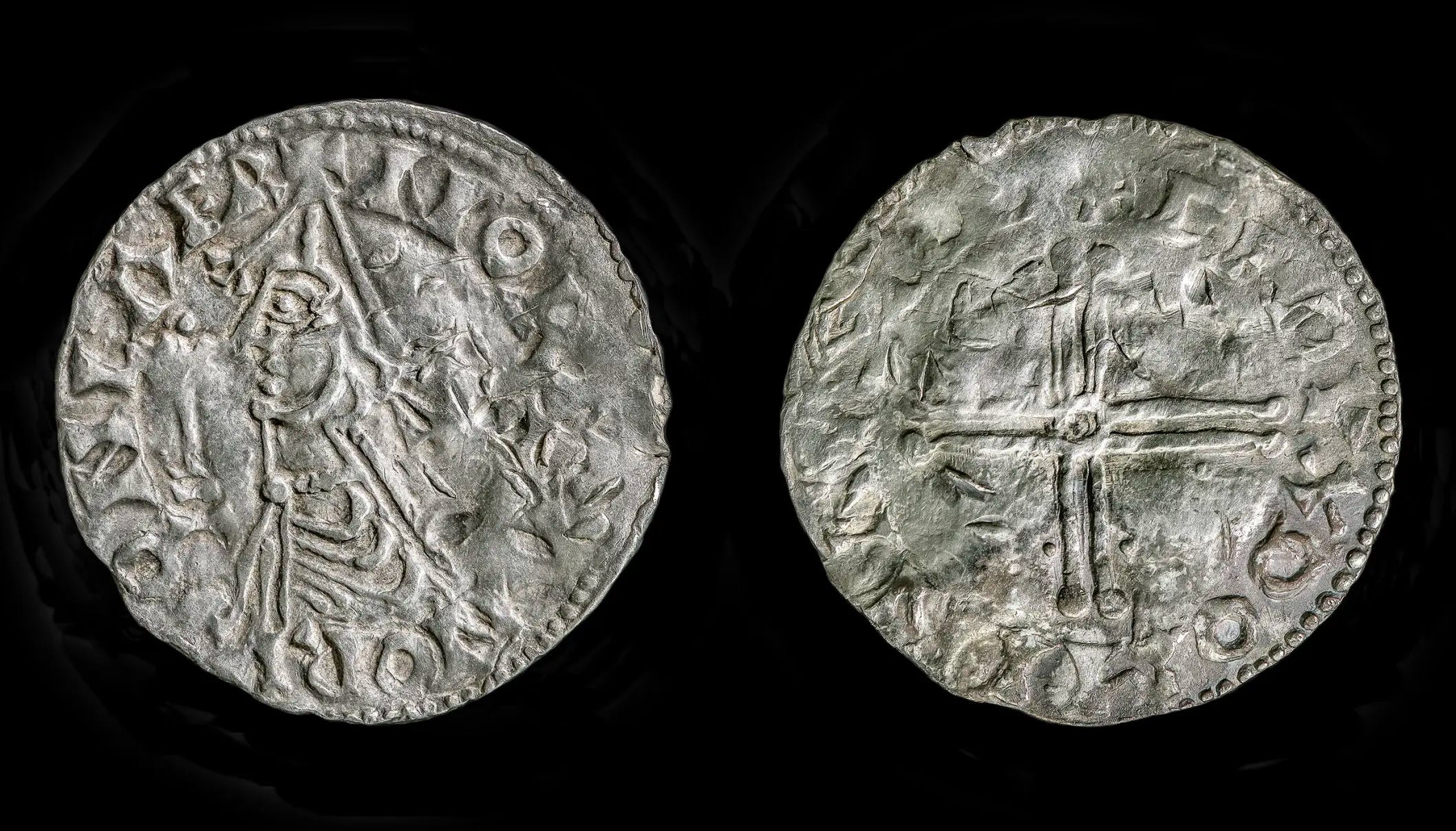
Anne Skogsfjord had already sorted the coin. It sat with the English coins struck for Æthelred II. Then she read the lettering around the king’s head. It said ONLAF R+ NORMANORV, which means Olaf, king of the Norwegians.
The penny belongs to the Mørstad Hoard, the largest Viking Age coin hoard ever found in Norway. The Museum of Cultural History in Oslo announced the identification on 9 October 2026. Skogsfjord said she realised in that moment that “we had found a national treasure,” and ran to tell a colleague.
She was working in an office at St. Olavs gate 29 in Oslo. She noted with some amusement that Olaf Haraldsson died on 29 July.
Olaf, King of the Norwegians
Olaf Haraldsson ruled Norway from 1015 to 1028, played a central part in bringing Christianity to the country, and after his death at the Battle of Stiklestad became Norway’s patron saint. Fewer than twenty of his coins survive. Most of them were found outside Norway.
This penny was struck between about 1024 and 1028. The king faces left in a pointed battle helmet, the feature that gives the type its nickname, the “Pointed Helmet.” The reverse carries a cross and a Christian acclamation. On this specimen the reverse lettering is worn. Other coins struck from the same die give the full legend as +CE DVX DOMINNVS MEI. Translations differ slightly, but all of them address a leader and lord.
Three different issues of Olaf’s pennies are known. All of them copy Anglo-Saxon pennies struck for Cnut the Great between about 1024 and 1030. Cnut was the rival who drove Olaf out of Norway in 1028, so Olaf issued coins modelled on the money of the man about to take his kingdom.
According to Professor Svein H. Gullbekk, the coin was probably struck at Nidarnes in Trondheim, close to where Nidaros Cathedral stands today. Gullbekk believes Olaf decided the design himself and may have been present when the coins were made. He sees the coin as a statement of the new faith and of Olaf’s claim to be a Christian king of European standing. In his words, “This is branding.”
Skogsfjord made the same point in more modern terms. She compared the coin to the Instagram of its day. Most people never saw the king, but they did handle his coins.
Jon Anders Risvaag, a numismatist at NTNU, explains that the coins of Olaf Haraldsson and Olaf Tryggvason were made in small numbers to display royal status rather than to serve everyday trade. He likened finding one to finding a needle in a haystack.
The church floor at Stein in 1924
The headline phrase “first since 1924” points back to a farm in Ringerike. The medieval church ruin at Stein, in Hole municipality, was restored in 1924 under the architect Gerhard Fischer. Repairs to the stone floor of the nave exposed a layer of topsoil under the slabs, and a coin hoard lay in that soil. Kolbjørn Skaare dated its burial to after 1023 and not much later than 1030.
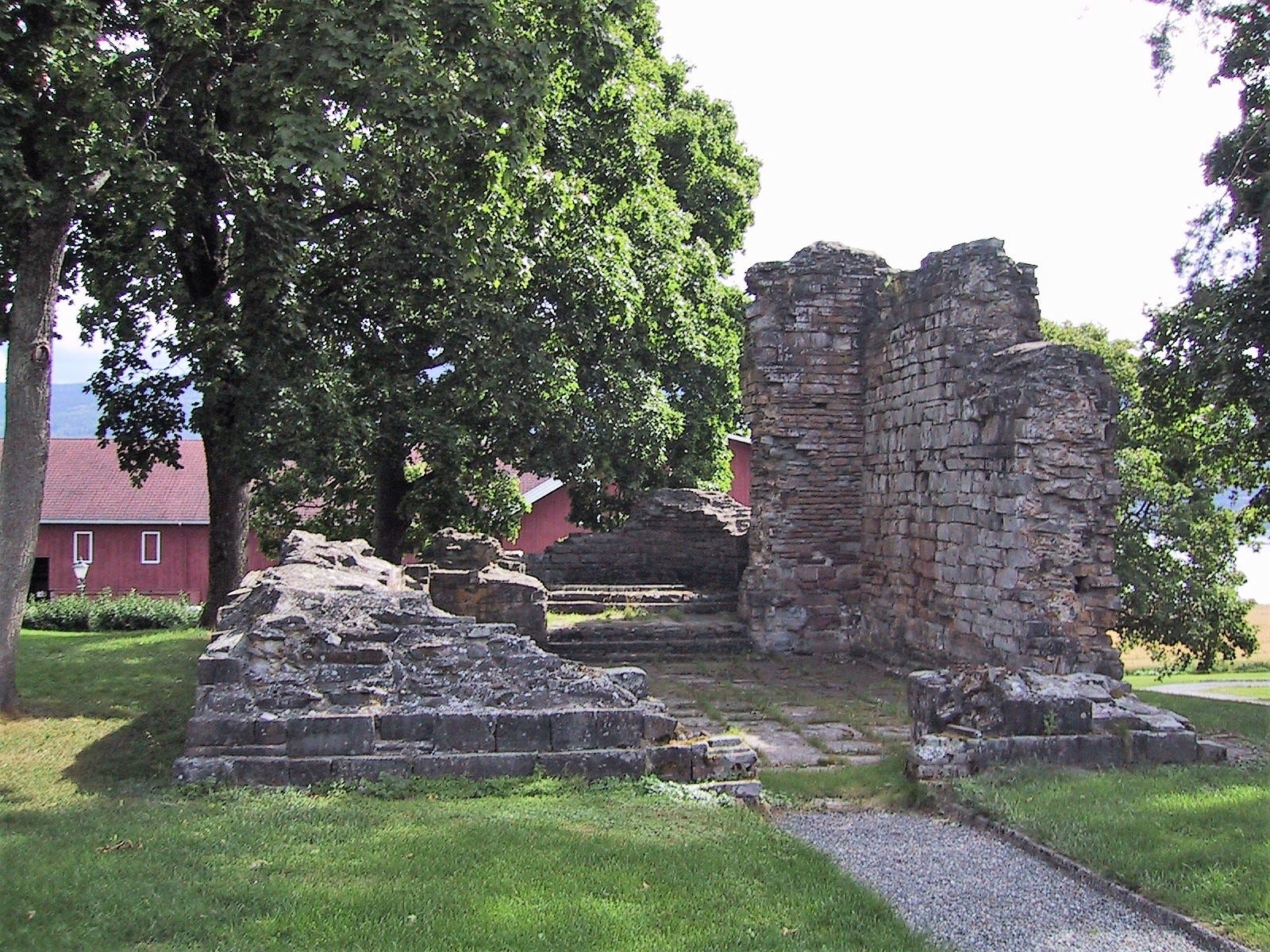
The hoard held Norwegian, English and German pennies. Its three Norwegian coins are all attributed to Olaf Haraldsson. Skaare’s catalogue counts 55 coins, while some local accounts give 63.
One of those Stein coins is the only other example of the Pointed Helmet type found in Norway. Of the four examples known before Mørstad, three are reported to be in Sweden. The Rena coin is the fifth.
Knife cuts and a quarter century of trade
The Mørstad specimen is well preserved, so researchers can study the details of its design. It also bears marks of use. Small knife cuts on both faces show people testing the silver during payments. The coin probably changed hands many times over the 20 to 25 years between its striking and its burial.
A field at Rena and more than 5,500 coins
Metal detectorists Vegard Sørlie and Rune Sætre found the hoard on 10 April 2026 at Rena in Innlandet county. They called in archaeologists after recovering 19 silver coins. Within a week the search had produced more than 3,000. The land at Mørstad belongs to Ole Erik Hørstad, who is also the mayor of Åmot municipality.

By the summer break the count stood at 4,886, and Hørstad sowed his grain. Searching resumed after the harvest, and in late September he and the two detectorists dug up coin number 5,000, an Otto-Adelheid penny. By 9 October the hoard held just over 5,500 coins. Florent Audy, who leads the museum’s cataloguing, expects the final total to pass 6,000. The previous Norwegian record belonged to the Årstad hoard from Egersund, found between 1836 and 1843, with 1,849 coins.
The contents span much of the northern world. Coin number one is an English penny of Æthelred II minted around 985 to 991. Otto-Adelheid pennies from Germany are among the most common types, and one coin names Sigtrygg Silkbeard as king of Dublin. Some of the English coins carry Norse-sounding moneyers’ names such as Beorn, Aslac and Cetil, which has led Skogsfjord to wonder whether Scandinavians worked in English mints. The finds also include a fragment of a silver brooch cut as hacksilver, and a coin with traces of suspension showing it was once worn as jewellery.
Four Norwegian coins of Harald Hardrada date the burial to around 1046 or 1047, at the close of the Viking Age. Harald set up a Norwegian national coinage after returning from Byzantium around 1045. The hoard therefore contains coins from both the earliest Norwegian minting under Olaf and the start of Norway’s own currency under his half-brother.
Iron, silver and a hiding place by the river
Nobody yet knows who buried the hoard. Ground-penetrating radar found no trace of a Viking Age settlement in the field. Knut Paasche of NIKU concludes the silver was hidden away from where people lived. He also notes that the river floods quickly in spring, which would have made the spot an even better hiding place.
Archaeologist Kjetil Loftsgarden links the hoard to the region’s iron production. The valleys around Rena and Åmot hold many ironworking sites, and he suggests the farmer at Mørstad grew rich from iron. This remains an interpretation. Loftsgarden also observes that “you don’t forget where you buried almost 5,000 silver coins.” Whoever buried the hoard never came back for it.
On show in Oslo from 20 November
Norway’s Cultural Heritage Act automatically protects all traces of human activity from before the Reformation in 1537, so the Mørstad Hoard belongs to the public. It will be studied and displayed at the Museum of Cultural History. The Olaf penny goes on display at the Historical Museum in Oslo when an exhibition opens on 20 November, the first public showing of any part of the hoard.
Each coin takes the numismatists about an hour to catalogue. One coin is still missing from the wish list. Norway’s first silver coin was Olaf Tryggvason’s penny, struck in Nidaros between 995 and 998, and the specialists say a hoard like Mørstad could plausibly contain one.
Thanks for reading. Subscribe for a few dollars a month and get every long read, the short documentaries and the full archive. Cancel anytime.
Sources
Museum of Cultural History, University of Oslo. “Sensational discovery: First in Norway since 1924.” October 2026. https://www.khm.uio.no/english/news/sensational-discovery-first-in-norway-since-1924.html
Bergstrøm, Ida Irene. “Sensational coin discovery: ‘We have found a national treasure’.” ScienceNorway, 9 October 2026. https://www.sciencenorway.no/archaeology-culture-the-viking-age/sensational-coin-discovery-we-have-found-a-national-treasure/2721235
Bergstrøm, Ida Irene. “Record hoard from the Viking Age: Coin number 5,000 has now been dug up.” ScienceNorway, 1 October 2026. https://www.sciencenorway.no/archaeology-culture-viking-age/record-hoard-from-the-viking-age-coin-number-5000-has-now-been-dug-up/2716288
ScienceNorway. “You can now see the first 100 coins from the unique Viking hoard.” 2026. https://www.sciencenorway.no/viking-age-culture/you-can-now-see-the-first-100-coins-from-the-unique-viking-hoard/2703769
ScienceNorway. “Four coins make the Viking hoard in Norway truly unique.” May 2026. https://www.sciencenorway.no/archaeology-culture-the-viking-age/four-coins-make-the-viking-hoard-in-norway-truly-unique-very-exciting/2661206
ScienceNorway. “This may be why a Viking coin hoard was buried in such an unlikely place.” May 2026. https://www.sciencenorway.no/archaeology-culture-the-viking-age/this-may-be-why-a-viking-coin-hoard-was-buried-in-such-an-unlikely-place/2666213
Museum of Cultural History. “Enormous Viking Age coin hoard discovered.” 2026. https://www.khm.uio.no/english/news/enormous-viking-age-coin-hoard.html
Historisk museum. “Mørstadskatten. Norges største myntfunn fra vikingtiden” (exhibition page). https://www.historiskmuseum.no/utstillinger/morstadskatten/
Forskning.no. “Sensasjonelt myntfunn: Vi har funnet en nasjonalskatt.” October 2026. https://www.forskning.no/arkeologi-vikingtiden/sensasjonelt-myntfunn-vi-har-funnet-en-nasjonalskatt/2721172
NTB via Nettavisen and Sol.no, October 2026 (Gullbekk on the Trondheim mint, Skogsfjord’s office anecdote). https://www.nettavisen.no/nyheter/unik-olavsmynt-funnet-i-morstadskatten-kronjuvelen-i-ny-utstilling/s/80-95-144920 and https://sol.no/nyheter/fant-ekstremt-sjelden-mynt-fantastisk/85264511
Archaeology Magazine. “Coin Hoard Discovered in Norway.” 27 May 2026. https://archaeology.org/news/2026/05/27/coin-hoard-discovered-in-norway/
Radley, Dario. “Rare coin of Norway’s King Olaf Haraldsson found in the country’s largest Viking hoard.” Archaeology News, 10 October 2026. https://archaeologymag.com/2026/10/rare-coin-of-norways-king-olaf-haraldsson-in-viking-hoard/
The History Blog. “‘National treasure’ coin identified in Mørstad Hoard.” 11 October 2026. https://www.thehistoryblog.com/archives/77120
Norges kirker. “Stein kirkeruin.” https://norgeskirker.no/wiki/Stein_kirkeruin
Skaare, Kolbjørn. Coins and Coinage in Viking-Age Norway. Oslo, Universitetsforlaget, 1976. (Standard catalogue for the Stein hoard. No DOI.)
!
Viking history is one of my favorite topics. I need to get back to Oslo, would love to see this!