


Archaeologists in northern Israel have uncovered two exceptionally preserved marble busts dating to the Roman period, roughly 1,700 years ago. The discovery was made near Binyamina, close to Caesarea, during an Israel Antiquities Authority excavation carried out as part of a major railway infrastructure project.
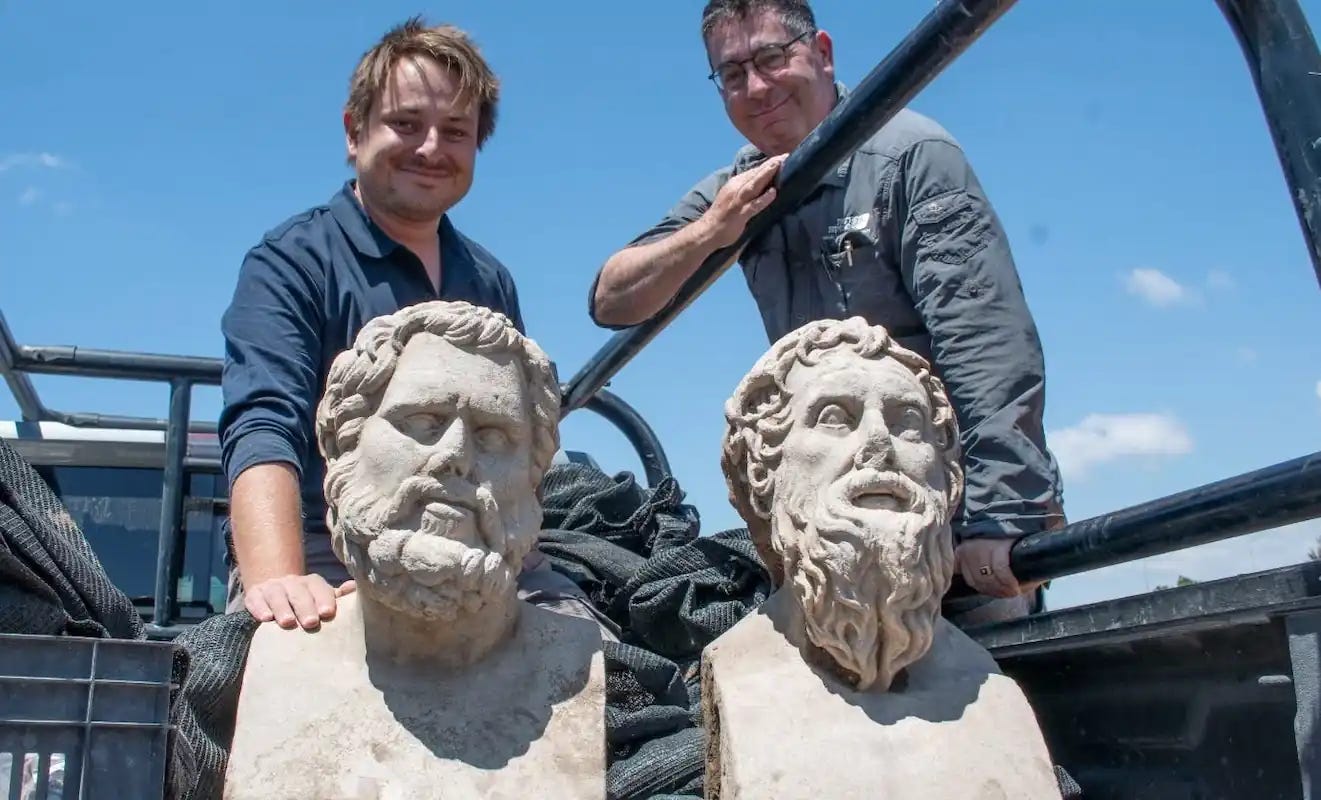
Roman Marble Busts Found in Ancient Winepress Near Caesarea. Image credit: Emil Aladjem, Israel Antiquities Authority
The statues were found in a surprising setting: inside the wine collection pit of a Roman-Byzantine winepress. Their placement has raised new questions about how elite Roman artworks were displayed, moved, hidden, and preserved in the region around ancient Caesarea.
A discovery during modern infrastructure work
The excavation took place ahead of construction connected with Israel’s National Infrastructure Plan 65, a transportation project led by the Ministry of Transportation and Israel Railways. The project is linked to the expansion of the coastal railway and is intended to shorten travel time between Haifa and Tel Aviv.
As often happens in Israel, modern development work brought archaeologists face to face with remains from the ancient past. At the entrance to Binyamina, the excavation team exposed an ancient winepress dating to the Roman-Byzantine period. While working in the installation, they noticed something unusual emerging from the soil.
Michael Sorotskin, an archaeologist with the Israel Antiquities Authority, said the object first appeared during the excavation of the winepress. At first, workers expected the usual material found at such sites, such as pottery fragments. Instead, the exposed surface turned out to be marble. As the excavation continued, two sculpted busts slowly came into view.
The discovery was unexpected because marble sculpture is rare in this kind of archaeological context. Winepresses usually produce industrial remains connected with production, storage, and daily work. These busts belonged to a different world: elite architecture, education, wealth, and Greco-Roman cultural identity.
Two marble protomes from the Roman world
The sculptures are described as protomes, a term used for representations of the head and upper torso. These were common in the Roman world, where such works could decorate public buildings, villas, bathhouses, gardens, or columned architectural settings.
The two Binyamina busts depict historical or cultural figures from the Greco-Roman world. They were carved from marble, a costly imported material in the region. Their quality and preservation suggest that they once belonged to a wealthy architectural setting, rather than an ordinary rural installation.
Both statues were found face down inside the collection pit of the winepress. Archaeologists believe they were deliberately placed there after the winepress had gone out of use. Their careful position suggests intentional burial, perhaps as an effort to protect them. The reason remains unresolved.
The find is especially important because comparable portrait sculptures from the Caesarea region are rare. According to the excavation team, the last similar portrait figure from the area was discovered in the 1990s.
The name “Lycurgus” on one bust
One of the busts preserves a Greek inscription with the name “Lycurgus.” This is one of the most intriguing aspects of the discovery.
Two major figures from antiquity carried this name. The first is Lycurgus of Sparta, the legendary lawgiver traditionally associated with the formation of Sparta’s social and political order. The second is Lycurgus of Athens, a prominent statesman and orator of the fourth century BC.
Dr. Peter Gendelman, an Israel Antiquities Authority expert on the Caesarea region, said researchers are still at the beginning of their study. At this stage, the bust may represent either of these famous figures, or the inscription may reflect a more complex artistic or cultural reference. Further study of the style, inscription, and context will be needed before a secure identification can be proposed.
Even before a final identification, the inscription is significant. It shows that the owner or viewers of the sculpture were connected with the intellectual and cultural vocabulary of the Greek-speaking Roman world. In Roman elite culture, figures such as philosophers, statesmen, poets, and lawgivers were often displayed as symbols of education, refinement, and status.
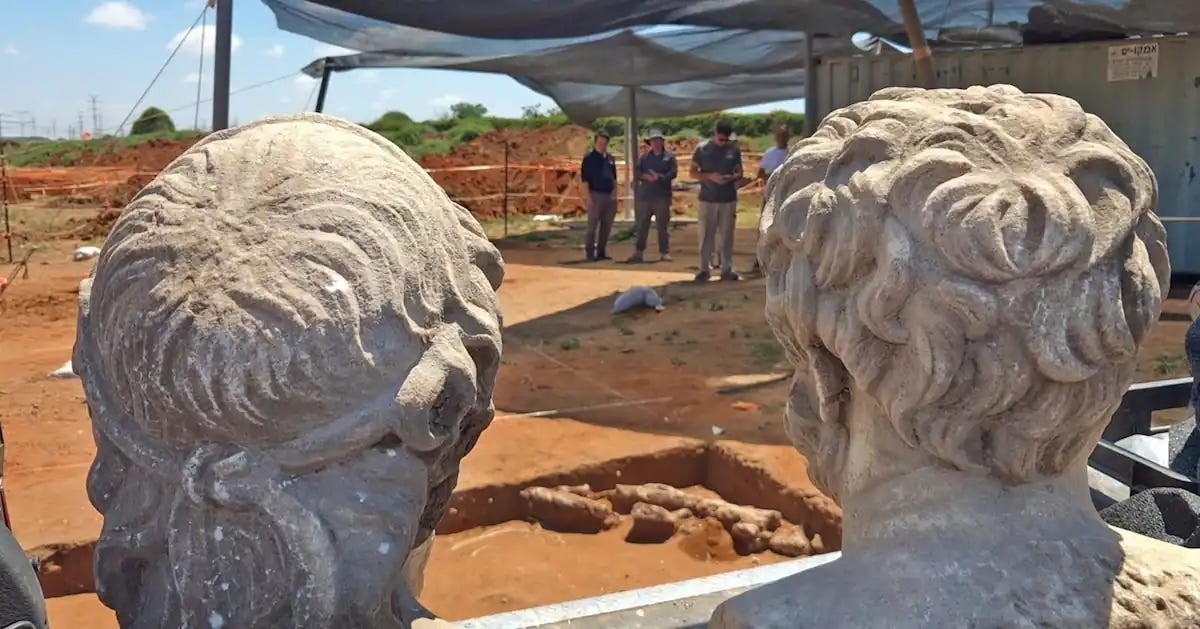
Rear view of the sculptures. Image credit: Emil Aladjem, Israel Antiquities Authority
Why were the busts inside a winepress?
The most striking part of the discovery is the location. These marble portraits were almost certainly displayed elsewhere before being moved into the winepress pit.
Excavation directors Eliran Oren and Avishag Reiss explained that the statues were found carefully placed face down inside the wine collection pit. They date to the Roman period, while the installation itself belongs to the Roman-Byzantine phase of the site. The winepress had apparently fallen out of use by the time the busts were buried.
The archaeologists have suggested that the statues may have been hidden for safekeeping, although the exact circumstances remain uncertain. They may have been removed from a nearby building during a period of change, danger, renovation, abandonment, or reuse.
Near the discovery area, archaeologists had previously identified remains of a bathhouse. This raises the possibility that the busts once decorated a luxurious villa belonging to a wealthy resident of the Caesarea region. Villas in the Roman world often included bath complexes, decorated halls, garden courts, and sculptural displays. In such settings, marble portraits expressed cultural sophistication as much as personal wealth.
Caesarea and elite Roman culture
The find belongs to the broader world of Roman Caesarea, one of the most important cities of the eastern Mediterranean. Caesarea was developed by Herod the Great into a major harbor city and later became an administrative, political, and cultural center under Roman rule.
The region around the city included estates, agricultural installations, bathhouses, residences, and public buildings. Wine production formed part of the local economy, while imported marble sculpture reflected the wealth and cultural ambitions of the elite.
In Roman Palestine, marble was especially valuable because it had to be imported. Finished sculptures and architectural elements were brought through Mediterranean trade networks or carved from imported stone by skilled craftsmen. Owning and displaying such works signaled status, education, and participation in the wider Greco-Roman cultural sphere.
The Binyamina busts fit this world closely. Their subject matter, material, and artistic form point to elite taste. Their final placement inside a winepress adds a more mysterious layer to their history.
A rare survival
Marble statues from antiquity often survive as fragments because they were broken, reused, burned into lime, or incorporated into later buildings. The two busts from Binyamina survived in unusually good condition. Their burial inside the pit may have helped protect them from later destruction.
The fact that both were found together also matters. A single bust could represent an isolated object, but a pair suggests a display arrangement. They may have stood in a decorated architectural space, possibly at the top of columns or within a formal setting where viewers encountered them as part of a visual program.
The name on one sculpture gives researchers a starting point, but the second bust may also hold important clues. Its style, facial features, hairstyle, marble type, and carving technique could help identify the workshop tradition, date, and intended subject.
Public display and future research
The statues are now undergoing cleaning, conservation, and detailed study. Specialists will examine the marble, inscriptions, iconography, and carving style in order to understand where the busts were made, who they represented, and how they reached the Caesarea region.
The discovery is scheduled to be presented publicly at the “Center VII – The Domestic House” archaeological conference on June 18, 2026, at MUZA – Eretz Israel Museum in Tel Aviv. The event is organized in collaboration with the Israel Antiquities Authority, Tel Aviv University’s Sonia and Marco Nadler Institute of Archaeology, and Bar-Ilan University’s Martin (Szusz) Department of Land of Israel Studies and Archaeology.
After the conference, the busts are expected to remain on public display at the museum during the summer months.
A modern project opens an ancient window
The Binyamina discovery shows how infrastructure work can reveal unexpected chapters of ancient life. A railway project meant to connect modern cities exposed two marble faces from a Roman world of villas, bathhouses, wine production, Greek learning, and elite self-representation.
The busts were probably admired in a wealthy setting before they were moved, hidden, and forgotten inside a disused winepress. Seventeen centuries later, their recovery adds a rare new piece to the cultural history of Caesarea and the Roman eastern Mediterranean.