


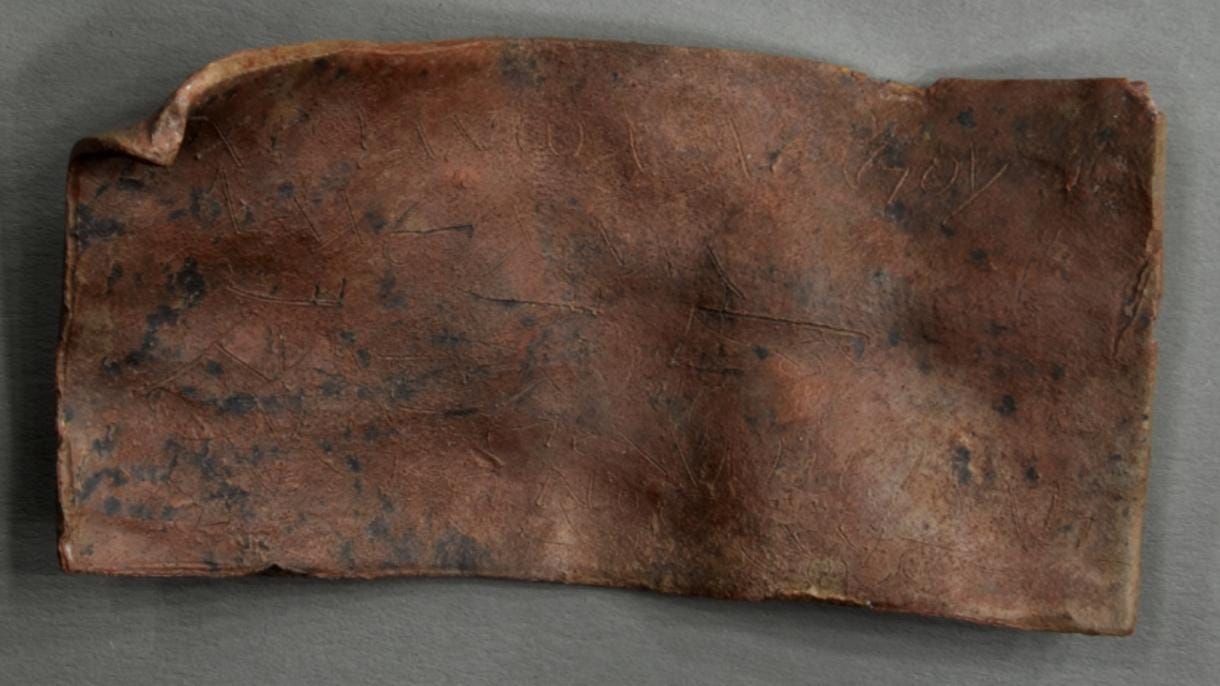
The Heerlen curse tablet contains an ancient Greek invocation calling on deities and demons in an Egyptian-influenced ritual style. Credit: Elke Fuchs, Institute of Papyrology, Heidelberg University
Ancient curse tablets, known as defixiones, were used in the Greco-Roman world to call upon supernatural powers against rivals, enemies, or specific individuals.
Researchers at Heidelberg University have deciphered a rare Roman curse tablet discovered in Heerlen, in the southern Netherlands. The artifact comes from the ancient settlement of Coriovallum, a Roman town in the province of Lower Germania, and dates to the 2nd century AD.
The small lead tablet preserves an unusual magical inscription. Instead of the Latin text more commonly found on curse tablets from northwestern Europe, this one was written in ancient Greek and follows an Egyptian magical style. It also includes a set of mysterious symbols known as characteres, which were likely intended to communicate with supernatural powers.
The discovery gives a close view of how magic, language, migration, slavery, and religious exchange could overlap in the Roman Empire.
A curse tablet from Roman Heerlen
The tablet was found during archaeological excavations in the Dutch municipality of Heerlen, beneath the modern town hall square. In antiquity, this area belonged to Coriovallum, a Roman settlement positioned in what was then the province of Germania Inferior, or Lower Germania.
Coriovallum occupied an important place in the Roman road system. It stood near the junction of major routes, including the roads later known as the Via Belgica and Via Traiana. These connections made Heerlen a place of movement, trade, administration, military presence, and cultural contact.
Modern Heerlen preserves one of the most important Roman archaeological landscapes in the Netherlands. Its Roman bathhouse, discovered in 1940, is among the best-preserved Roman buildings in the country and reflects the settlement’s long urban life. The curse tablet now adds a very different kind of evidence: the private religious and magical practices of people living in the same Roman world.
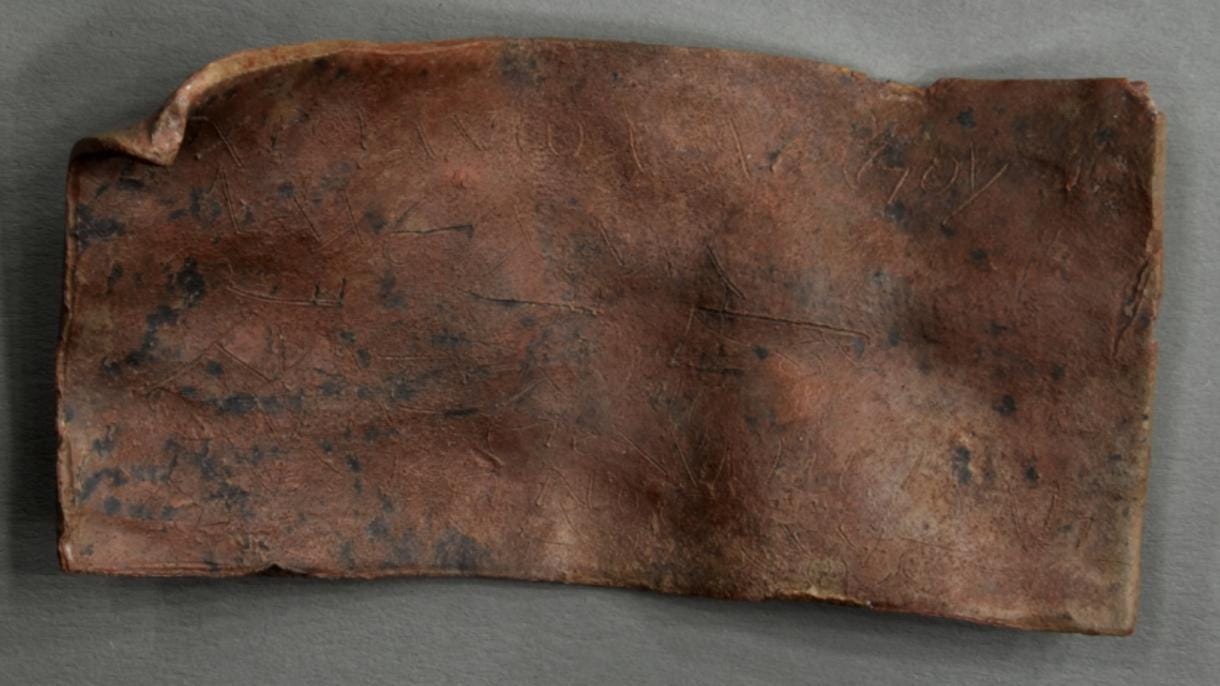
The Heerlen curse tablet contains an ancient Greek invocation calling on deities and demons in an Egyptian-influenced ritual style. Credit: Elke Fuchs, Institute of Papyrology, Heidelberg University
What is a curse tablet?
Curse tablets were known in Latin as defixiones and in Greek as katadesmoi. They were usually made from thin sheets of lead, a material that was easy to inscribe, fold, pierce, and bury. Lead also carried symbolic force. Its heaviness, coldness, and association with the underworld made it especially suitable for rituals of binding.
People used such tablets to ask gods, demons, spirits, or the dead to influence a person or situation. The intended target could be a legal opponent, business rival, thief, romantic rival, athlete, or enemy. In many cases, the aim was to “bind” the target: to silence them, weaken them, restrain them, confuse them, damage their success, or bring supernatural pressure against them.
The texts were often buried, folded, placed in graves, thrown into wells, hidden in buildings, or deposited in sanctuaries. Their purpose was private. They were meant for divine or demonic beings rather than ordinary human readers.
The Heerlen tablet belongs to this broad tradition, but its language and ritual style make it highly unusual for the region.
A small lead object with a complex inscription
The artifact measures 9.3 by 4.8 centimeters, small enough to fit in the palm of a hand. Although modest in size, its inscription is unusually complex.
Researchers at Heidelberg University’s Institute for Papyrology examined the object using reflectance transformation imaging, or RTI. This technique photographs an object many times under different lighting angles. The images are then digitally combined, allowing specialists to adjust the light and reveal faint scratches, surface details, and difficult inscriptions.
RTI made it possible to distinguish three separate groups of characters on the lead surface. This allowed the Heidelberg team to read and analyze the tablet more precisely.
The work was led by specialists including Dr. Rodney Ast, Academic Director at the Institute for Papyrology. According to Heidelberg University, the tablet is especially notable because it preserves an ancient Greek text composed in an Egyptian magical style, even though most curse tablets from northern Europe are written in Latin.
Greek text in Egyptian magical style
The use of Greek is one of the most important features of the find. Greek often appeared in magical formulas across the Roman Empire, especially in traditions influenced by Egypt and the eastern Mediterranean. However, in the Roman West, many curse tablets were written primarily in Latin, sometimes with Greek words or magical names inserted into the text.
The Heerlen tablet goes further. Its whole magical composition appears in Greek. The formulas invoke deities and demons in a style associated with Egyptian magical practice. This gives the artifact a strongly eastern Mediterranean character, even though it was found in a Roman settlement in the Netherlands.
This combination points to the mobility of people and ideas within the empire. Magical techniques, ritual language, divine names, and written formulas could travel across great distances. A person in Lower Germania could use a magical style rooted in Egypt or the Greek-speaking eastern Mediterranean.
The tablet therefore shows that Roman Heerlen was connected to much wider cultural currents. Coriovallum stood at a road junction, and this object reflects a world where goods, people, religious practices, and written traditions moved together.
The mysterious characteres
Another striking feature is a set of three magical symbols, called characteres. These signs appear in many ancient magical traditions and often do not belong to ordinary alphabets. They could combine visual, symbolic, and ritual functions.
According to Dr. Ast, the characteres on the Heerlen tablet were probably meant to transmit the desired message to supernatural powers. In other words, they were not simple decoration. They formed part of the magical technology of the curse.
Such symbols could make a text appear more powerful, more secret, or more suitable for contact with divine and demonic beings. They also show that the person who prepared the tablet had knowledge of specialized magical writing.
The combination of Greek, Egyptian-style invocation, and characteres suggests an experienced ritual practitioner or someone with access to learned magical models.
Four enslaved people named in the text
After the magical signs, the tablet lists four people: two men and two women. The Heidelberg researchers identify them as fellow slaves. This social detail makes the artifact especially valuable.
The names themselves show a mixed linguistic background. The two men have Latin names, while the two women have Greek names. This is unusual and may reflect the multicultural reality of enslaved and mobile populations in the Roman Empire.
The exact purpose of the curse remains open. Dr. Ast explains that the tablet may have been directed against the four enslaved people, or it may have been written on their behalf against another unnamed person.
Both possibilities are important. If the four named individuals were the targets, the tablet records hostility directed at them. If they were the people requesting the curse, it shows that enslaved people could participate in magical practices as agents, petitioners, or clients.
Dr. Julia Lougovaya of Heidelberg University’s Institute for Papyrology has suggested another possibility: one of the two women may have authored or commissioned the inscription and brought knowledge of such magical communication from Roman Egypt.
This possibility cannot yet be proven, but it fits the wider evidence for movement across the Roman Empire. Enslaved people, freedpeople, soldiers, merchants, and migrants could carry languages, rituals, and religious knowledge with them.
Magic in the Roman world
Magic was a normal part of ancient life, although not all forms of magic were treated equally. In Roman and Egyptian contexts, rituals for protection, healing, divination, and religious communication could be accepted in some settings. Other practices, especially those meant to harm rivals or influence others secretly, were more likely to be hidden.
Prof. Joachim Quack, Director of the Institute for Egyptology at Heidelberg University, notes that magic played a major role in Egypt’s ancient civilization. Some magical practices were part of accepted religious life, especially those connected with healing and protection. Practices used to advance one person’s interests at the expense of another were more likely to be performed privately.
The Heerlen tablet belongs to this more secretive side of ritual practice. It was buried in a pit, hidden from view, and written for supernatural forces. Its purpose was to act invisibly in a human conflict.
By the early centuries AD, religious and magical traditions from Egypt, the Near East, Jewish communities, Greek-speaking regions, and later Christian circles increasingly interacted across the Roman Empire. The Heerlen tablet is a small but strong example of this fusion.
Why this discovery stands out and remains exceptionally rare
Several details make the tablet exceptional.
First, curse tablets from the Netherlands and Belgium are already uncommon. Second, a tablet from this region written fully in Greek is extremely rare. Third, the inscription follows an Egyptian magical style, which gives it a cultural profile usually associated with the eastern Mediterranean rather than the northwestern provinces. Fourth, it names enslaved people, giving researchers a glimpse into the social world behind the ritual.
The tablet also shows the importance of modern imaging techniques. Without RTI, the faint and damaged inscription would have been much harder to read. The research demonstrates how new methods can recover information from small, fragile objects that have spent nearly two thousand years underground.
Coriovallum as a place of exchange
The discovery also changes how we can think about Roman Heerlen. Coriovallum was more than a local settlement on the northern edge of the empire. It was a place connected by roads, commerce, soldiers, travelers, and migrants.
The Roman Museum in Heerlen describes Coriovallum as a strategic crossroads where goods, ideas, and cultures were exchanged. The curse tablet fits that setting closely. It combines a northern provincial findspot with Greek language, Egyptian magical elements, Roman social hierarchy, and the personal names of enslaved individuals.
This makes the tablet a valuable document of everyday Roman globalization. It shows how far ritual knowledge could travel and how deeply multicultural the empire could be, even in towns far from Rome, Alexandria, or Athens.
Ongoing research and future exhibition
The curse tablet is expected to be displayed in the Heerlen Museum in the future. Heidelberg University has also announced that the deciphered inscription will be made available in a scholarly publication, allowing other researchers to study it in detail.
That future publication will be important because many questions remain. Scholars will want to examine the exact wording, the names, the magical formulas, the characteres, and the tablet’s archaeological context. They may also compare it with other Greek and Egyptian-style magical texts from the Roman world.
For now, the object already offers a powerful insight into the private fears and conflicts of people living in Roman Lower Germania. It shows that behind the roads, baths, pottery workshops, and public buildings of Coriovallum, there were also hidden rituals, personal rivalries, enslaved lives, and attempts to call supernatural forces into human affairs.
The Heerlen curse tablet is small, but it opens a wide window onto Roman magic, migration, and cultural exchange.
Support Independent Ancient Content :
Your support helps me create more archaeology posts, articles, and mini history videos:
Sources
Heidelberg University’s official press release is the primary source for the decipherment, date, measurements, findspot, RTI method, Greek/Egyptian-style inscription, characteres, and interpretation of the four named enslaved people.