


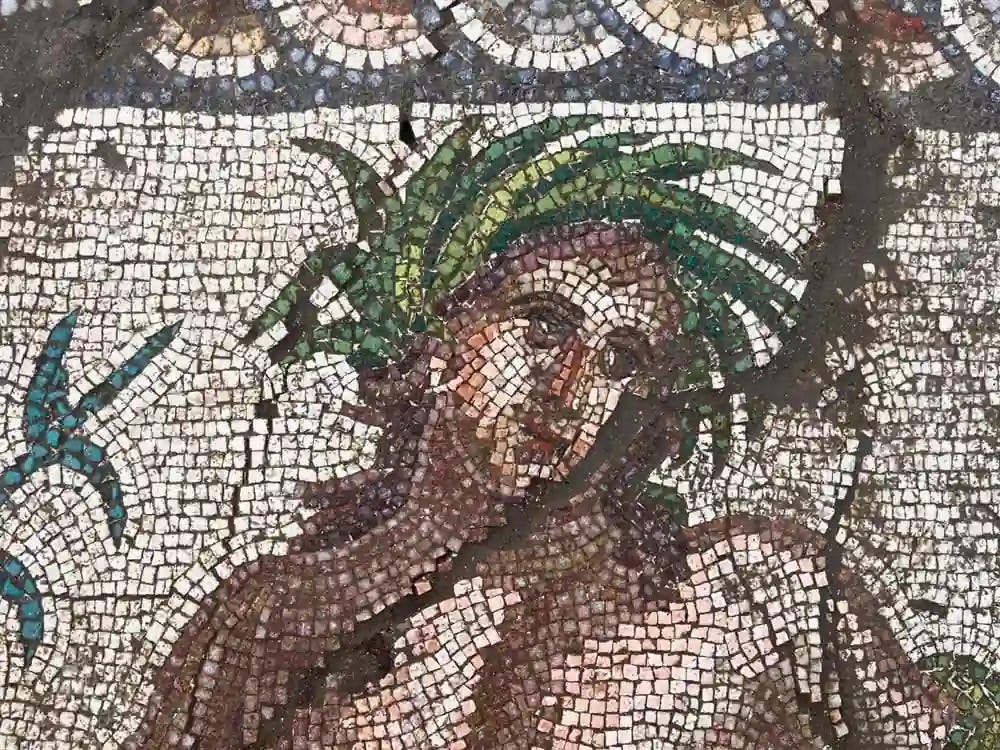
Rare River God Mosaic Unearthed in Ancient Aspendos. Credit: Turkish Ministry of Culture and Tourism
The mosaic was found during excavations on Theatre Street, the route that connected the acropolis of Aspendos with its famous Roman theatre. The newly exposed pavement belongs to a large mosaic-decorated architectural structure located in the eastern square of the street, between the square and the eastern city walls.
At the center of the composition is a youthful figure identified as “Young Eurymedon,” the divine personification of the Eurymedon River, today known as the Köprüçay River. In antiquity, this river was central to the life of Aspendos, supporting agriculture, trade, water supply, and the prosperity of the surrounding landscape.
A major discovery on Theatre Street
The discovery was announced by Türkiye’s Ministry of Culture and Tourism. Minister Mehmet Nuri Ersoy stated that the find is scientifically important because it provides new evidence for Roman-period Anatolian mosaic art.
The structure containing the mosaic measures approximately 6 by 25 meters. Excavation has so far been completed in an area of about 6 by 7.5 meters, but the mosaic pavement continues into sections that remain unexcavated. This suggests that the visible part may represent only a portion of a larger decorated floor.
The building was uncovered in the eastern square of Theatre Street, one of the important routes inside Aspendos. This street linked the city’s acropolis with the theatre, the monument for which Aspendos is best known today.
Initial assessments suggest that the building was constructed in the early 3rd century AD, probably as a pool or water-related structure. The presence of a river god mosaic in such a setting is highly significant. The imagery of flowing water, fish, reeds, and an amphora would have matched the function and atmosphere of a water installation.
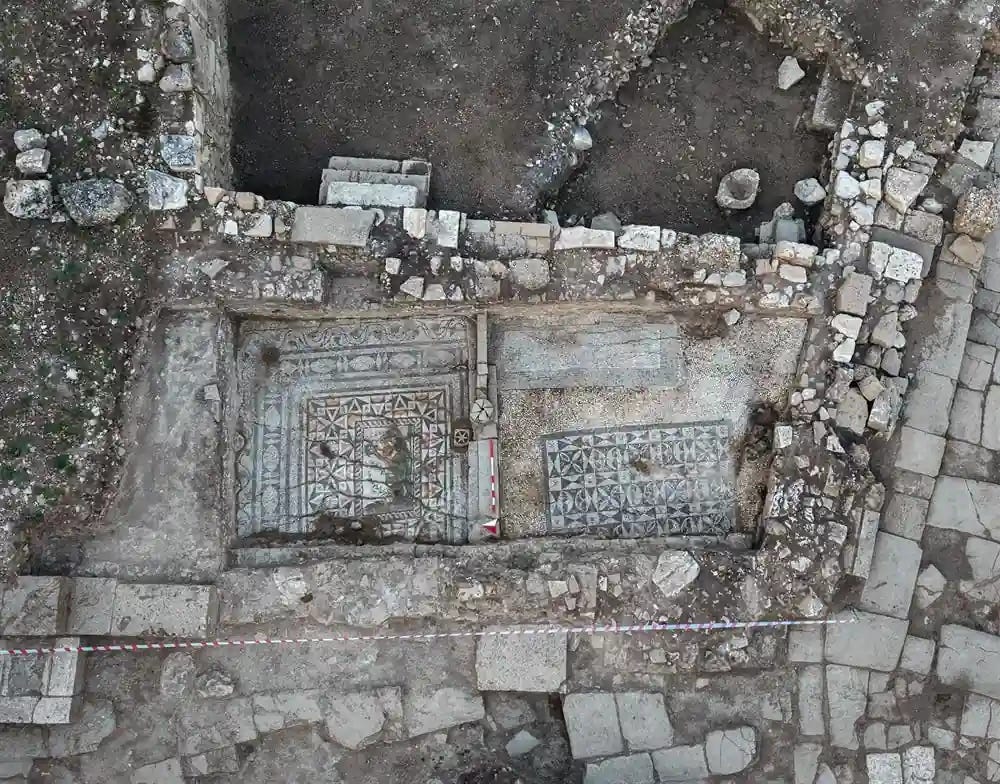
Aerial view of the place of discovery. Credit: Turkish Ministry of Culture and Tourism
A structure changed after the AD 262 earthquake
Archaeologists believe the building went through later alterations. After the earthquake of AD 262, the structure appears to have been divided by interior walls and converted into separate spaces.
This detail gives the discovery an urban-historical dimension. The mosaic does not only show artistic taste; it also records how Aspendos changed after a major seismic event. Buildings that originally served one purpose could be reorganized, subdivided, and reused as the city adapted to new conditions.
The mosaic therefore belongs to more than one phase of the building’s history. Its original design points to a 3rd-century water-related structure, while later architectural changes reveal how the space was modified after damage or urban restructuring.
Two panels: geometry and divine imagery
The exposed mosaic floor consists of two main panels. One panel contains geometric decoration, while the other carries the figurative scene that makes the find exceptional.
The figurative panel shows the youthful river god Eurymedon. Based on iconographic features and comparisons with similar examples, specialists identify the figure as the local river deity of Aspendos.
In Greco-Roman art, rivers were often represented as divine beings. They could appear reclining beside flowing water, leaning on vessels, holding reeds, or surrounded by aquatic imagery. The Aspendos mosaic follows this broader artistic language but gives it a local identity by representing Eurymedon, the river that sustained the city.
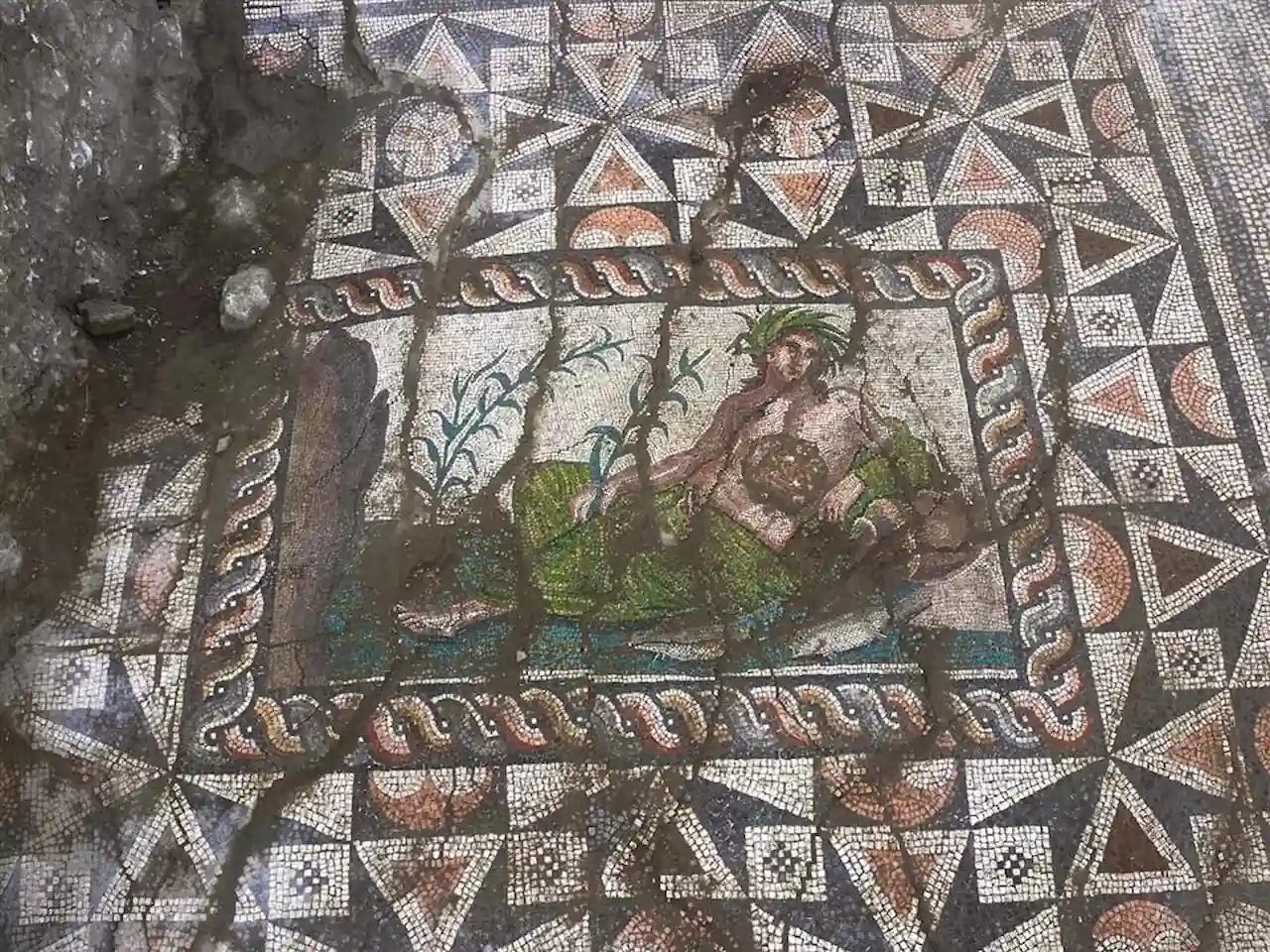
Rare River God Mosaic Unearthed in Ancient Aspendos. Credit: Turkish Ministry of Culture and Tourism
The “Young Eurymedon”
The central figure is shown with reed leaves on his head and in his hand. These details connect him directly with river vegetation and wetland imagery. He is also shown leaning against an amphora from which water flows, a familiar symbol in classical art for the source or abundance of a river.
Fish figures accompany the scene, swimming through the water around the god. These fish add movement and help complete the aquatic setting. Together, the reeds, amphora, flowing water, and fish create a composition built around fertility, abundance, and the life-giving power of water.
The fact that Eurymedon is shown as a young figure is also interesting. Many river gods in Greco-Roman art appear as mature or bearded male figures. A youthful representation gives the Aspendos mosaic a more dynamic visual character and may emphasize renewal, flow, and vitality.
The Importance of the Eurymedon River
The river was essential to Aspendos. The ancient city stood in Pamphylia, in what is now Antalya Province, and was positioned near the Eurymedon River. Its location gave it access to fertile land, inland routes, and a river harbor connected to the Mediterranean.
The Aspendos Project of Ankara University describes the ancient city as closely tied to the Eurymedon and to the surrounding resource-rich territory. Ancient written sources and archaeological evidence point to Aspendos as a prosperous city whose economy was supported by agriculture, production, and trade through the river harbor.
This context makes the mosaic especially meaningful. The river god was not an abstract mythological figure. For the inhabitants of Aspendos, Eurymedon represented a real waterway that helped sustain the city’s wealth, landscape, and daily life.
Craftsmanship and small tesserae
Minister Ersoy emphasized the quality of the mosaic’s craftsmanship. The work stands out for its fine color transitions, rich detail, and the use of small tesserae. Tesserae are the tiny stone, glass, or ceramic cubes used to build mosaic images.
The smaller the tesserae, the more subtle the visual effects can be. Skilled mosaicists could use them to create shading, texture, movement, and naturalistic transitions between colors. In the Aspendos mosaic, these technical features help bring the river god and surrounding aquatic scene to life.
The mosaic’s artistic quality suggests that Aspendos still possessed significant cultural and economic resources during the Roman period. Such a pavement required trained craftspeople, expensive materials, careful planning, and a patron or civic authority willing to fund a high-quality decorated structure.
A rare theme in mosaic art
The discovery is important because river god depictions are rare in mosaic art, especially when they appear in such a locally identifiable form. While personifications of rivers are known in Greco-Roman visual culture, the Aspendos example stands out because it appears to represent a specific river directly tied to the city itself.
This makes the mosaic valuable for both art history and local religious history. It shows how Roman-period communities in Anatolia could use shared classical imagery while adapting it to local geography and identity.
The figure of Eurymedon links myth, place, water, and civic memory. It transforms the city’s river into a divine presence, visible in a public or semi-public architectural space.
Aspendos beyond its famous theatre
Aspendos is internationally known for its Roman theatre, one of the best-preserved ancient theatres in the world. Built in the 2nd century AD during the reign of Marcus Aurelius, the theatre remains the city’s most famous monument.
But the new mosaic shows why Aspendos should be understood as more than a single monument. The city also had streets, squares, market buildings, water systems, houses, civic spaces, and a wider urban landscape that continued to develop across different periods.
The theatre and aqueducts have long attracted scholarly attention. The aqueducts, with their impressive siphon system, carried water from sources north of the city and helped support both Aspendos and the surrounding plain. Water, therefore, was a central part of the city’s infrastructure and identity.
The discovery of a river god mosaic fits this broader picture. It adds a visual and symbolic layer to what archaeology already shows: Aspendos was a city deeply connected to water.
Roman Anatolia and local identity
The mosaic also contributes to the study of Roman Anatolia. Roman-period cities in Asia Minor often combined imperial culture, Greek artistic traditions, local religious identities, and regional forms of self-representation.
Aspendos was part of this world. Its monuments show Roman architectural influence, but its cultural identity was also shaped by local geography, older traditions, and the economic life of Pamphylia.
The Eurymedon mosaic reflects that mixture. The artistic language is Greco-Roman, but the subject is local. The image communicates the importance of a specific river to a specific city.
This is why the discovery has scientific value. It helps researchers understand how local communities in Roman Anatolia expressed place, prosperity, and sacred landscape through mosaic art.
A discovery still in progress
Excavation of the structure is ongoing. Since only part of the mosaic has been exposed, further work may reveal additional panels, borders, inscriptions, architectural details, or construction phases.
Future study may clarify the building’s exact function, the full extent of the mosaic floor, the workshop traditions behind its production, and the relationship between the structure and Theatre Street.
For now, the visible evidence already points to a major discovery. A 3rd-century mosaic of Young Eurymedon, placed in a likely water-related building in the heart of ancient Aspendos, gives researchers a rare image of how the city represented the river that sustained it.
The mosaic brings together art, water, mythology, urban history, and local identity. It is both a work of craftsmanship and a statement about the life-giving power of the Eurymedon River in one of ancient Pamphylia’s most important cities.
What an amazing find. The mosaic is gorgeous and the details about the river god are so interesting.