


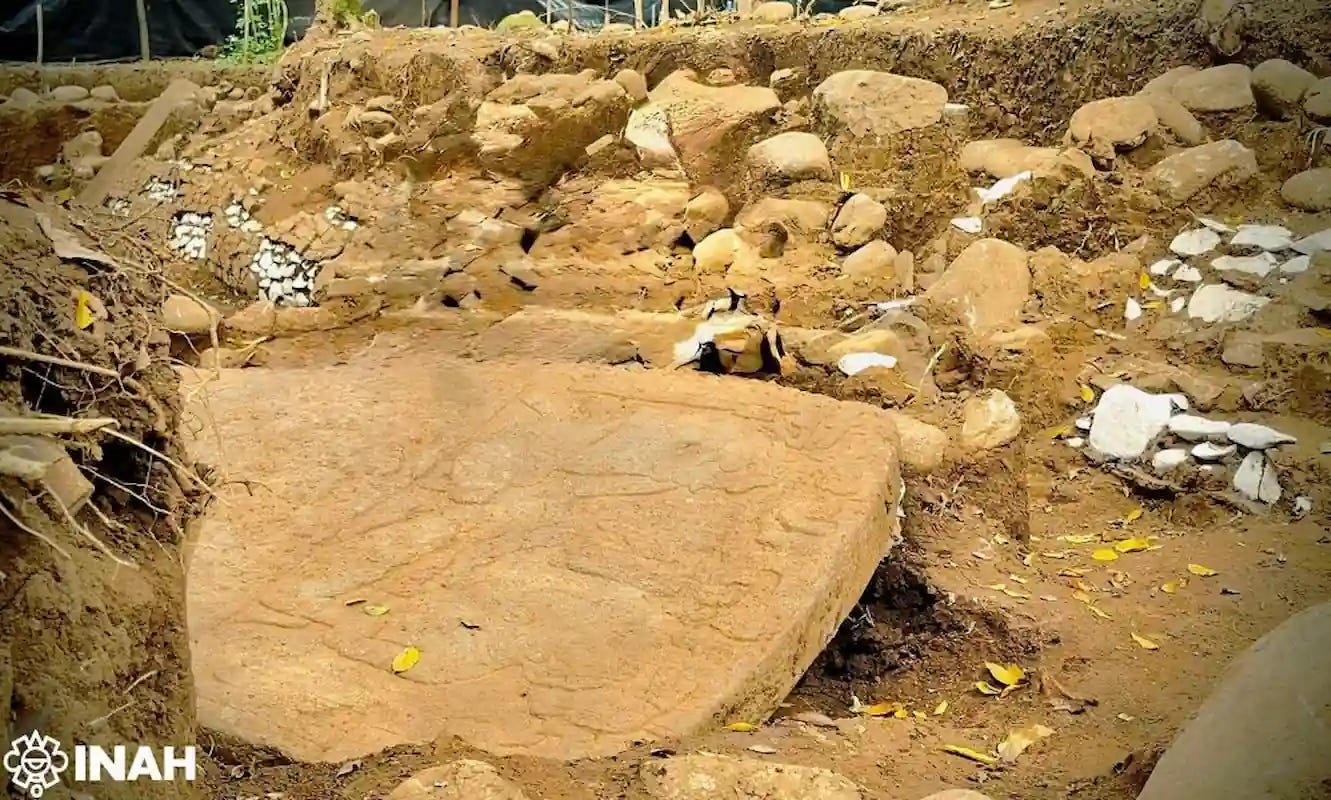
The stele at the moment of discovery. Credit: INAH.
The discovery was made by specialists from Mexico’s National Institute of Anthropology and History, INAH, during a salvage archaeology project in the San Lucas residential development area. The remains are located near the archaeological zone of Campo Viejo, an area that has been under research and protection by the INAH Veracruz Center for more than two decades.
The newly discovered structures probably date to the Early Classic period, between AD 200 and 600. This places them more than 1,400 years in the past, in a period when societies across Mesoamerica were developing complex ceremonial centers, regional identities, and long-distance cultural contacts.
A discovery during salvage archaeology
The excavation took place in a private property of approximately 12 hectares intended for residential development. Because the project required a change in land use, the work was reviewed and authorized by INAH’s Council of Archaeology.
Once fieldwork began, archaeologists identified cultural remains that required detailed documentation and protection. The operation became a formal archaeological salvage project, with specialists recording the structures, recovering associated materials, and defining areas that will remain restricted because of their archaeological importance.
The fieldwork began in late 2025 and is expected to continue until mid-August 2026. Laboratory analysis of the recovered materials is expected to continue into February 2027.
The project involves an interdisciplinary team coordinated by archaeologists Alberto Vázquez Domínguez and Lino Espinoza García of the INAH Veracruz Center. Fieldwork has been carried out by archaeologists Mireya Moreno Aguirre, Erika Ramírez Córdoba, Jorge Ulises Mota Landa, Emmanuel Hernández Sánchez, and around 30 field workers.
According to INAH, the discovery forms part of a wider research program that has been carried out around Campo Viejo since 2000, focused on documenting, protecting, and preserving the archaeological heritage of the area.
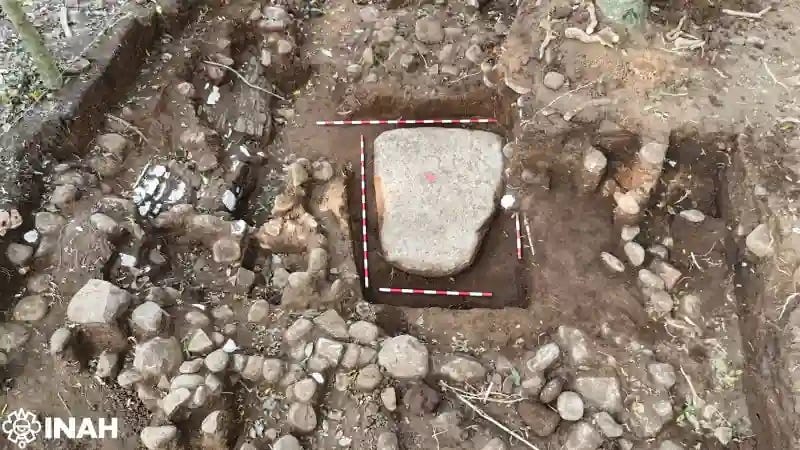
The stele in situ at the location where it was discovered. Credit: INAH.
A civic-ceremonial structure from the Early Classic period
The central architectural find is a large platform, about 30 meters long and 12 meters wide. It was built with flagstones and carefully worked white limestone. The stone has a pale, gypsum-like texture, apparently produced intentionally, perhaps through a heating or firing process used to create a decorative finish for the walls.
This detail is one of the reasons the structure has drawn attention. The construction technique and visual treatment of the stone appear unusual for the region. Archaeologists have also identified ornamentation made up of lines or square-like figures, as well as circular stones placed on two of the platform’s flanks.
These decorative features have not been previously recorded in the local archaeological record. Their presence suggests that the builders were working within a distinctive architectural tradition, possibly connected to a local group with its own ceremonial style.
The structure is interpreted as civic-ceremonial in character. In Mesoamerican archaeology, such platforms often served as places for ritual activity, public gatherings, elite display, or community ceremonies. Further analysis will be needed to understand its exact function.
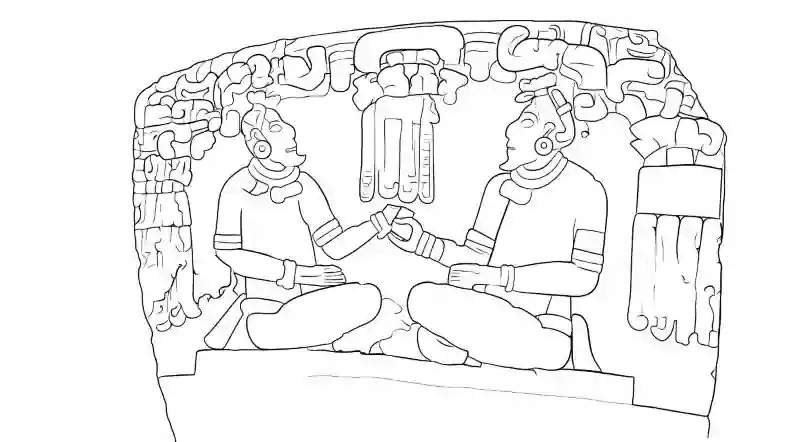
Preliminary drawing of Stele 2. Credit: Lino Espinoza.
A monolithic sculpture with a symbolic scene
Associated with the platform, archaeologists found a large monolithic sculpture. The piece measures 1.88 meters high, 1.47 meters wide at its broadest point, and 0.68 meters wide at its narrowest point. Its thickness ranges between 22 and 25 centimeters.
The stone bears carved imagery that appears to represent a symbolic or ceremonial event. Two elite figures are shown seated, wearing elaborate garments and ornaments. In the scene, they receive a fluid in a container from a divine entity positioned above them.
The image is especially important because it suggests a ritual exchange between human elites and a supernatural being. The fluid may represent a sacred substance, offering, blessing, or divine essence, though its meaning remains under study.
One of the seated figures appears to show possible Mayoid traits. This detail is important because it may point to wider cultural interaction across Mesoamerica. Veracruz, positioned along the Gulf Coast, was historically connected with many regions through exchange, migration, and shared ritual traditions.
At this stage, archaeologists are avoiding firm conclusions. The sculpture’s meaning, cultural affiliation, and iconographic parallels will require detailed study.
A local culture with Gulf Coast connections
The cultural identity of the builders remains one of the most important open questions.
The Totonac culture is often associated with parts of Veracruz, especially regions between the Cazones and Papaloapan rivers. However, specialists have indicated that the newly discovered remains do not currently show clear indicators that would allow them to be assigned to the Totonac tradition.
Instead, researchers propose that the structures may belong to a local culture with its own traits, while also sharing broader features with other groups of the Gulf Coast.
This interpretation is significant. It suggests that the ancient cultural landscape of central Veracruz was more diverse than a single ethnic or cultural label can explain. The site may reveal a local society that participated in wider Mesoamerican networks while maintaining distinctive architectural and ritual forms.
Offerings of maize, buried vessels, and greenstone
The archaeological team also recovered materials associated with the platform. These include charred maize remains, buried vessels, and a greenstone bead broken into four parts.
The charred maize appears to have been deposited as an offering. In Mesoamerica, maize was both a staple food and a sacred substance deeply tied to origin myths, agriculture, fertility, and political authority. Its placement near the ceremonial structure suggests ritual activity connected with the building or its use.
The buried vessels may also have formed part of offerings or dedicatory deposits. Such deposits were often placed during construction, renewal, abandonment, or important ceremonial events.
The fragmented greenstone bead is also significant. Greenstone materials were highly valued in Mesoamerica and were often connected with water, fertility, preciousness, and elite status. The fact that the bead was found broken into four pieces may have ritual significance, although laboratory analysis and contextual study will be needed before a firmer interpretation can be proposed.
All recovered materials will be studied in the laboratory. These analyses may help determine chronology, ritual use, diet, exchange networks, and the social practices of the group that built the complex.
Conservation and protection
Both the platform and the monolithic sculpture were found in good condition. However, each requires different conservation work.
The architectural structure will need restoration, consolidation, and maintenance. Because it is a large built feature exposed during excavation, stabilizing the stonework and protecting the decorated surfaces will be essential.
The monolithic sculpture has already received consolidating treatments. Archaeologists also removed soil deposits that could damage the surface or interfere with preservation.
The importance of the discovery has led researchers to define protected areas within the property. These zones will remain restricted because of the archaeological value of the remains.
The property owners have provided economic, technical, professional, and logistical support for the salvage project, including specialized tools, equipment, and field personnel.
Significance of the discovery
The Coatepec discovery is important because it adds new evidence for the Early Classic period in central Veracruz. The platform’s architectural features, the carved monolith, and the associated offerings all suggest a complex ceremonial setting.
The monolithic sculpture is especially valuable because its imagery appears to show an elite ritual involving a divine being. Scenes of supernatural communication, offerings, and sacred substances were central to many Mesoamerican visual traditions, but the specific form of this Veracruz monument appears unusual for the region.
The possible Mayoid features on one figure add another layer of interest. During the Classic period, Mesoamerican societies were connected through trade, diplomacy, pilgrimage, elite exchange, and shared religious imagery. The sculpture may eventually help clarify how central Veracruz communities interacted with distant cultural spheres.
The discovery also matters because it challenges overly simple cultural labels. Rather than assigning the find automatically to a well-known tradition, archaeologists are treating it as evidence for a local group with distinctive traits and Gulf Coast connections.
A new chapter for Campo Viejo and Coatepec
The site lies near Campo Viejo, a place already recognized for its archaeological importance. INAH Veracruz has been studying the area since 2000, and the new salvage work shows that the surrounding landscape still preserves major remains.
The find demonstrates the importance of archaeological monitoring during development projects. Without salvage work, the platform, monolith, and associated offerings could have been damaged or lost before proper documentation.
Instead, the project has produced a major discovery that may reshape understanding of ancient central Veracruz.
Fieldwork will continue through 2026, and laboratory analysis will extend into 2027. The next phase of research will focus on dating, materials, iconography, construction techniques, and cultural affiliation.
For now, the Coatepec platform and monolithic sculpture offer a rare view of a local Gulf Coast society more than 1,400 years ago: a society that built ceremonial architecture, carved complex divine imagery, deposited ritual offerings, and developed traditions that archaeologists are only beginning to understand.