


Archaeologists working at the ancient city of Nineveh in northern Iraq have uncovered a rare Assyrian stele near the Shamash Gate, also known as Bab Shamash or the Sun Gate.
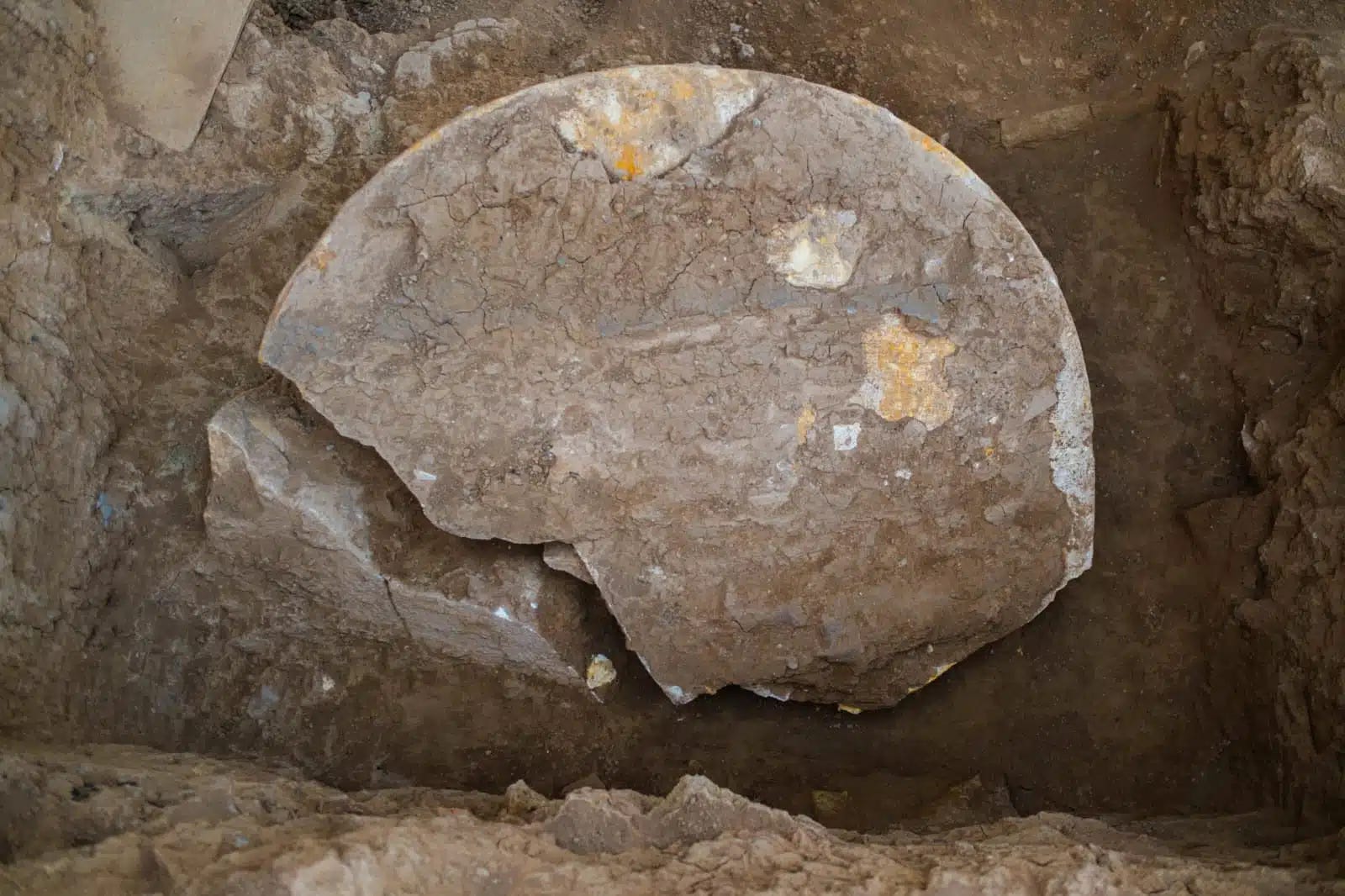
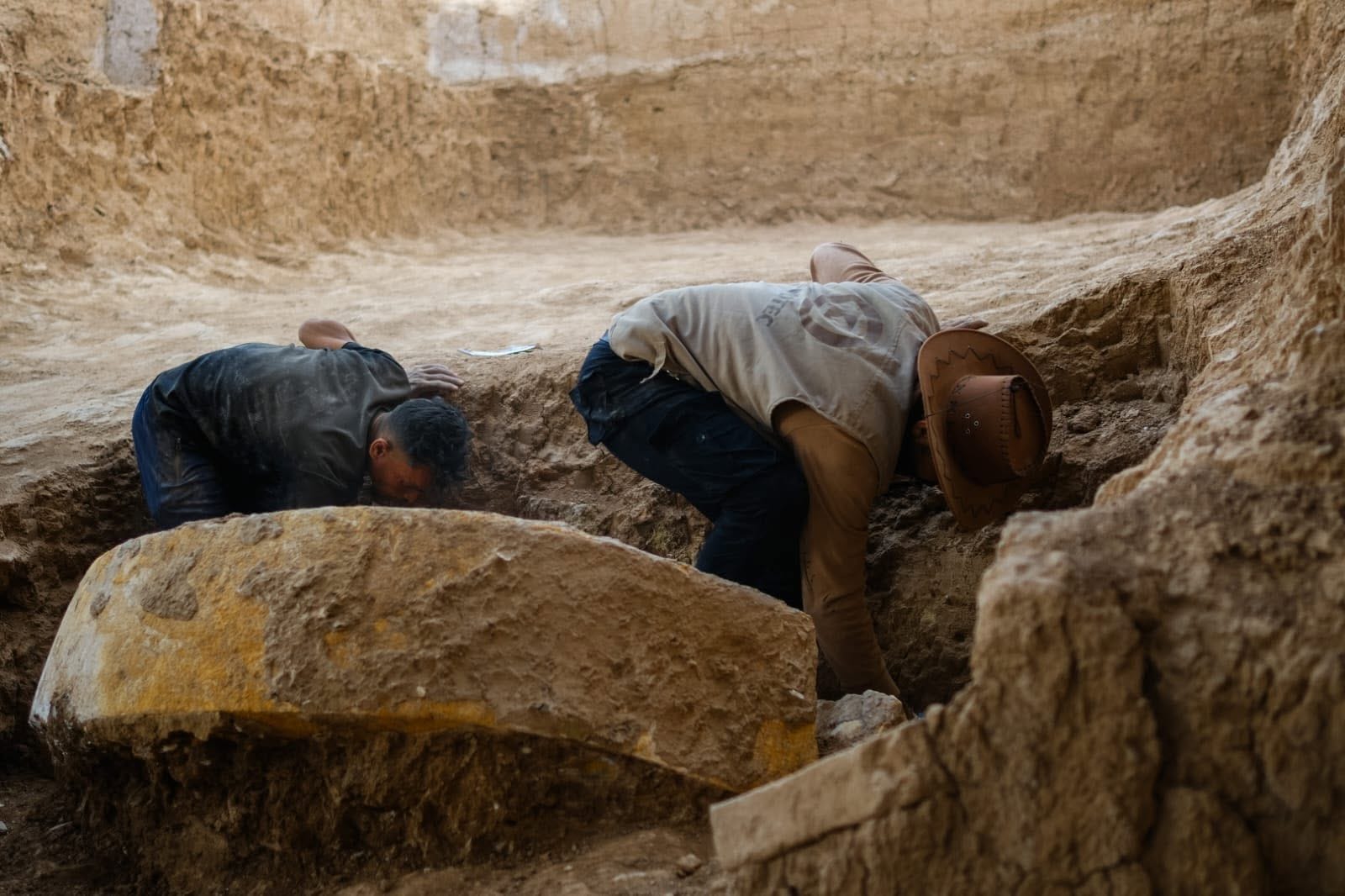
Rare Assyrian Stele Found at Nineveh’s Sun Gate. Credit: Iraq’s General Authority for Antiquities and Heritage
The stone monument dates to the seventh century BC and is linked to the reign of King Ashurbanipal, one of the last great rulers of the Neo-Assyrian Empire. It was found on June 6 during restoration work at the gate, a major entrance in the eastern fortifications of ancient Nineveh, now within modern Mosul.
The discovery was announced by Iraq’s State Board of Antiquities and Heritage. According to Iraqi officials, the stele preserves relief imagery and cuneiform inscriptions connected with royal building projects in Nineveh and possibly elsewhere in the Assyrian Empire.
The full inscription has not yet been published or translated in detail. Even so, the monument already stands out as a major archaeological find. It links the final century of Assyrian imperial power with one of Nineveh’s most symbolic thresholds: the gate of Shamash, the sun god associated with justice, order, and divine authority.
A royal monument from the Assyrian capital
The newly discovered stele is a large stone monument, about 2 meters high and 1.55 meters wide. It was carved from Mosul marble, a local stone closely tied to the region’s ancient and modern architectural identity.
The front of the stele shows a relief of King Ashurbanipal. The back reportedly includes smaller images of two other Assyrian kings, along with cuneiform writing. Researchers believe the inscription records building activities carried out during Ashurbanipal’s reign, although specialists are still studying the text.
This kind of monument was part of the political language of Assyrian kingship. Royal inscriptions were created to preserve achievements, announce construction works, honor the gods, and project authority across generations.
In the Assyrian world, writing was not only a record. It was power carved into stone.
A stele placed near a major gate could speak to everyone entering or leaving the city: officials, soldiers, merchants, envoys, priests, workers, and foreign visitors. It marked the city as a royal space and the king as the builder, protector, and legitimate ruler of that space.
Rare Assyrian Stele Found at Nineveh’s Sun Gate. Credit: Iraq’s General Authority for Antiquities and Heritage
Ashurbanipal and the last great age of Assyria
Ashurbanipal ruled in the seventh century BC, during the final great phase of Assyrian power. He inherited an empire built by earlier kings such as Tiglath-pileser III, Sargon II, Sennacherib, and Esarhaddon.
By his time, Assyria controlled or influenced enormous territories across the ancient Near East. Its armies had campaigned from Mesopotamia to the Levant and Egypt. Its capitals were filled with palaces, temples, libraries, administrative archives, reliefs, statues, gates, and monumental inscriptions.
Ashurbanipal is often remembered as both a warrior king and a patron of scholarship. His royal library at Nineveh preserved more than 30,000 clay tablets and fragments, including literary, medical, ritual, astronomical, lexical, administrative, and divinatory texts. Among the most famous works preserved there is the Epic of Gilgamesh.
This combination of violence, empire, scholarship, and urban display makes Ashurbanipal one of the most complex rulers of the ancient world.
The newly found stele belongs to this same world. It is not only a royal image. It is part of a larger system in which kingship, architecture, writing, religion, and urban order were tied together.
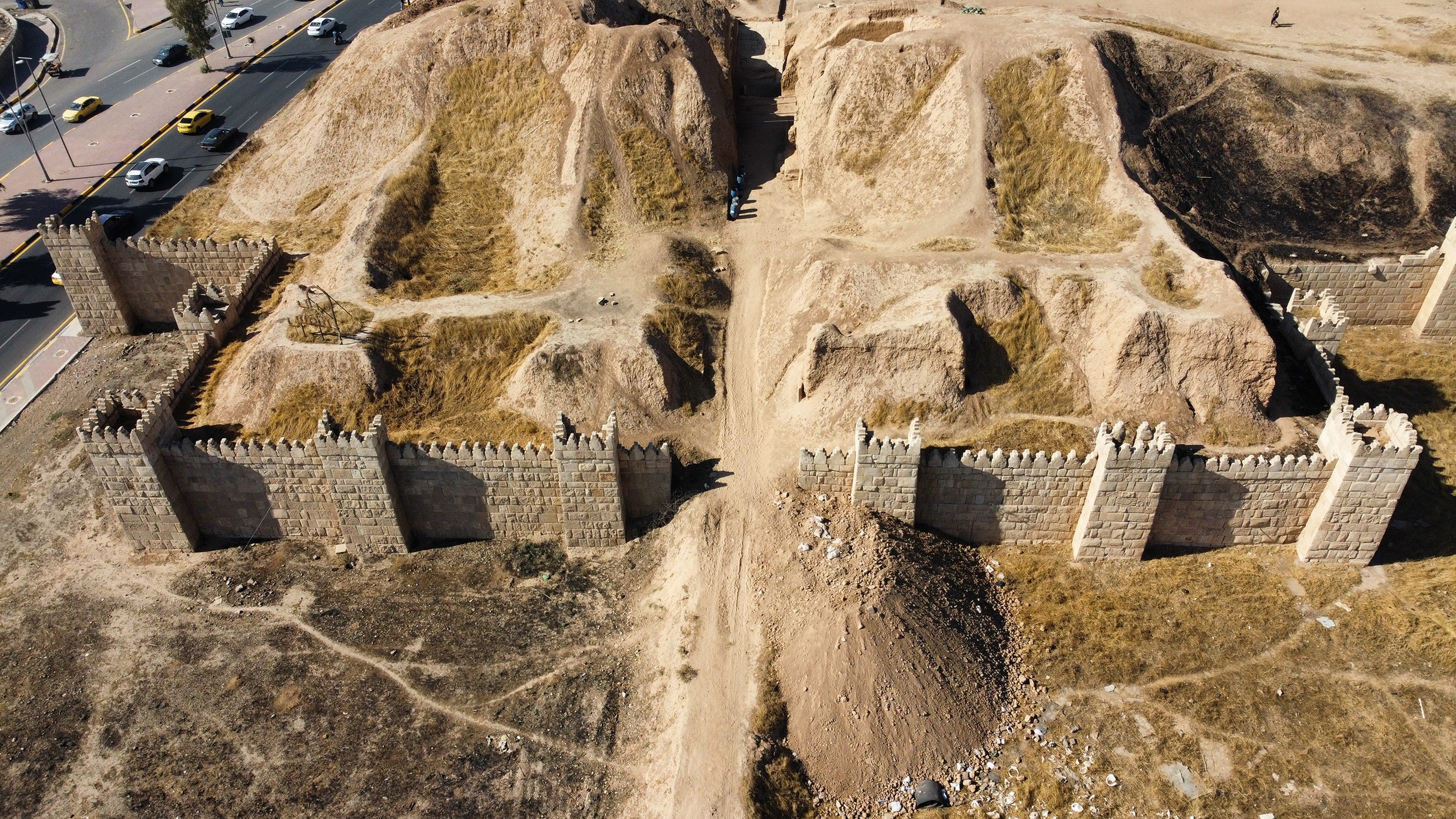
Aerial Photo of the Shamash Gate from the east. Credit: Cambridge.org
The Shamash Gate
The stele was found at the Shamash Gate, one of the major gates of ancient Nineveh.
The gate stood on the eastern side of the city and controlled movement along the road toward Arbela, modern Erbil. This made it strategically important. It was part of Nineveh’s defensive system, but it also served as a ceremonial and symbolic entrance into the imperial capital.
The name Bab Shamash means “Gate of Shamash.” Shamash was the Mesopotamian sun god, strongly associated with justice, truth, judgment, and the lawful order of the world.
That connection is important. A city gate was a place of movement, control, visibility, and authority. Placing royal imagery and inscriptions near a gate named for the god of justice created a powerful message: the city’s defenses, roads, royal works, and public order all stood under divine witness.
The gate was therefore more than a military structure. It was an architectural statement about power.
A threshold between road and empire
Ancient city gates were practical, but they were also deeply symbolic.
They controlled access. They shaped traffic. They protected the settlement. They framed the first impression of the city. They could also carry names, inscriptions, reliefs, divine associations, and ritual meaning.
The Shamash Gate was one of Nineveh’s great eastern thresholds. From the outside, travelers approached from the direction of Arbela. From inside, the route led toward the city’s monumental center, including royal and sacred zones.
A stele placed in this setting would have belonged to a space of transition. It stood between outside and inside, road and city, visitor and king, ordinary movement and imperial ideology.
This is why the discovery is so important. The stele was not found in isolation. It was found at a charged urban location where architecture, movement, and royal authority met.
Nineveh under Sennacherib
The story of the Shamash Gate begins before Ashurbanipal.
Nineveh became a major imperial capital under King Sennacherib, who ruled from 705 to 681 BC. He transformed the city into one of the largest and most impressive capitals of the ancient Near East.
Sennacherib expanded the city, built new walls, improved water systems, constructed palaces, and reshaped Nineveh as a monumental seat of Assyrian power. His famous “Palace Without Rival” was decorated with carved reliefs showing campaigns, royal ceremonies, landscapes, engineering works, and the king’s command over the empire.
The Shamash Gate formed part of this enlarged urban system. Scholarly work on the gate indicates that its construction was connected with Sennacherib’s expansion of Nineveh. Later work may have taken place under Ashurbanipal or earlier successors.
The new stele therefore appears in a gate complex that had already carried royal meaning for generations.
![Relief of Ashurbanipal hunting a Mesopotamian lion,[27] from the Northern Palace in Nineveh, as seen at the British Museum](https://substackcdn.com/image/fetch/$s_!8zHU!,f_auto,q_auto:good,fl_progressive:steep/https%3A%2F%2Fsubstack-post-media.s3.amazonaws.com%2Fpublic%2Fimages%2Fe6f835b4-bb41-4cd7-9f0d-2c2a2e8ad357_927x626.jpeg "Relief of Ashurbanipal hunting a Mesopotamian lion,[27] from the Northern Palace in Nineveh, as seen at the British Museum")
Relief of Ashurbanipal hunting a Mesopotamian lion, from the Northern Palace in Nineveh, as seen at the British Museum
Ashurbanipal at the gate
If the stele records Ashurbanipal’s building works, it would add a new layer to the history of the Shamash Gate and the wider city.
Royal inscriptions often described construction as an act of piety and legitimacy. A king rebuilt walls, restored gates, strengthened temples, improved roads, and made the city worthy of the gods. These acts were political, but they were also religious.
Ashurbanipal’s image on the stele suggests that the monument was intended to place his authority into the architectural fabric of Nineveh.
The presence of other royal figures on the back may indicate dynastic memory or a connection between Ashurbanipal and earlier kings. Until the inscription is fully translated, this remains open.
Still, the basic message is clear: the stele belongs to the Assyrian tradition of monumental royal self-presentation. It turned stone, image, and text into a permanent record of kingship.
Cuneiform as imperial memory
The cuneiform text is one of the most important parts of the discovery.
Assyrian royal inscriptions were written in Akkadian using the cuneiform script, a writing system made from wedge-shaped signs. These texts could be carved on stone, written on clay, stamped on bricks, or inscribed on cylinders and prisms.
They often followed established formulas. The king named himself, listed his titles, invoked gods, described construction projects, recorded military achievements, and asked future rulers to preserve the monument.
The new stele may belong to this tradition. Reports suggest that its text concerns building projects in Nineveh and across the empire.
If the inscription is well preserved, it could provide valuable details: the exact royal names, the works described, the language used, the building sequence, and the purpose of placing the monument at the gate.
For now, the text remains the key unanswered part of the discovery.
The final century of the Assyrian Empire
The date of the stele places it in a dramatic period.
In the seventh century BC, Nineveh was one of the most powerful cities in the world. It was the political center of a huge empire, the home of kings, administrators, scribes, priests, soldiers, artisans, and captives from across the Near East.
But this was also the final century of Assyrian rule.
After Ashurbanipal’s reign, Assyria entered a period of political instability, succession struggle, and military pressure. In 612 BC, Nineveh fell to a coalition that included Babylonian and Median forces. The city was violently destroyed, and Assyrian imperial power collapsed soon afterward.
This gives the newly discovered stele a special historical position. It belongs to the late imperial world shortly before its fall.
It preserves the confidence of a royal system that still spoke in the language of construction, divine order, and imperial achievement, even as the empire moved toward crisis.
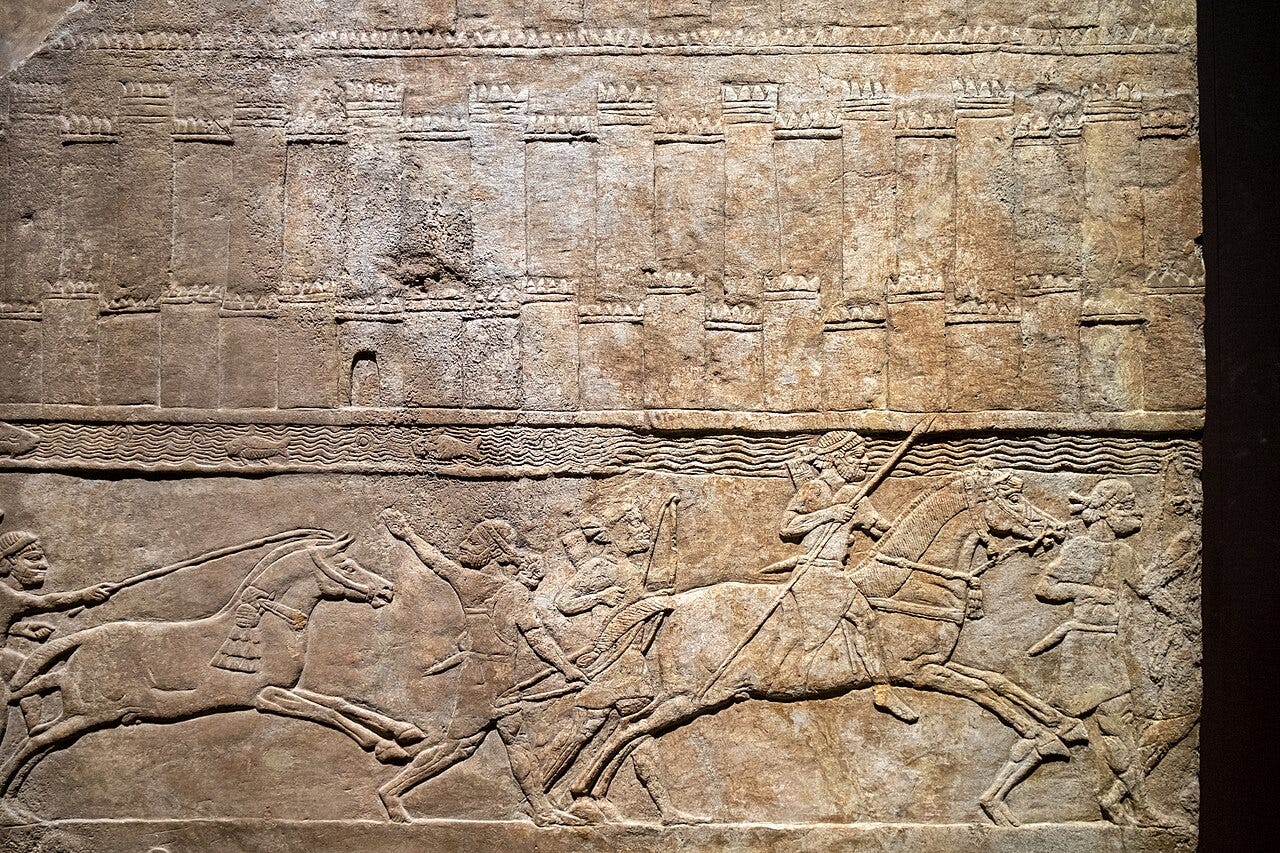
The walls of Nineveh at the time of Ashurbanipal. 645–640 BC. Credit: British Museum BM 124938
The fall of Nineveh
The destruction of Nineveh in 612 BC was one of the major turning points in ancient Near Eastern history.
The city’s fall ended the dominance of the Neo-Assyrian Empire, which had shaped the region for centuries through warfare, deportation, administration, monumental building, and imperial ideology.
Archaeological work at the Shamash Gate has revealed evidence connected with this destruction. Recent research has shown that the gate preserves traces of catastrophic episodes separated by more than 2,600 years: the ancient destruction of Nineveh and the modern destruction connected with ISIS occupation and the battle for Mosul.
This makes the Shamash Gate a rare archaeological location. It holds the physical record of two periods of violence, one ancient and one modern.
The new stele enters that story as a monument of royal ambition found within a landscape scarred by collapse and recovery.
Damage under ISIS
The Shamash Gate suffered major damage during the Islamic State occupation of Mosul between 2014 and 2017.
Archaeological research has documented how the gate was converted into a defensive position. Tunnels were cut through its foundations and superstructure. Some stone elements, including alabaster and limestone orthostats, were damaged or destroyed.
The gate’s modern history is therefore inseparable from the wider destruction of cultural heritage in Mosul and Nineveh during that period. Parts of Nineveh’s walls, gates, and monuments were attacked. The Mosul Museum was also heavily damaged.
The discovery of the stele during restoration work gives the find a powerful modern context. It was uncovered in the process of recovering a site that had itself become a battlefield.
Restoration at the Shamash Gate
Work at the Shamash Gate has continued through Iraqi and international collaboration.
The project has involved documentation, mapping, damage assessment, tunnel stabilization, excavation, conservation, and plans for future public presentation. The University of Chicago’s Institute for the Study of Ancient Cultures has been involved through the Nineveh East Archaeological Project, working with Iraqi authorities and international partners.
Earlier work showed that the gate’s core structure survived despite severe damage. Stabilization of the tunnels was essential because they threatened the integrity of the ancient gate complex.
The new stele was found during this wider effort. That makes the discovery part of a larger story of rescue archaeology and cultural restoration.
At Nineveh, conservation is not only about preserving stone. It is about returning a damaged ancient landscape to the people of Mosul and Iraq.
A gate with a long excavation history
The Shamash Gate has attracted archaeological attention for nearly two centuries.
In the mid-19th century, Austen Henry Layard and Hormuzd Rassam investigated parts of Nineveh and its gates. Their work brought many Assyrian monuments to European museums, but it also belonged to an era of colonial excavation practices that often prioritized the removal of spectacular objects.
In the 1960s, Iraqi archaeologists carried out more systematic work at the Shamash Gate. They excavated parts of the structure and undertook reconstruction, including the restoration of sections of the outer wall and the gate’s massive mudbrick form.
Modern work has returned to the site with different priorities: stabilization, documentation, conservation, local heritage recovery, and careful archaeological recording.
The new stele therefore emerges from a place with a long and complicated archaeological biography.
Mosul marble and local material identity
The stele was carved from Mosul marble.
This detail connects the object to the landscape around Nineveh. Stone was not simply a neutral material in Assyrian architecture. It carried local identity, durability, and visual authority.
Assyrian palaces and gates used carved stone slabs, orthostats, inscriptions, and reliefs to turn buildings into historical and ideological statements. Walls were not passive surfaces. They were places where kings told stories about conquest, construction, divine support, and world order.
The newly discovered stele belongs to this same tradition of monumental stone communication.
Its material, size, and placement all suggest that it was meant to endure.
The royal image
The figure of Ashurbanipal on the front of the stele would have been central to its message.
Assyrian royal images were highly controlled. Kings were shown with symbols of power, authority, piety, and command. Their bodies, clothing, gestures, weapons, and posture communicated status.
A royal relief at a gate created a direct visual encounter between the king and anyone passing through that space. Even if the viewer could not read cuneiform, the image carried authority.
The stele’s combination of image and text allowed it to speak on two levels. The relief communicated royal presence. The inscription preserved royal memory.
Together, they made Ashurbanipal visible at one of Nineveh’s most important entrances.
The god Shamash and royal justice
The gate’s association with Shamash gives the discovery another symbolic layer.
Shamash was the sun god, but also a god of justice, truth, and judgment. In Mesopotamian thought, sunlight could reveal what was hidden. The sun’s daily journey across the sky made Shamash a divine witness to human conduct, legal order, and royal decision-making.
Kings often linked themselves with divine justice. A ruler who built or restored a city gate under the name of Shamash could present his work as part of a larger cosmic order.
This does not mean the stele was only religious. Assyrian kingship did not separate politics, religion, and urban construction in a modern way. A royal building inscription could be a political document, a sacred dedication, and a public display at the same time.
At the Sun Gate, those meanings came together naturally.
A monument waiting to be read
The most important work now belongs to epigraphers and conservators.
The inscription must be cleaned, documented, photographed, drawn, compared, translated, and published. Scholars will examine the script, grammar, royal titles, formulae, divine references, and any unusual historical details.
They will also compare the stele with other Ashurbanipal inscriptions, including building records from Nineveh and other Assyrian sites.
The results could clarify whether the monument refers specifically to the Shamash Gate, to a wider building program, or to another royal project. It may also help researchers understand how Ashurbanipal framed his role in maintaining Nineveh late in Assyrian imperial history.
Until that work is complete, the stele remains partly silent.
But even before full publication, its location, date, imagery, and scale make it one of the most important recent finds from Nineveh.
Future display in Mosul
Iraqi authorities have not yet made a final decision about where the stele will be displayed.
Reports suggest that it may remain near the Shamash Gate or eventually be shown in the planned Mosul Civilization Museum. Either option would carry strong meaning.
Keeping the stele near the gate would preserve the connection between monument and original setting. Displaying it in a museum would allow controlled conservation, public interpretation, and wider access.
In both cases, the find belongs to Iraq’s cultural heritage and to the recovering historical identity of Mosul.
After years of destruction, the discovery of a royal Assyrian monument at Nineveh has become part of a broader cultural resurgence.
Nineveh after destruction
The story of the new stele is not only ancient.
It is also modern.
The monument was found at a gate damaged by ISIS, in a city deeply affected by war, during restoration work designed to preserve a heritage landscape for the future.
That context gives the discovery a rare emotional force. A stone monument created to record royal building works in the seventh century BC was uncovered while modern teams were repairing damage from the 21st century.
Nineveh’s ancient and modern histories meet at the Shamash Gate.
The gate witnessed Assyrian power, imperial collapse, 19th-century excavation, 20th-century reconstruction, modern conflict, and now recovery. The stele adds another layer to that long sequence.
A new royal voice from the Sun Gate
The discovery at Bab Shamash adds a remarkable new object to the archaeology of Nineveh.
It brings together Ashurbanipal, cuneiform writing, royal building, Shamash, the eastern road to Arbela, the memory of the Assyrian capital, and the modern restoration of Mosul’s heritage.
The stele’s full text is still awaiting detailed publication. Its historical value will grow once specialists complete the reading.
For now, the monument already tells a powerful story.
It shows that Nineveh still holds major evidence beneath its damaged stones. It shows that restoration can become discovery. It shows that the gates of an ancient empire can still speak, even after conquest, collapse, excavation, destruction, and rebuilding.
At the Sun Gate of Nineveh, a royal message from Ashurbanipal’s world has returned to the surface.
Sources
Greek Reporter. (2026, June 26). Rare Assyrian Stele Found at Ancient Nineveh’s Sun Gate in Iraq. Greek Reporter.
The National. (2026, June 25). Rare stele of Assyrian king who reigned 2,600 years ago unearthed in Iraq’s Nineveh. The National.
Arkeonews. (2026, June 25). 2,700-Year-Old Assyrian Stele Discovered at Nineveh’s Ancient Sun Gate. Arkeonews.
SyriacPress. (2026, June 24). New ancient Assyrian stele discovered at Bab Shamash, Iraq. SyriacPress.
Harrison, T., AbuJayyab, K., Batiuk, S., Gibbon, E., Marchesi, G., Evans, B., Shafiq, R., & Fonti, A. (2026). The Shamash Gate, Nineveh: A Window into Two Episodes of Instability. Iraq, 87, 163-183. DOI: 10.1017/irq.2026.10042
Harrison, T. P., & Abu Jayyab, K. (2024). Nineveh Shamash Gate Project. Institute for the Study of Ancient Cultures, University of Chicago, Annual Report 2023-2024.
British Museum. (2018). A library fit for a king. British Museum.
British Museum. What was Ashurbanipal’s Library? British Museum Research Project.
Rare?
How do you know that? They might have been as common as muck in the 7th C BC.