


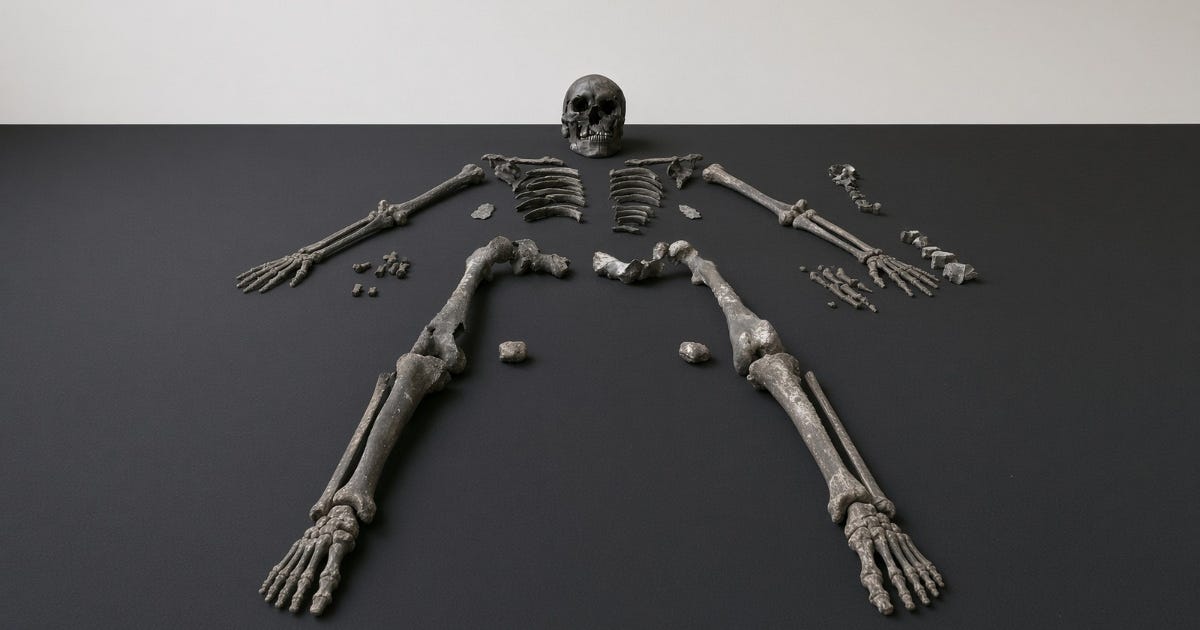
The skeleton known as Yotzin, laid out for study by INAH's Bioarchaeology Section. The dark colour of the bones comes from the swamp sediment of former Lake Xaltocan, where he was found in 2021 on the site of Felipe Ángeles International Airport. Credit Melitón Tapia, INAH
A wisdom tooth from a man found among mammoth and camel remains north of Mexico City has been radiocarbon dated to roughly 13,000 years ago. Mexico’s National Institute of Anthropology and History (INAH) announced the results on 20 November 2026. The skeleton, which researchers call Yotzin, is now one of the 23 oldest human remains known from the Basin of Mexico.
Archaeologist Israel Peña found him in 2021 on the northwest side of what is now Felipe Ángeles International Airport in Santa Lucía, State of Mexico. INAH carried out salvage excavations while the airport was being built, on land that was once the bed of Lake Xaltocan. The name Yotzin means “unique” in Nahuatl.
Two laboratories dated the same wisdom tooth
The sample came from a third molar. Jean-Philippe Vielle Calzada of the Advanced Genomics Unit at Cinvestav in Irapuato arranged for it to go to two laboratories.
ISOTOPIQ AGING, a company in Belgium, dated the tooth’s collagen to between 13,087 and 12,987 years before present. The Center for Applied Isotope Studies at the University of Georgia dated its bioapatite, the mineral part of the tooth, to between 12,050 and 11,700 years before present.
The two ranges are about 900 years apart and do not overlap. INAH presents them together as one span of 13,087 to 11,700 years before present and does not explain the gap. Radiocarbon specialists generally treat well-preserved collagen as the more dependable material, because the carbonate in bone and tooth mineral can exchange carbon with groundwater after burial and often gives younger results. On that reading, the collagen date of about 13,000 years is the stronger figure. INAH has not said which result it prefers, and no full laboratory report or peer-reviewed paper has been published yet.
Either range places Yotzin at the end of the last Ice Age, when mammoths, camels and horses still grazed around the lakes of the Basin of Mexico.
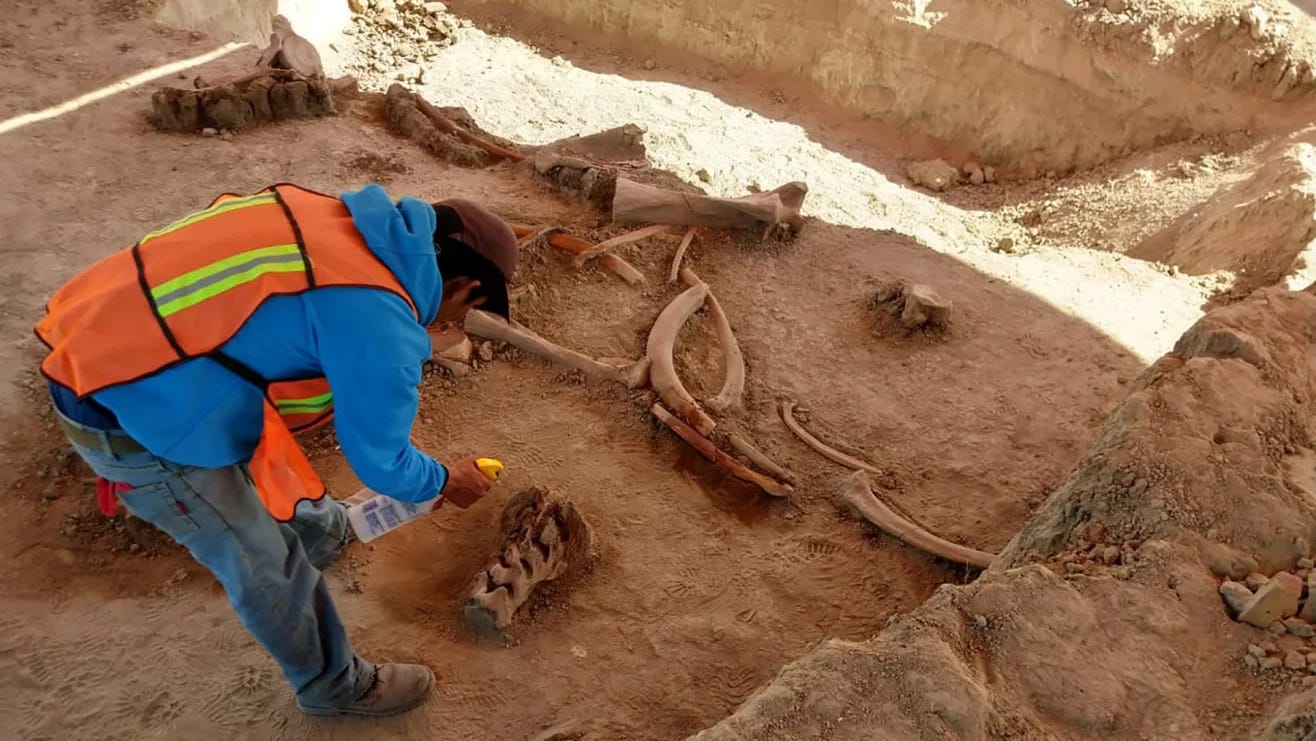
An archaeologist cleans mammoth bones, including ribs and vertebrae, during INAH’s salvage excavations at the Felipe Ángeles International Airport site in Santa Lucía, north of Mexico City, in 2020. Yotzin was found at the same airport site in 2021. Credit Instituto Nacional de Antropología e Historia (INAH)
A tall, robust man found flexed in swamp mud near megafauna
INAH’s June 2024 bulletin describes the first results of the physical study. Yotzin was a man aged 25 to 30 at death, and he stood about 1.75 metres tall. Physical anthropologist Arturo Talavera González of INAH’s Bioarchaeology Section says most pre-Hispanic people in the region measured between 1.60 and 1.65 metres.
The excavators found him in a flexed position at the site known as M3, close to the hill and town of Xóloc, at about 2,240 metres above sea level. He lay in Stratigraphic Unit IV, a dark, silty swamp deposit that palaeoenvironmental researchers classify as a Solonchak, near where it meets an overlying wetland soil. Project director Rubén Manzanilla López reported no artefacts with the body, and Pleistocene megafauna remains lay about half a metre away in the same layer. Yotzin was the only human skeleton in an excavation area measuring 25 by 30 metres. The swamp sediment stained his bones a deep brown to black, the same colour as the animal fossils around him.
About 80 per cent of the skeleton was recovered. The skull was broken at the nose and left eye, and the chest was crushed. Talavera describes the skull as long and narrow and the jaw as wide. The shinbones are flattened from front to back, a trait often linked to heavy walking. His teeth are deeply worn and have no cavities, which dentist Sandra López Flores confirmed. Talavera connects this to a diet with almost no carbohydrates, heavy chewing of roots and bark, and use of the teeth as a tool. The 2024 study also recorded signs of a middle-ear infection, inflammation of the bone surface, and possible migraine.
Talavera describes Yotzin as a hunter used to long walks and hard physical effort. At a lecture at El Colegio Nacional on 19 November 2026, reported by the Mexico City newspaper Crónica, he suggested the man may have been killed by a mammoth and said the body was probably not an intentional burial. Both ideas are his interpretation. INAH’s bulletins do not state a cause of death.
The new dates sharply revise the 2024 estimate
When INAH first announced Yotzin in June 2024, radiocarbon dates were still pending. The team suggested an age of about 10,000 years based on the skeleton’s form. Biologist Lauro González Quintero linked the swamp layer to an interglacial phase that has been dated between 20,000 and 13,000 years ago at Tlapacoya, another site in the Basin of Mexico.
The new results push the estimate back by about 3,000 years if the collagen date holds. That makes Yotzin comparable in age to the Peñón III woman, found in 1959, whom INAH dates to more than 12,000 years ago. Peña stresses that Yotzin came from a controlled excavation with full records of plans, sections and photographs. Many early skeletons from the region came from chance finds or poorly documented digs.
Further south, Naia, a teenage girl found in the flooded Hoyo Negro cave on the Yucatán Peninsula, is dated to between about 13,000 and 12,000 years ago. Her mitochondrial DNA belongs to a lineage still found among Native Americans today.
A genome study in Burgos may test the skull-shape theory
Talavera compares Yotzin’s long skull with those of the Pericú, a people of the southern tip of Baja California. Researchers have argued since the early 2000s that Pericú skulls preserve an early “Palaeoamerican” form. Later genome sequencing of Pericú remains placed them within the range of other Native American populations, which shows how skull shape on its own is a weak guide to ancestry.
Yotzin’s DNA should settle the question for him. INAH says a genomic study will take place at the University of Burgos in Spain, and results could arrive in the first quarter of 2027. Crónica reports that the inner-ear bone, the part of the skull that usually preserves ancient DNA best, will be sent for sequencing. Talavera has said the aim matters more than the age, since the key question is where Yotzin came from.
Once the studies are complete, Yotzin will join the Preceramic Collection of the Basin of Mexico at the National Museum of Anthropology, which currently holds 22 specimens.
Subscribe for a few dollars a month and get every long read, the short documentaries and the full archive. Cancel anytime.
Explore this discovery on the Ancient Content Atlas:
Sources:
INAH, Boletín 548, “Fechamiento arroja antigüedad de 13,000 años para el esqueleto humano Yotzin”, 20 November 2026. https://www.inah.gob.mx/boletines/fechamiento-arroja-antigueedad-de-13-000-anos-para-el-esqueleto-humano-yotzin
INAH, Boletín 347, “Estudios de antropología física identifican a ‘Yotzin’, que podría ser el único hombre precerámico descubierto en Santa Lucía”, 18 June 2024. https://www.inah.gob.mx/images/boletines/2024/347/Boletin%20347.pdf
INAH, Boletín 783, 2024 year-end round-up of discoveries, 26 December 2024. https://inah.gob.mx/images/boletines/2024/783/Boletin%20783.pdf
Andrea Martínez, “Arturo Talavera confirma que Yotzin, el esqueleto hallado en el AIFA, tiene 13 mil años”, Crónica, 15 November 2026. https://www.cronica.com.mx/academia/2026/11/15/arturo-talavera-confirma-que-yotzin-el-esqueleto-hallado-en-el-aifa-tiene-13-mil-anos-en-espana-secuenciaran-su-genoma/
Chatters, J. C. et al. (2014). Late Pleistocene human skeleton and mtDNA link Paleoamericans and modern Native Americans. Science 344, 750–754. DOI 10.1126/science.1252619
González-José, R. et al. (2003). Craniometric evidence for Palaeoamerican survival in Baja California. Nature 425, 62–65. DOI 10.1038/nature01816
Raghavan, M. et al. (2015). Genomic evidence for the Pleistocene and recent population history of Native Americans. Science 349, aab3884. DOI 10.1126/science.aab3884
Fascinating
@mexicosoul
Now this is why I love archaeology! Imagine finding a fellow who's been lying there for 13,000 years, only to discover that his wisdom tooth has quite a story to tell. I'm particularly curious about what the DNA analysis will reveal. Every time we think we've pieced together a bit of human history, someone comes along with another piece of the puzzle. Fascinating stuff!