


Archaeologists in the Marche region of central Italy have uncovered a monumental sixth-century BC burial complex built around the tomb of a Picene prince, laid to rest with a two-wheeled chariot and surrounded by grave goods that speak to the power and reach of the Adriatic aristocracy. The discovery, announced on July 1, 2026, by the regional heritage office for Ancona and Pesaro and Urbino, comes from the great Picene necropolis of the Conero, near the town of Sirolo.
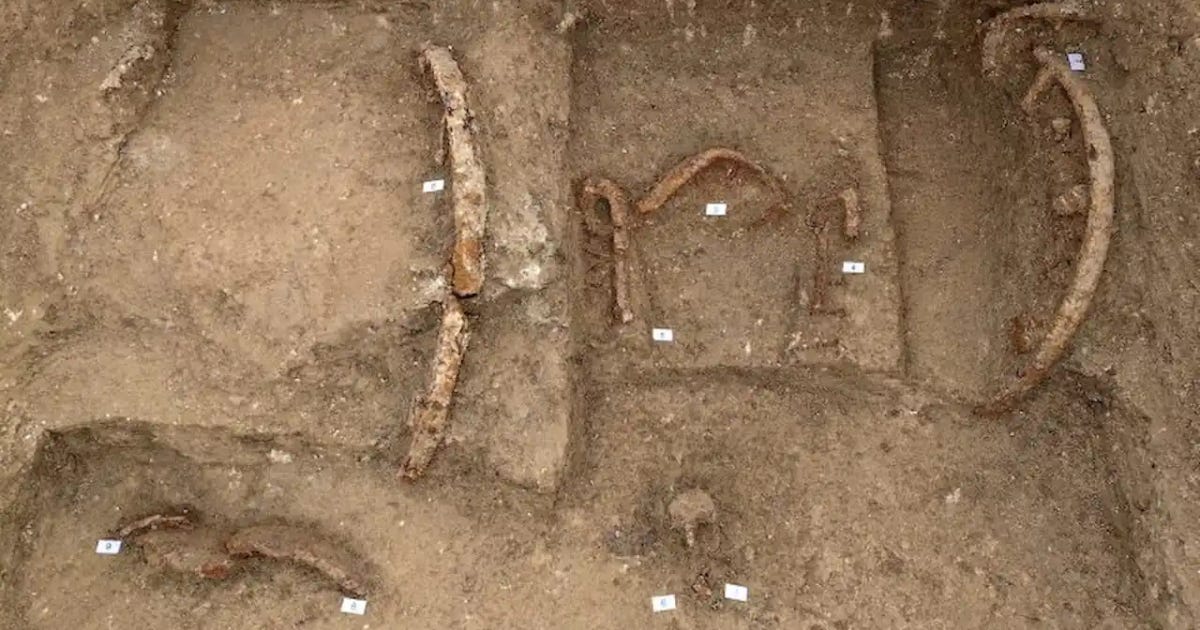
Picene Prince’s Chariot Tomb Unearthed on Italy’s Conero Coast. Credit: Soprintendenza Abap Ancona Pesaro Urbino
The find emerged during preventive archaeology work carried out by the firm ArcheoLab in collaboration with the Comune di Sirolo, and funded by Italy’s Ministry of Culture. What the team uncovered is not a single grave but an organized aristocratic burial ground, and with it a clearer picture of the ruling families who dominated this stretch of coast some 2,600 years ago.
The context of a warrior found in 2020
The new complex finally makes sense of an earlier discovery. In 2020, in the same area, archaeologists found the tomb of a warrior who lived in the second half of the sixth century BC, buried with a first-rate set of arms that included a helmet, a spear, a long sword, and a dagger. His grave goods also held a refined bronze oinochoe, a wine jug in the Greco-Etruscan tradition, and something rarer still, a diphros, the folding stool that ranked among the most exclusive emblems of authority in pre-Roman Italy.
At the time, that warrior stood alone. The new excavation shows he belonged to a much larger monumental cemetery organized around a central princely burial. For the first time, researchers can read the group rather than the individual, tracing the hierarchical and symbolic relationships that bound an entire aristocratic nucleus together.
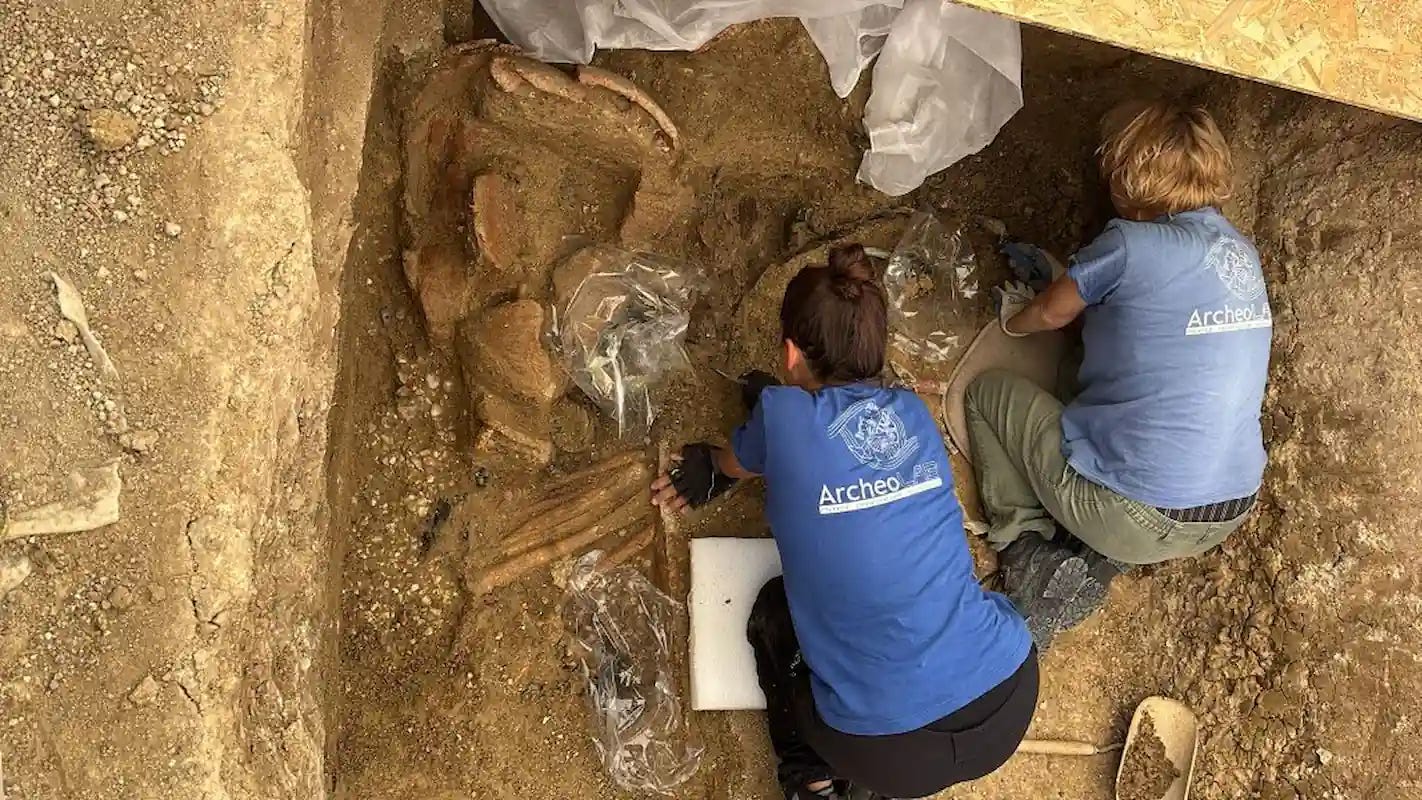
Archaeologists excavating the Tomb of the Chariot. Credit: Soprintendenza ABAP Ancona–Pesaro Urbino.
A prince buried with his chariot
At the heart of the newly revealed monumental circle lay a large male burial containing the remains of a currus, a two-wheeled chariot that appears to have been placed intact in the grave pit. In the funerary world of the Picenes and pre-Roman Italy more broadly, a chariot was among the clearest markers of princely rank, and this one places its owner firmly among the elite.
The weapons buried with him, including a helmet, an axe, and other offensive arms, reinforce that status. So do several other objects, still being cleaned and studied, that seem to point to forms of power and authority not previously well documented in Picene territory. The excavators suggest these pieces may eventually reshape how we understand the roles played by the Conero’s ruling class in the sixth century BC.
A banquet sealed for the afterlife
Among the most striking finds are large vessels of beaten bronze sheet recovered from the chariot tomb. Sealed with ceramic lids and still full, they held organic material, ceramic fragments, and animal bones. The team reads them as the traces of a funeral banquet held at the burial, or as food offerings meant to sustain the dead man on his journey into the afterlife. That they remained closed for more than two and a half millennia gives researchers a rare chance to study the contents directly.
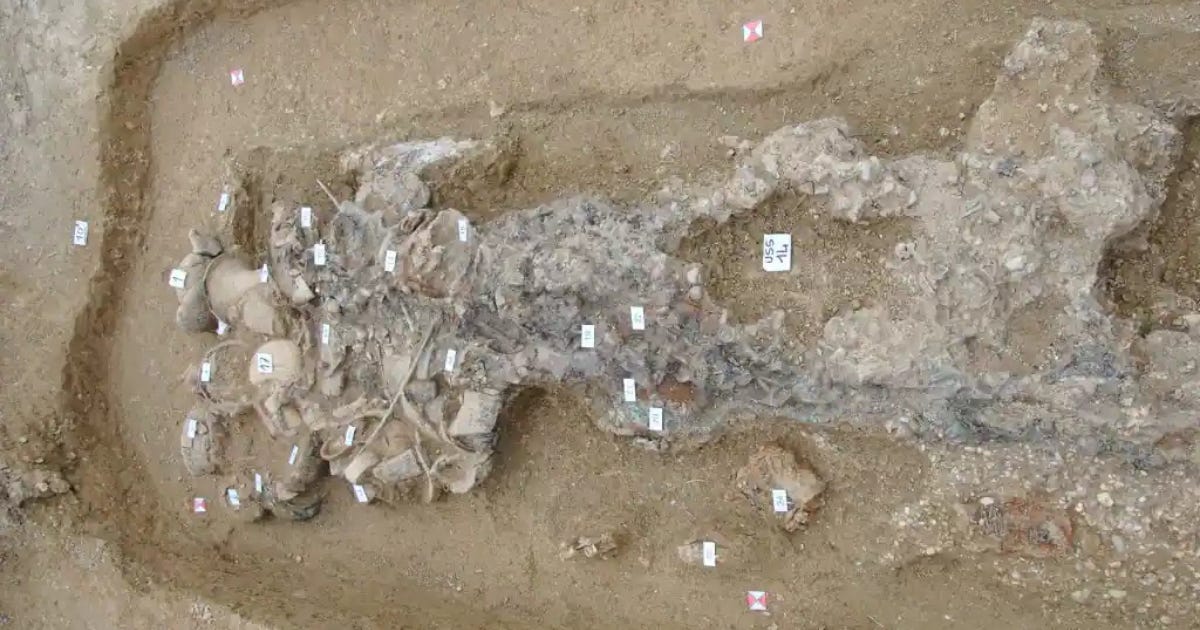
Excavation of the female burial. Credit: Soprintendenza ABAP Ancona–Pesaro Urbino.
A woman adorned in fibulae and amber
Beside the central tomb lay a female burial of considerable richness. Excavators documented textiles, decorative elements, and the remains of footwear with metal fittings still in their original positions. Numerous fibulae, the ornamental brooches used to fasten clothing, were arranged directly on the body at the chest, shoulders, pelvis, and feet, holding in place the garments and shroud that wrapped her. A large fibula with an amber core lay just beyond her head, possibly part of a headdress or hairstyle. These details promise new insight into ritual practice and into how prestige was expressed for aristocratic women in Picene society.
A monument built to be seen
The complex also rewrites part of what was known about how these burials were designed. The great funerary circles of the Conero and the wider Piceno had always been defined by a ring ditch, usually cut in a V-shaped profile, that separated the space of the living from that of the dead. The Sirolo complex does something new. Its boundary is marked not by a ditch but by a ring palisade, traceable through a regular series of post holes, each holding small deposits of carefully selected pottery fragments at its base.
Its placement looks equally deliberate. The circle sits on a low natural rise that commands the surrounding land, a choice that seems meant to make the monument immediately visible across the funerary landscape and to underline its symbolic weight. It lies not far from the celebrated Tomb of the Queen and the area long known as the necropolis of the Pini, and geophysical surveys suggest the burial ground extended well beyond its previously understood limits.
Why it changes the picture
For Stefano Finocchi, the excavation’s scientific director, the value of the find is that it lets researchers see a whole aristocratic community rather than a lone grave. He describes a nucleus with legible hierarchical and symbolic relationships, one that opens new perspectives on the elites who led the major Picene center that grew up in the Conero area. The scale of the monument, the quality of the grave goods, and the objects still under study together sketch a ruling group woven into a dense web of contacts, one that linked the middle Adriatic to the leading centers of central Italy.
Source: Soprintendenza Archeologia, Belle Arti e Paesaggio per le Province di Ancona e Pesaro e Urbino (July 1, 2026).