


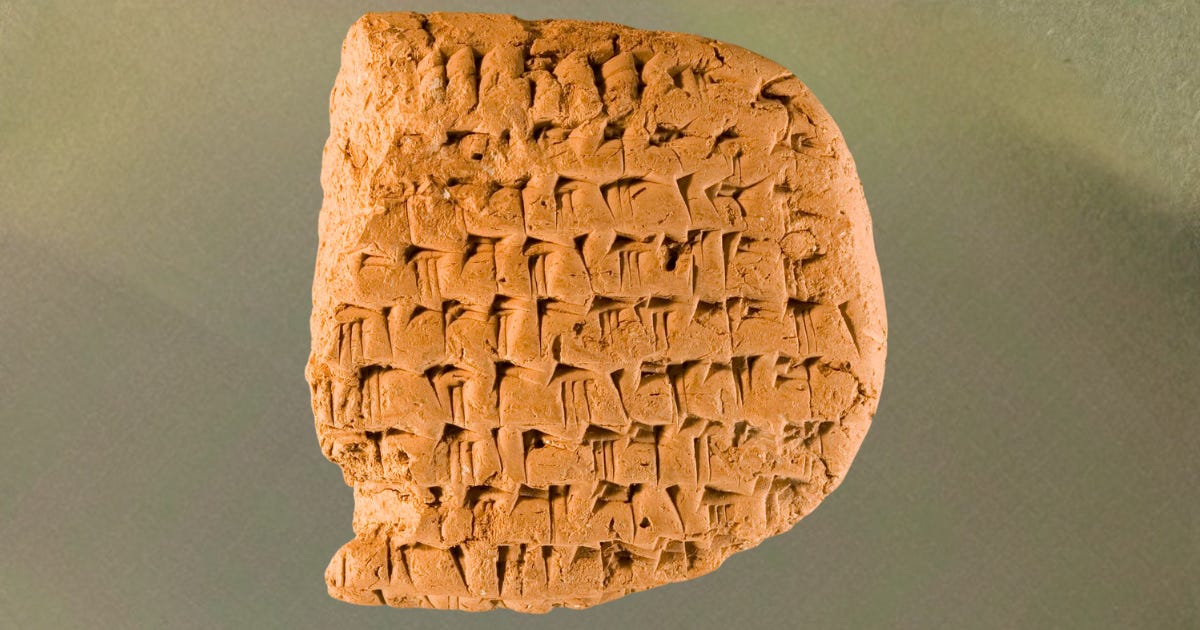
An administrative clay tablet from Persepolis, written in cuneiform. Photo by Ardeshir Khosravi, Wikimedia Commons, CC BY-SA 4.0.
Clay tablets from the Persepolis Fortification Archive, written under Darius I between about 509 and 493 BCE, record extra food rations for women who had given birth, and mothers of boys received twice as much as mothers of girls. In tablet PF 1224, nine Ionian mothers of boys each received twice the amount given to each of 14 mothers of girls, according to Fariz Öncü and an overview of Richard Hallock’s edition. The same archive shows women drawing monthly work rations beside men, and a royal woman named Irdabama who held her own seal and whose work teams reached close to 500 people.
Ancient Content, November 9, 2026
A clay archive recorded the empire’s food rations
Ernst Herzfeld’s Oriental Institute expedition found the Persepolis Fortification tablets in March 1933 in a bastion of the fortification wall, according to Achaemenica. Herzfeld reckoned the find at 30,000 tablets or more, and the tablets were packed in 2,353 cardboard boxes. Current estimates run to at least 15,000 original Elamite tablets, of which about 7,000 are legible, plus about 840 Aramaic tablets and up to 5,000 tablets bearing only seal impressions.
The texts cover regnal years 13 to 28 of Darius I, about 509 to 493 BCE, and record the intake and issue of grain, wine, livestock and other goods. Richard Hallock published 2,087 Elamite texts in 1969 as Oriental Institute Publications 92.
Mothers of boys received twice the ration of mothers of girls
Encyclopaedia Iranica reports that mothers of newborns received extra rations and that mothers of boys received twice the food of mothers of girls. An overview of Hallock’s edition places these texts in its category N, PF 1200 to 1237 and 2048, and describes them as single payments. Wikipedia likewise reports single rations for new mothers.
The clearest example is PF 1224, dated to month 12 of Darius’s 22nd year. Öncü reports that Ionian mothers at Persepolis received 32 BAR of grain in total. Nine mothers of boys received 2 BAR each and 14 mothers of girls received 1 BAR each, and 9 times 2 plus 14 times 1 gives the total.
Other texts follow the same pattern with other goods. In PF 1203, from year 25, Öncü reports 1 marriš of wine for each mother of a boy and half a marriš for each mother of a girl. In PF 1233, from year 21, the amounts are 1 BAR and half a BAR of a commodity that Öncü transliterates as mitli. Öncü presents the mothers’ amounts as monthly, which differs from the single payments in the Hallock overview and Wikipedia.

