


Excavations at the gymnasium of ancient Mieza, near Naousa in northern Greece, have uncovered two banquet halls with intact mosaic floors. The Greek Ministry of Culture says the quality of the floors and finishes matches the Royal Palace of Aigai at Vergina, the residence of Philip II.
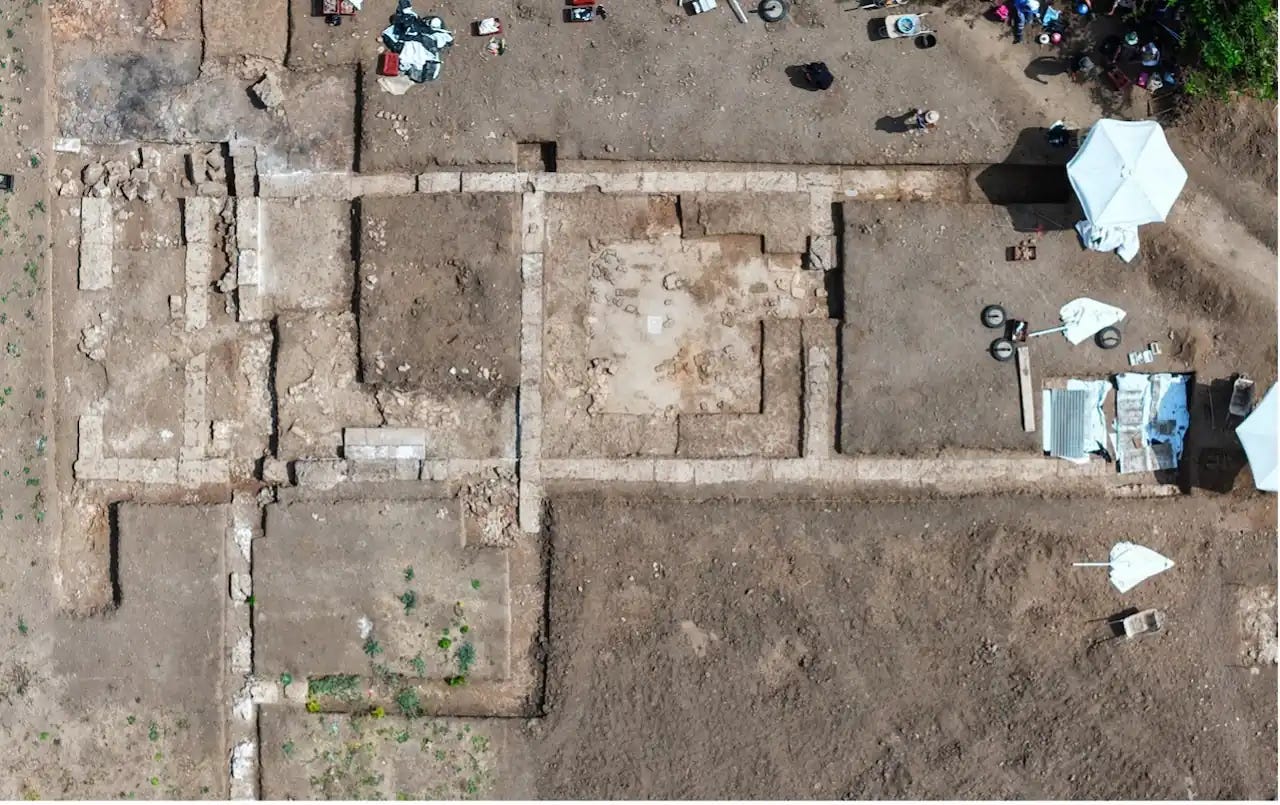
Mieza is the site where Aristotle is said to have taught the young Alexander. This year’s work, led by Angeliki Kottaridi, focused on the eastern side of the complex, where the palaestra meets the Didaskaleion, the house of teaching. There the team found the classrooms, rows of stone benches still facing where a teacher would have stood.
Next to them stood a three-room building of more than 160 square metres, built around a central vestibule flanked by two andrones, the men-only dining halls of the Greek world. Both keep their mosaic floors, and the raised platforms show each hall held ten couches, so at least twenty guests reclining at once. The students studying alongside Alexander were learning to host and attend symposia with the same ceremony practised at court.
The comparison with Aigai carries real weight. It suggests Mieza was not an ordinary school but a building raised to palace standard, quite possibly by the same craftsmen who worked for the Macedonian kings.
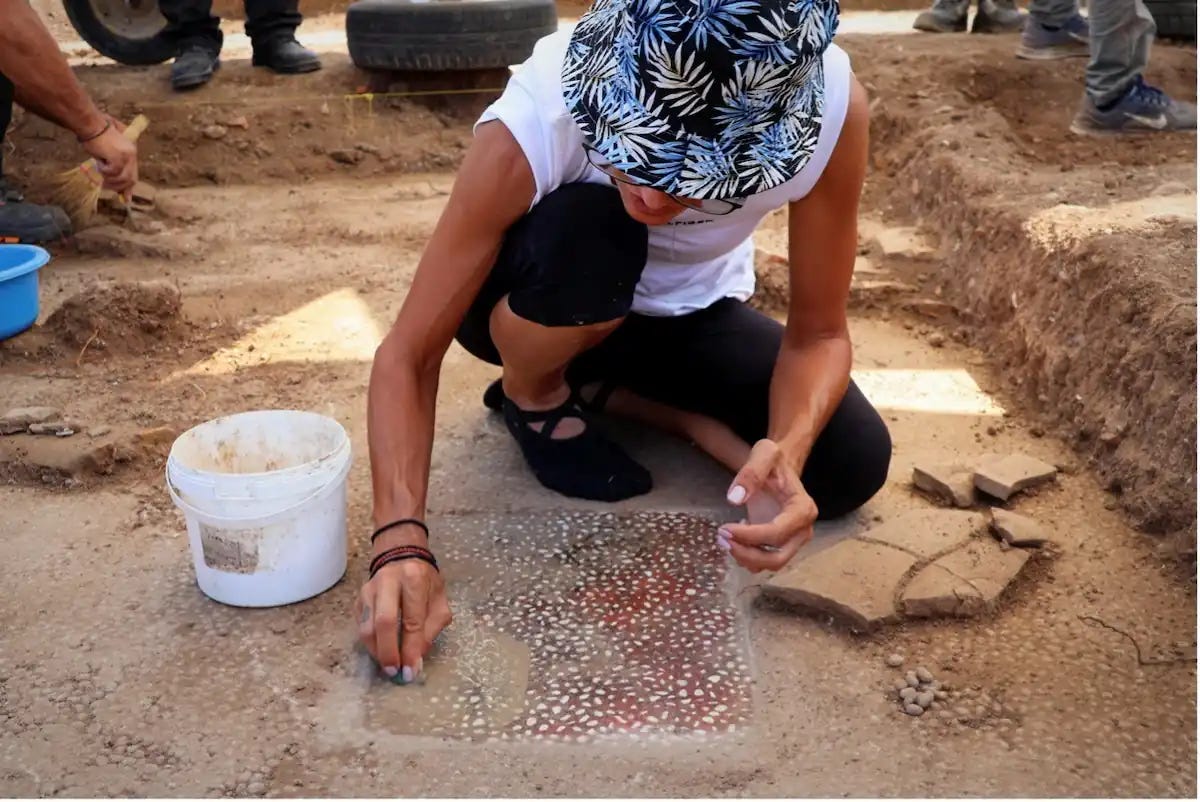
Archaeologists carefully cleaning the mosaic in the northern portico. Credit: Hellenic Ministry of Culture
What earlier seasons found
Systematic excavation began in 2024. By 2025 it had produced four bronze writing styluses linked to the wax-tablet exercises of Aristotle’s students, and fragments of Panathenaic amphorae, the containers for the sacred olive oil awarded at Athens. The largest feature remains the xystos, a two-storey covered colonnade nearly 200 meters long where students ran laps under cover.
The Aristotle link is a hypothesis
Worth stating plainly. The connection to Aristotle’s actual lessons rests on later literary sources, chiefly Plutarch, who places the tutoring at a nearby Sanctuary of the Nymphs rather than inside the gymnasium. Identifying this building as the classroom is supported by the dating, the scale, the quality and the proximity to Pella, but it is not documented certainty.
What is certain is the ending. The Romans dismantled the gymnasium after the second Battle of Pydna in 148 BC, which ended Macedonia as an independent kingdom. The demolition debris and a later fire buried the plaster and floors, which is why they survive nearly intact twenty-one centuries on.
Source. Hellenic Ministry of Culture, September 2026.