


Picture Cave sits in Warren County, Missouri, about sixty miles west of St Louis. Beyond its entrance is a section researchers call the dark zone, where no daylight reaches at all. On those walls are more than 300 pictographs, painted in red and black, and every one of them was made by someone working in complete darkness by firelight.
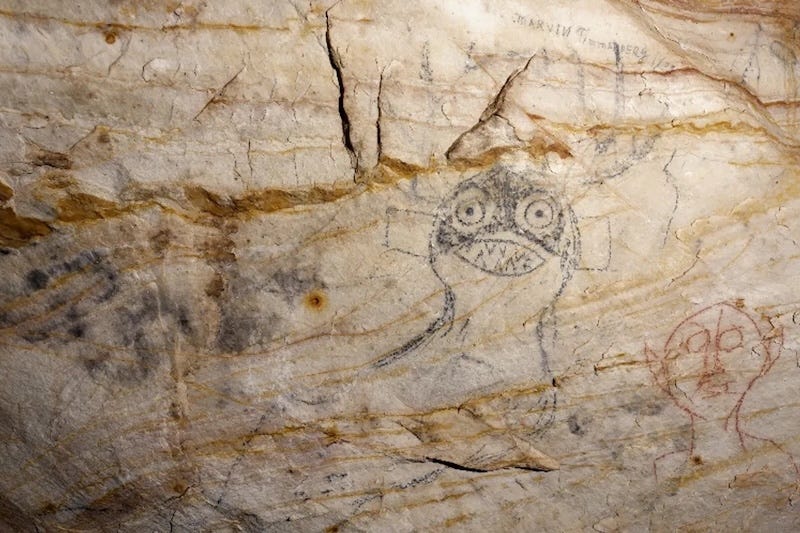
A new radiocarbon study has established when. The answer is that they kept coming back for roughly 1,500 years.
The work, by Karen Steelman and Michael Fuller, appears in American Antiquity.
What the pigment dated to
Steelman and Fuller sampled red and black pigment from 24 of the images and ran radiocarbon dates on them. The results spread across a range of between 905 and 1,480 years, with the earliest paintings possibly made as early as AD 85.
The most recent dates to around AD 1630.
That end date is worth pausing on. It places people still painting in this cave well into the seventeenth century, long after European contact had begun reshaping the continent. Whatever Picture Cave meant to the communities using it, they did not stop.
Two eras on the same walls
The chronology cuts across a major change in how people in this region lived.
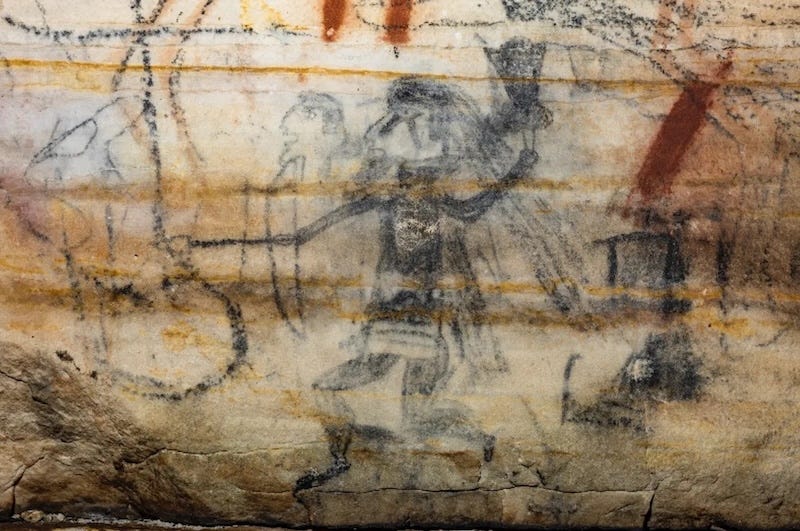
The most recent study dates one particular image, a spiritual being known variously as Morning Star, Hawk, or Birdman, shown in a scene depicting the first sunrise, to about 980 years ago. That places it in the Mississippian period, when stratified societies developed across the Southeast and Midwest, with Cahokia as their great centre.
Other images are considerably older, reaching back into the Woodland period, when social organisation was less hierarchical.
Ritual painting continued through that transition. The people changed how they organised themselves and kept returning to the same cave.
The authors read Picture Cave as a place set aside for sacred ritual, its images representing elements of Siouan cosmology. The artists were likely connected to Cahokia, and are ancestral to the present-day Omaha, Osage, Ponca, Kansa, and Quapaw nations.
Reading the images with descendants
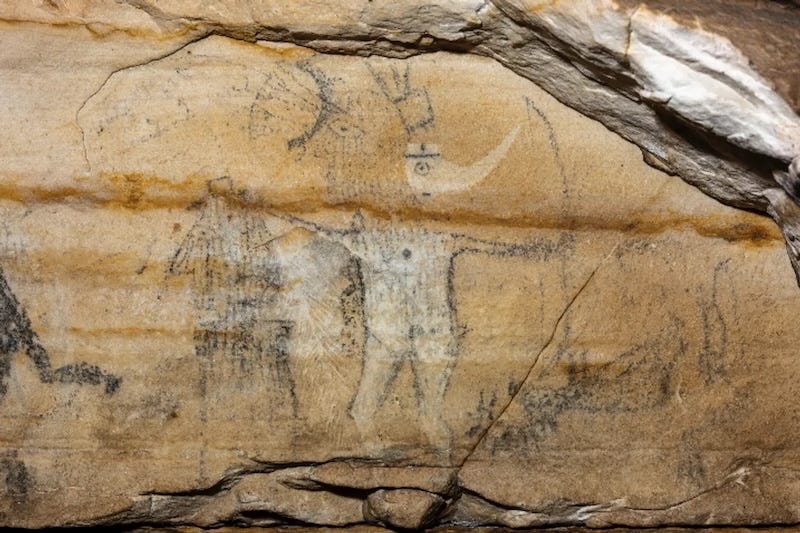
Last year a separate group of researchers worked with tribal elders from some of these nations to understand the pictographs and what they meant. That collaboration produced the identification of the Morning Star figure, among others.
The images include horned beings understood as underwater spirits, a warrior holding a mace with bow and arrows, and the Great Serpent depicted with an erect phallus. These are not decoration. They are a visual record of a cosmology.
Sold in 2021
In September 2021 the cave and the 43 acres around it were auctioned by Selkirk Auctioneers and Appraisers in St Louis and sold to an anonymous bidder for 2.2 million dollars. The land had been in private hands since 1953, owned by a family who used it mainly for hunting, and went to auction after negotiations with the Osage Nation broke down.
The Osage Nation had tried to buy it, backed by The Conservation Fund, which raised two million dollars toward the purchase. They were outbid.
The Nation called the sale truly heartbreaking. Their statement noted that their ancestors had lived in the area for 1,300 years, that it had been their land, and that hundreds of thousands of their ancestors are buried across Missouri and Illinois, including at Picture Cave. Andrea Hunter, the Nation’s tribal historic preservation officer, said it is Osage ancestors buried in the cave, Osage ancestors who made the images and performed the rituals there, and that the site is the most sacred they have.
Elders on the Traditional Cultural Advisors Committee described Picture Cave as among the most significant cultural and sacred sites for the Osage people, and its pictographs as unique in offering a visual record of their ancestors’ way of life, religion, and traditions.
The buyer was described by the auction house as a cave conservationist who wished to remain private. The Osage Historic Preservation Office has stated that the buyer did not respond to repeated attempts at contact.
The cave remains in private ownership. The current owner does appear willing to respect its cultural and religious significance, and has permitted research teams and Indigenous elders to continue studying the pictographs.
Sources: Steelman, K.L., and Fuller, M.J. (2026). "Picture Cave (23WN79), Pictograph Chronology." American Antiquity, 1 to 9. Reporting on the 2021 sale from NPR, Smithsonian Magazine, Artnet News, and the Osage Nation Historic Preservation Office.
I grew up an hour from this cave. It's literally something out of my short stories. Amazing. Thank you.
What I find amazing is that people on different continents did the same thing in cave, do you think it’s built into our DNA