


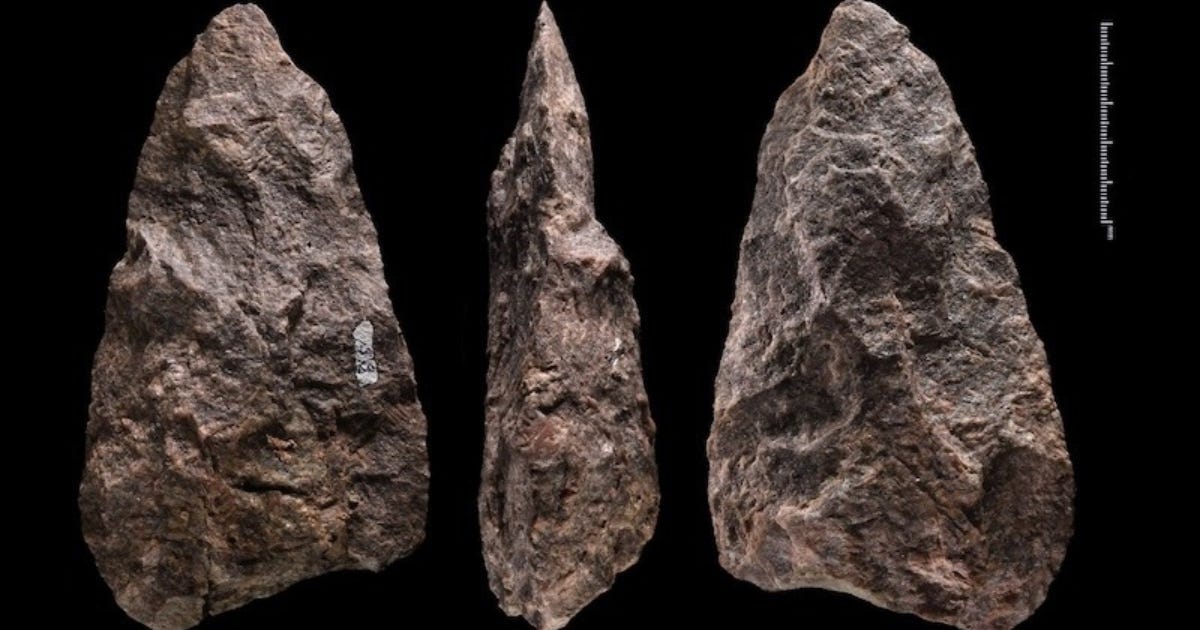
Polish archaeologists have recovered close to 100 Acheulean handaxes from the Okwa Valley, a remote and little-explored dry valley in Botswana’s Kalahari Desert. The team is led by Professor Mirosław Masojć, director of the Institute of Archaeology at the University of Wrocław. This year it found about 40 handaxes at a single site, together with the stone fragments left over from making them and from working larger blocks of raw material.
PAP’s Science in Poland service announced the finds on 24 November 2026. No peer-reviewed paper has described them yet, and the team has not published a date for the tools.
The handaxes lay along the shore of a Pleistocene lake
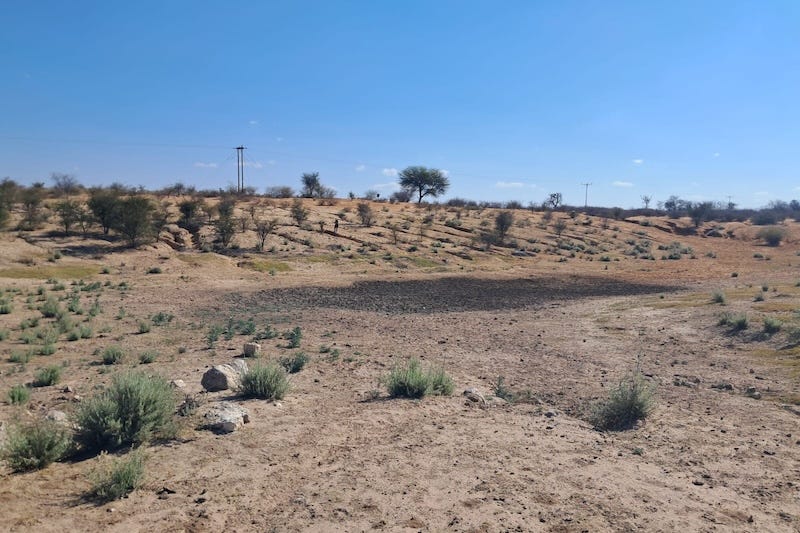
The Okwa Valley is dry today and lies far from any modern town. It runs west towards the border with Namibia. In the Pleistocene the area had a wide network of rivers and lakes, and their sediments hold a record of changing environments and early human activity.
The team found its way into that record through calcrete quarries. Calcrete is sediment cemented together by calcium carbonate, and Botswana digs it locally as a road-building material. The quarry faces cut through Kalahari sediments and show the valley’s geological structure. In them the researchers found traces of ancient river channels and a Pleistocene lake. The handaxes were lying along the lake’s former shoreline.
Masojć said the quarries proved invaluable. Dense bush covers much of the Kalahari, which makes the ground hard to reach and rules out systematic surface survey in many places. He described the valley as “an exceptionally challenging area for research.”
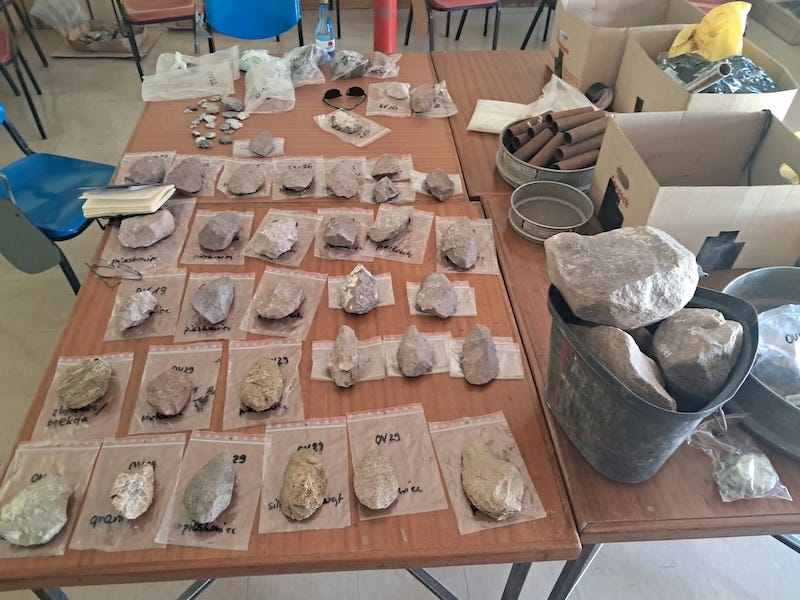
Workshop debris points to toolmaking on the spot
Shaping a handaxe from a block of stone produces large numbers of flakes. At this year’s main site, that debris turned up alongside the finished tools. This suggests people made handaxes at the lakeshore rather than only carrying them in from somewhere else.
The age falls somewhere in a span of 1.5 million years
Handaxes are the best-known tools of the Acheulean, one of the longest-lasting stone tool traditions. Masojć said the consensus is that it appeared in Africa about 1.7 million years ago and lasted until about 200,000 years ago.
Some reports have given 1.7 million years as the age of the Okwa handaxes. That figure is when the tradition began. Until the lakeshore sediments are dated, the Kalahari tools could belong anywhere in that long span. The team plans to combine its study of the tools with work on the sediments, their chronology and the ancient environment. The aim is to reconstruct how early communities used the Kalahari landscape and coped with environmental change in southern Africa.
The tools are now being analysed in Kraków
The handaxes are at AGH University in Kraków for detailed study. The team plans to compare them with handaxes from regions north of the Kalahari and with Acheulean material from South Africa. Many of the best-studied southern African Acheulean sequences come from the Northern Cape, at sites such as Wonderwerk Cave and Kathu Pan, while the Kalahari interior has seen far less fieldwork.
Masojć said the team is looking for the earliest evidence of hominin presence and movement, and for sites where it can do direct research. He added that the University of Wrocław has in effect been given access to the whole Kalahari for research into early human history.
The project is funded by a grant from Poland’s National Science Centre. Partners include the University of Botswana, the Korea Institute of Geoscience and Mineral Resources (KIGAM), and the Department of Regional and Deposit Geology at the Polish Geological Institute – National Research Institute in Warsaw.
Masojć’s team has worked on this kind of question before, in Sudan’s Eastern Desert. There, Acheulean and Middle Stone Age tools came out of sediments exposed by gold-mining shafts, with dates going back about 390,000 years.
See : Okwa Valley on the Ancient Content Atlas
Subscribe for a few dollars a month and get every long read, the short documentaries and the full archive. Cancel anytime.
Explore 2,350+ ancient sites on the free Ancient Content Atlas,
on the web at https://atlas.ancientcontent.com and on Android at:
https://play.google.com/store/apps/details?id=com.ancientcontent.atlas
Sources
Krajczyńska-Wujec, E. (2026). Polish archaeologists uncover nearly 100 ancient handaxes in remote Kalahari Desert. PAP – Science in Poland, 24 November 2026. https://scienceinpoland.pl/en/news/news%2C115771%2Cpolish-archaeologists-uncover-nearly-100-ancient-handaxes-remote-kalahari-desert (primary report; no DOI)
Zdziebłowski, S. Earliest traces of man found buried in abandoned Saharan gold mine. PAP – Science in Poland. https://scienceinpoland.pl/en/news/news%2C87507%2Cearliest-traces-man-found-buried-abandoned-saharan-gold-mine.html (for the Sudan work)
No peer-reviewed publication or DOI exists yet for the Okwa Valley finds.
I rather enjoy imagining what this landscape must have looked like when people sat along the lakeshore making these tools. How fascinating that a modern road-building quarry helped uncover their little corner of the world!
The handaxe is the first standardised object we can still read: same shape, thousands of kilometres apart, no writing involved. That is a mechanism doing the work that instructions would later do.