


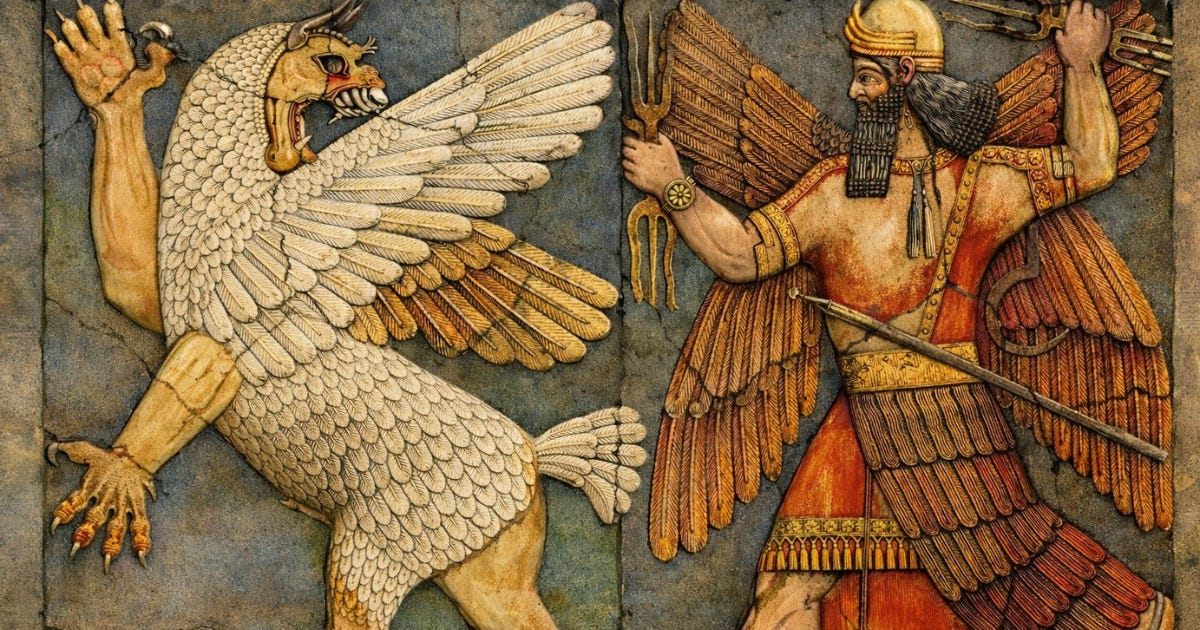
Alabaster wall panel relief showing the monster Anzu facing left; part of group as follows: alabaster wall panel reliefs showing god and monster; the god is Ninurta, chief god of the city of Nimrud and has a thunderbolt in each hand; he pursues the monster Anzu; inscribed. ( colorized)
In Neo-Assyrian thought, order was an achievement. It had to be guarded, renewed, and imposed against forces that threatened to break the structure of the world. Few images express this idea with more force than the great relief of Ninurta pursuing Anzu from the Temple of Ninurta at Nimrud, ancient Kalhu, carved around 865–860 BC during the reign of Ashurnasirpal II.
The relief shows a moment of divine pursuit. Ninurta, the chief god of Nimrud, advances with thunderbolts in his hands. Ahead of him is Anzu, the monstrous storm bird whose body combines the terror of the sky with the power of a predatory beast. The scene is direct, forceful, and easy to read: a god of disciplined power drives a cosmic threat back into defeat.
The story behind the image begins with a crisis at the heart of divine authority. In the Mesopotamian myth, Anzu steals the Tablet of Destinies from Enlil. This tablet was more than a sacred object. It represented the right to command fate, uphold cosmic hierarchy, and define the order of gods and humans. When Anzu takes it, he seizes the symbol of supreme authority. The theft throws the divine world into disorder.
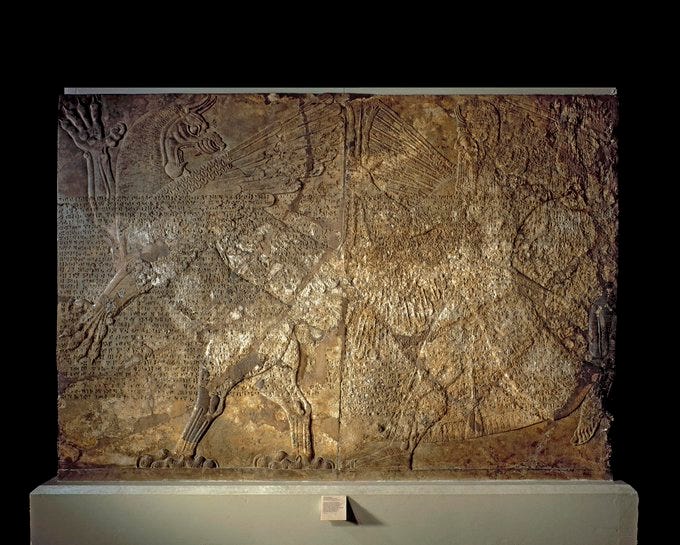
Alabaster relief panel from Nimrud showing the storm-bird monster Anzu as Ninurta, chief god of the city, pursues him with thunderbolts in both hands. Credit: The Trustees of the British Museum.
For Mesopotamian audiences, this was a crisis of legitimacy. Anzu’s act was a rebellion against the structure of reality. The tablet gave its holder access to the power that organized the universe. With it in the hands of a monstrous outsider, authority became unstable, ritual order faltered, and divine kingship itself came under threat.
Ninurta enters the myth as the restoring force. He was an old and complex Mesopotamian deity, deeply connected with agriculture, fertility, storms, battle, and heroic victory. In Assyrian royal ideology, his warlike side became especially important. Ninurta was the divine champion who could defeat chaos, recover stolen authority, and return the world to its proper arrangement.
The Nimrud relief turns that myth into a public statement. Ninurta moves forward with complete confidence, while Anzu recoils before him. The composition is built around momentum. The god’s body, wings, weapons, and direction all communicate controlled force. Anzu, by contrast, becomes the image of power losing its claim to rule. The message is immediate: disorder may rise, but divine authority advances against it.
The original setting made the scene even more powerful. These carved gypsum panels belonged to the Temple of Ninurta at Nimrud, the new Assyrian capital developed by Ashurnasirpal II. The temple was part of a larger royal and sacred landscape where architecture, sculpture, inscription, and ritual worked together. A visitor entering such a space encountered more than decoration. The building itself spoke in images.
Doorways and thresholds mattered deeply in Mesopotamian sacred architecture. They marked transitions between ordinary and protected space, between the outside world and the charged interior of a temple. Placing a scene of Ninurta defeating Anzu in such a setting gave the myth architectural force. The temple became a boundary where order was displayed, protected, and renewed.
The relief also belongs to the wider visual language of Assyrian power. Neo-Assyrian art was designed for impact. Its carved figures use strong outlines, repeated textures, clear gestures, and controlled movement. The viewer did not need to read cuneiform to understand the central idea. A divine warrior is pursuing a cosmic enemy. Authority is active. Chaos is retreating.
This visual message also supported royal ideology. Assyrian kings presented themselves as guardians of stability, chosen by the gods to defeat rebellion, punish enemies, expand order, and restore rightful hierarchy. In royal inscriptions and palace reliefs, military victory often appears as a moral act: the king brings the world back into alignment. Ninurta’s recovery of the Tablet of Destinies provided a divine model for that claim.
The god’s victory over Anzu therefore operated on several levels at once. It was mythological, because it recalled a famous divine battle. It was religious, because it showed the protection of sacred order. It was political, because it mirrored the Assyrian king’s claim to legitimate rule. It was also philosophical, because it presented order as something maintained through action.
This is what gives the relief its lasting power. It does not present order as calm or automatic. It presents order as a struggle that must be won again and again. The world is stable because someone guards its boundaries. Authority survives because it is defended. Sacred space remains sacred because chaos is pushed away from the threshold.
The Anzu myth also captures an ancient fear that still feels familiar: the fear that the symbols of authority can be stolen, that power can fall into the wrong hands, and that the structure holding society together can suddenly weaken. Ninurta’s answer is movement. He does not wait for balance to return. He pursues the threat directly.
Carved into the stone of a temple, this image became a Neo-Assyrian statement of cosmic confidence. It declared that rightful power could be challenged, but also recovered. The Tablet of Destinies could be seized, but also restored. Chaos could surge, but it could be driven back.
Ninurta and Anzu therefore form more than a mythic combat scene. They represent two opposing principles. Anzu is the force that breaks hierarchy and steals legitimacy. Ninurta is the force that reclaims order and makes the world coherent again.
In that sense, the relief remains one of the clearest visual statements of Neo-Assyrian thought: order is active, sacred, and guarded.
Do you see this relief as divine protection, royal propaganda, or a universal image of how order survives?
Support Independent Ancient Content :
Your support helps me create more archaeology posts, articles, and mini history videos:
Sources
The British Museum identifies the paired gypsum wall panels as Neo-Assyrian reliefs from the Temple of Ninurta at Nimrud, dated 865–860 BC, showing Ninurta with thunderbolts pursuing the monster Anzu.
The Metropolitan Museum of Art notes that the Ninurta Temple at Nimrud was built by Ashurnasirpal II and explains Ninurta’s importance as an agricultural deity whose associations with war and victory became central for Assyrian kings.
The SOAS translation of the Epic of Anzû preserves the core mythic crisis: Anzu gains possession of the Tablet of Destinies, robs Enlil of his power, and throws the divine order into crisis.