


A young woman was buried on the Mangyshlak Peninsula in western Kazakhstan sometime in the second half of the fifth century or the first half of the sixth. She was laid on her back with her head to the north. Robbers reached the grave at some point and appear to have taken her skull, though enough of the skeleton survived for the excavators to reconstruct how she had been placed.
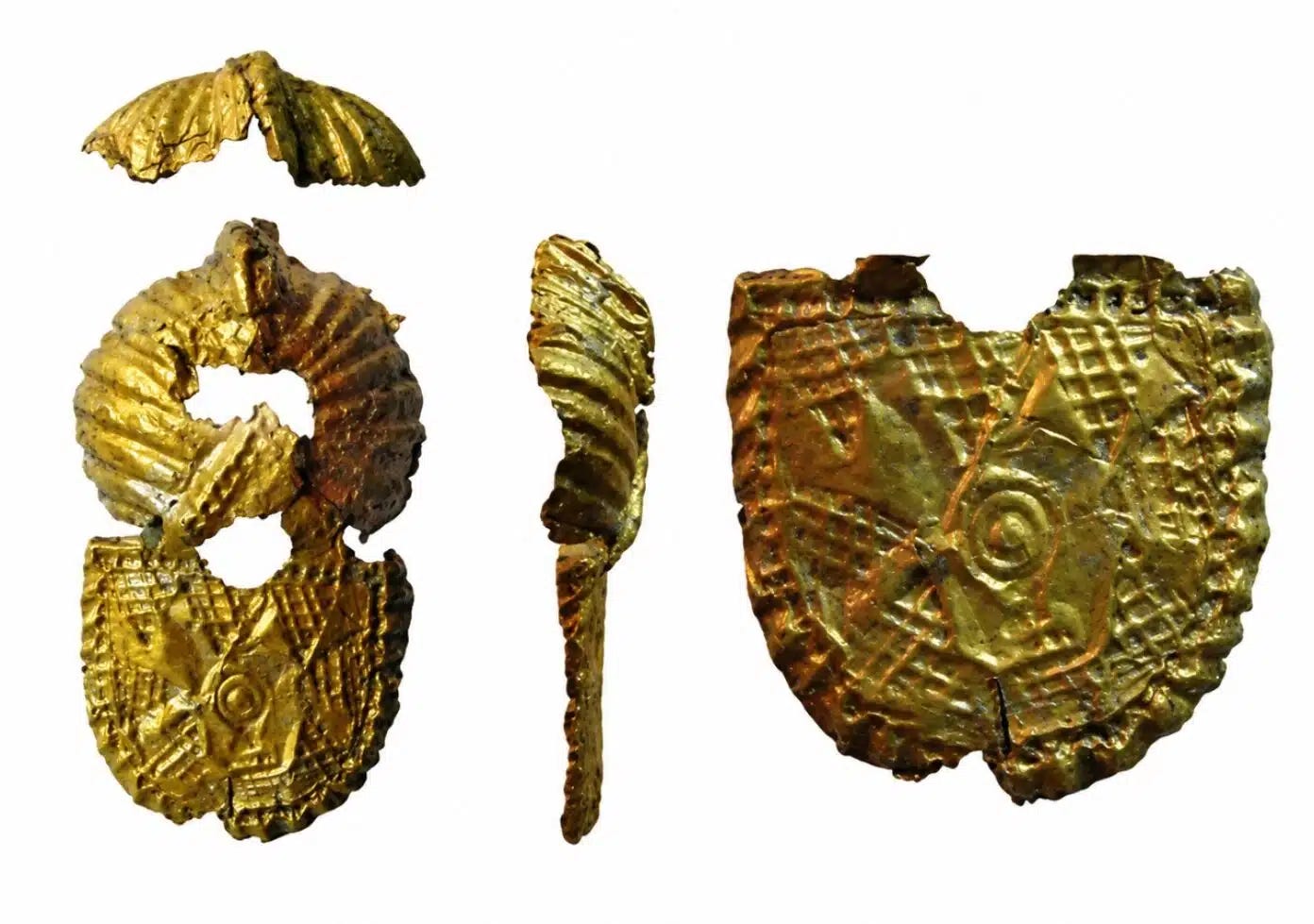
What they also found was gold. Buckles at her ankles, a headdress covered in plaques, and a face on her forehead that looks like a Greek gorgoneion.
The grave is Burial 11 at the Karakabak-10 cemetery. The study is by A.E. Astafyev of the Mangystau State Historical and Cultural Reserve and E.S. Bogdanov of the Institute of Archaeology and Ethnography at the Siberian Branch of the Russian Academy of Sciences, published in Archaeology, Ethnology and Anthropology of Eurasia.
The shoes were made for the grave
At her ankles were two shoe straps, each with a buckle of carved wood covered in gold foil and small gold-covered tips at the other end.
The study is clear that these were never walked in. They show no wear, and the excavators take them as objects made specifically for the burial. Whatever they were for, it was not footwear.
A separate gold buckle in the shape of a bird of prey with spread wings also came from the grave. Its style belongs to what archaeologists call the Shipovo horizon, after a site in the Volga region of Russia. Gold shoe fittings of this kind are unusual for the area around the Caspian and Aral seas.
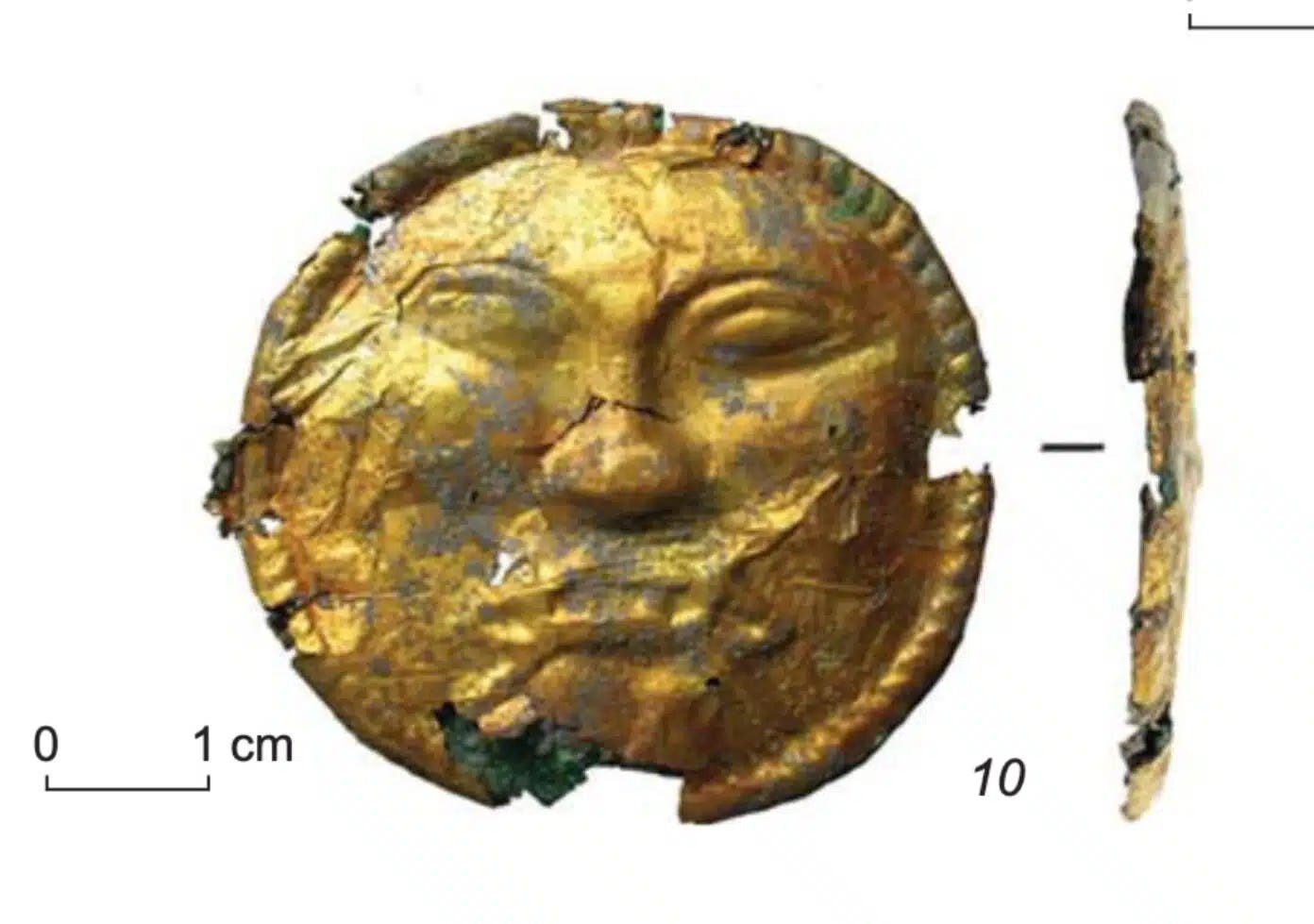
A Greek face on a steppe headdress
The headdress carried dozens of small gold plaques, two carved wooden masks covered in gold at her temples, and a larger gold-covered face worn on the forehead.
That forehead piece resembles a gorgoneion, the head of Medusa used as a protective motif in Hellenistic Greek art and carried east through the Black Sea colonies and the Bosporan kingdom. Comparable masks have turned up in the Volga region and near the Black Sea. The wooden temple masks have no known parallel anywhere.
She may not have been from here
The other graves at Karakabak-10 show what the researchers call Pontic fashion, a style associated with communities near the Black Sea. Burial 11 shows very little of it.
That absence, together with the unmatched temple masks, leads the authors to suggest she may not have been local. The gold itself probably was. They think it was made at a nearby settlement called Karakabak, on the strength of similarities with objects found earlier at Altynkazgan.
Source: Astafyev, A.E., and Bogdanov, E.S. (2026), in Archaeology, Ethnology and Anthropology of Eurasia.
Interesting, What is known about trade or exchanges of intellectual or spiritual heritage between the location of the grave and the hellenistic world?