


For more than twenty years, a small group of scholars has pursued an audacious idea, that the Ithaca of Homer's Odyssey, the homeland Odysseus spent ten years fighting to reach, is not the modern Greek island that bears its name.
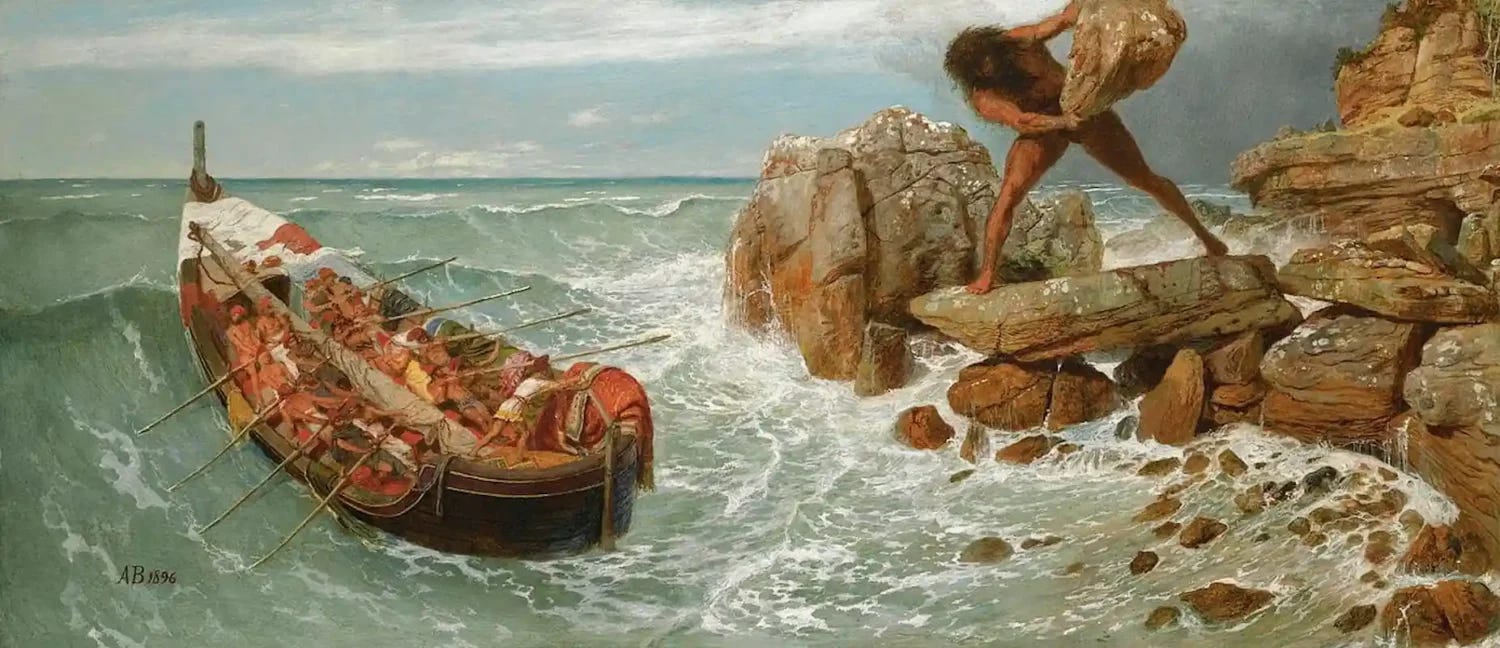
Odysseus and Polyphemus, painted by Arnold Böcklin (1896). Credit: Public domain / Wikimedia Commons
Two studies released within weeks of each other in 2026, one geological, one philological, now converge on a striking resolution. Ithaca, they argue, was never an island at all, and Homer himself knew it.
An old hypothesis meets new rock
The idea traces back to Robert Bittlestone’s 2005 book Odysseus Unbound, written with Cambridge classicist James Diggle and University of Aberdeen geoscientist John Underhill. Bittlestone proposed that Ithaca was not the island called Ithaki today, but Paliki, the low-lying western peninsula of neighboring Kefalonia. The idea fit Homer’s description of a homeland positioned furthest west among three neighboring islands, low-lying rather than mountainous, unlike Ithaki, which faces east and rises steeply.
There was an obvious snag. If Homer’s Ithaca was an island, then Paliki had to have been a genuine island in Odysseus’s Late Bronze Age, roughly 1200 BC, separated from the rest of Kefalonia by open water. Bittlestone found support for this in the Greek geographer Strabo, who wrote in the first century AD that at its narrowest point Kefalonia formed a low isthmus, often submerged from sea to sea. Bittlestone read this as describing a marine channel later filled by earthquake-triggered landslides, in one of Europe’s most tectonically active zones.
Testing that claim became Underhill’s life’s work. Over two decades, he led an extensive geoscientific campaign across the Thinia Valley, the narrow six by two kilometer land bridge connecting Paliki to the rest of Kefalonia, using seismic imaging, airborne geophysics, borehole sampling, subsurface rock cores, and geomorphological analysis. Presenting the results at the EAGE conference in Aberdeen in June 2026, Underhill reported that the marine channel hypothesis does not hold up. The team found marine sediments dating to the Late Pleistocene, but no evidence of a continuous seaway running through the valley during the Bronze Age. Instead, Thinia appears to have been shaped by an overland drainage system, an upland lake and meadow feeding rivers that flowed north and south to the coasts, a pattern that still shows itself occasionally today after heavy storms, and one Underhill argues matches Strabo’s actual description more closely than a vanished channel ever did.
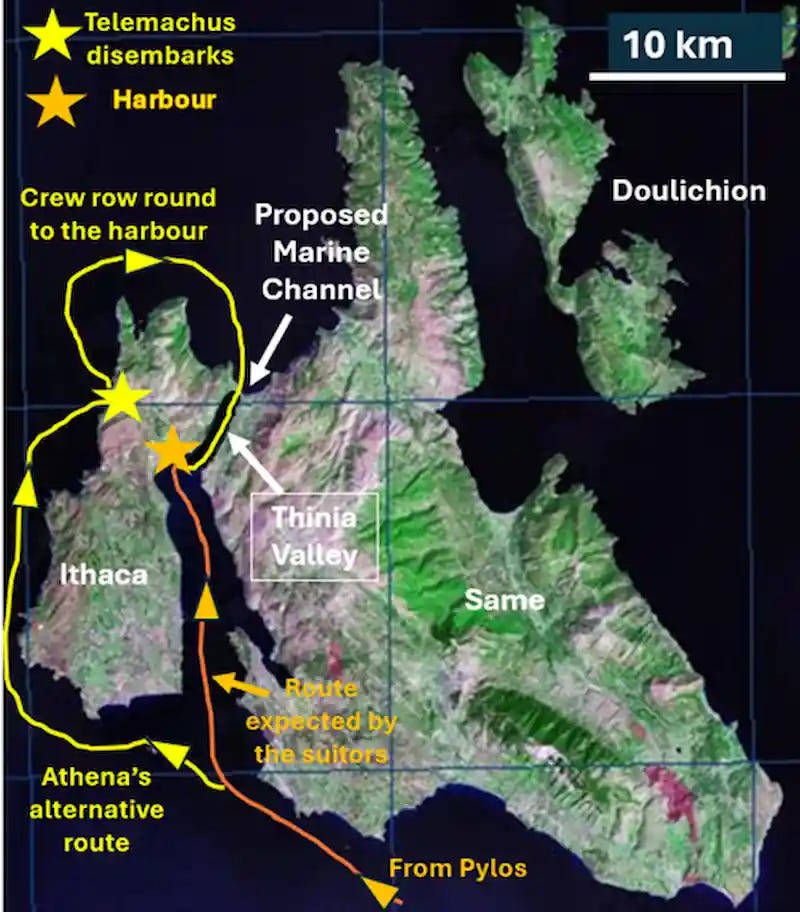
Telemachus’ journey, based on the reconstruction by Robert Bittlestone. Credit: James Diggle and John Underhill
A blow that became a breakthrough
On the face of it, this result undercut Bittlestone’s founding mechanism. If Paliki was never separated from Kefalonia by water, it could not have been an island in Odysseus’s time, seemingly disqualifying it from matching Homer’s island Ithaca.
Instead, the finding sent Diggle back to the Greek text itself, and what he found overturned an assumption scholars had carried since antiquity. In a paper titled “Was Homer’s Ithaca an Island?,” published in the online journal Antigone on July 5, 2026, Diggle and Underhill argue that Homer never actually calls Ithaca an island in the first place. Despite having abundant opportunity to use the Greek word for island, nisos, a word that would have fit the poems’ meter just as easily, Homer instead consistently describes Ithaca using words meaning land, native land, or domain, gaia, patris, and dimos.
One passage, long read as clinching proof of an island Ithaca, turns out to hinge on a subtle mistranslation. When Odysseus finally makes landfall at the end of his ten-year voyage, standard translations describe his ship approaching “the island,” where “on Ithaca there is a bay of Phorcys.” Diggle points out that Homer’s actual phrase is “in the dimos of Ithaca,” meaning “in the domain of Ithaca,” language that implies Ithaca is a district within a larger island the ship is approaching, not the island itself. A further clue comes from the Iliad’s Catalogue of Ships, where Odysseus leads not “Ithacans” but “the gallant Cephallenians,” the very name later used for the inhabitants of Kefalonia as a whole.
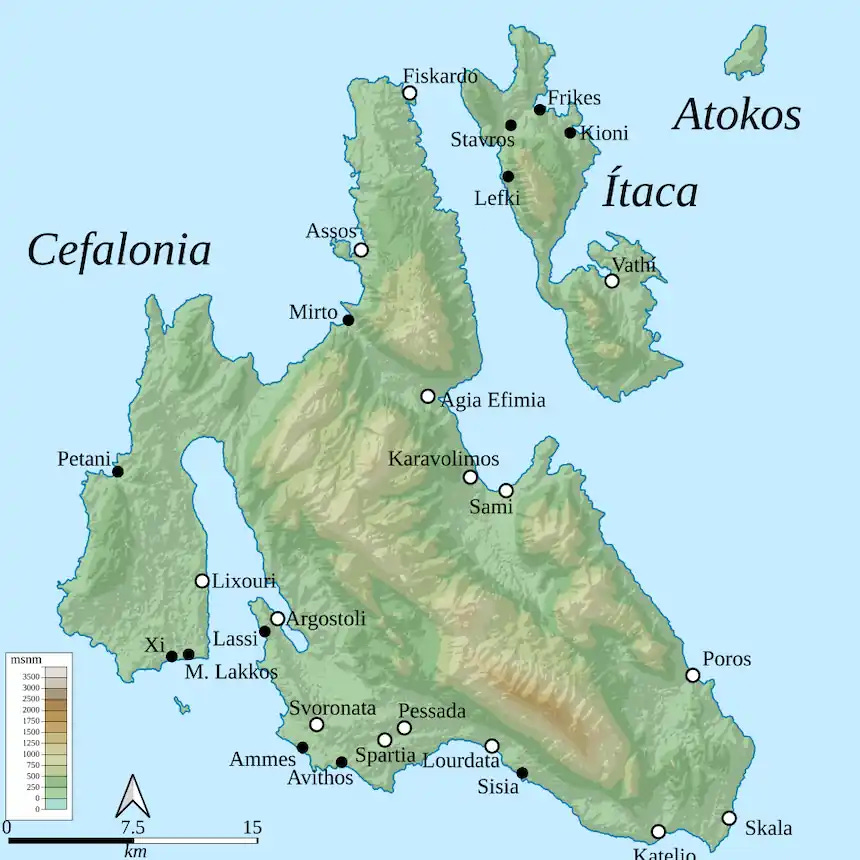
Map of the islands of Cephalonia and Ithaca. Credit: Gobbler / Wikimedia Commons
Reassembling the map
Freed from the requirement that Ithaca be a freestanding island, the case for Paliki grows stronger rather than weaker. Homer’s description of Ithaca as low-lying and facing west toward the setting sun, with the neighboring islands of Zacynthos, Same, and Doulichion turned instead toward dawn, matches Paliki and not Ithaki, which sits mountainous and east-facing. Zacynthos and Same can be identified confidently as modern Zakynthos and Kefalonia. Doulichion has long puzzled scholars, but if Paliki is Ithaca, modern Ithaki itself becomes the obvious candidate for Doulichion, an identification that appeared on some early maps.
Underhill and Diggle describe the result as an elegant explanation that unifies the geoscience, the Homeric text, and Strabo’s ancient account into a single coherent picture, one they say remains entirely consistent with Bittlestone’s founding insight even though its supporting mechanism has changed. Recent excavations by the Ephorate of Antiquities for Kefalonia and Ithaca have added a further encouraging thread, uncovering newly identified Early Bronze Age sites on Paliki, including Livadi Marsh, the location Bittlestone proposed as the site of Odysseus’s harbor.
A myth measured against real ground
The renewed attention arrives at a fitting moment, with global interest in Homer’s epics heightened by the approaching release of Christopher Nolan’s film adaptation of the Odyssey. Underhill frames the convergence of geoscience and classical philology as proof that the line between myth and physical reality can be narrower than long assumed. The debate over Odysseus’s true homeland has never fully closed. Other scholars have argued over the past century for Lefkada to the north, or continued to defend the traditional island of Ithaki itself, and the new studies will not be the last word. But by tying precise textual analysis to two decades of hard geological fieldwork, the Diggle and Underhill research offers what may be the most tightly argued case yet for where Odysseus was actually trying to go.
Support Independent Ancient Content. Your support helps me create more archaeology posts, articles, and mini history videos:
Sources. University of Aberdeen (June 11 and July 1, 2026). James Diggle and John Underhill, “Was Homer’s Ithaca an Island?,” Antigone (2026).
This article hits home in a very strange way.
My uncle Simo Jovicic was a bon vivant. A man that left Yugo in the 50's. Walked around the continent following the shoreline. 9 months and 20 pairs of shoes is how he described it, and along that journey he learned Italian, French, Spanish, Portuguese..
By the time he passed he spoke 9 languages, including English and Greek.
At the very end of his life, he packed his belongings in Roselare Belgium, and headed for Ithaki, Greece.
When I asked him why he was going there..
The response was "I am going home, like Odysseus"
Well.. he got kicked out of Ithaki because he caused so much shit at his local taverna.
He ended up in Lixouri in Paliki penninsula.
Buried in the small graveyard in that town.. the locals have since resold his grave and scattered his bones in the spirit of the traveler that he was..
But as it turns out..
Lixouri is most likely the place where the ancient hero returned to after all..
It is a story guys, not an historical account.