


More than 3,100 years ago an Egyptian widow of about eighty stood before a panel of fourteen villagers at Deir el-Medina and named which of her eight children would inherit from her. Naunakhte left her property to five who had supported her and cut out three who had neglected her. Two scribes recorded her statement on a papyrus now held in Oxford as Papyrus Ashmolean 1945.97, and a later addendum records that an excluded child tried to claim her property.
Ancient Content, November 1, 2026.
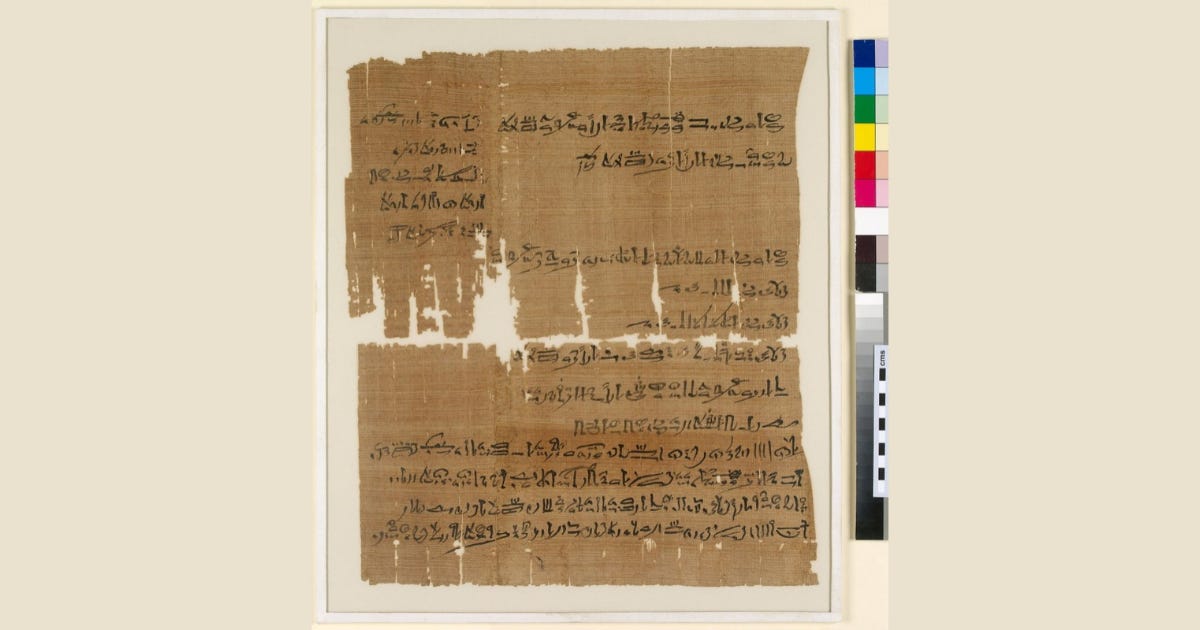
Hieratic papyrus, part of a will made by a woman named Naunakhte, about 1145 BCE, from Deir el-Medina. Ashmolean Museum, University of Oxford, accession AN1945.97.4. Image © Ashmolean Museum, University of Oxford.
A widow of about eighty made her case before her village
Naunakhte lived at Deir el-Medina, the village of craftsmen who built the royal tombs of the Valley of the Kings. Guy Middleton, writing in a 2023 Cambridge University Press volume, places her statement in the third year of Ramesses V, about 1145 BCE, and gives her age as about eighty. She explained her wishes to a panel of fourteen fellow villagers, and two scribes wrote them down. In Middleton’s account she wanted to leave her property only to the children who had supported her in old age.
The village is the one reported earlier on Ancient Content for the Strike Papyrus. On the figures in this report, three to twelve years separate the workmen’s walkout in year 29 of Ramesses III from her statement. A woman of about eighty at the will would have been in her late sixties or seventies at the strike, if she lived in the village at the time.
The will survives on a papyrus rejoined in Oxford
The document is catalogued as Papyrus Ashmolean 1945.97 at the Ashmolean Museum in Oxford. Wikipedia reports that the French Institute found it in 1928, that it began as two separate rolls later recognised as cut from one sheet and physically rejoined, and that it measures 43 centimetres high and 192 centimetres long. Changes of handwriting suggest two scribes. Jaroslav Černý published it with its related documents in the Journal of Egyptian Archaeology in 1945.
Margaret Taylor Deane, reviewing Koenraad Donker van Heel’s 2016 book on Naunakhte, notes that only four documents concern her directly, although Donker van Heel draws on hundreds of ostraca and papyri from the village. Middleton likewise counts this papyrus and three others. A 2021 study in the legal journal Fundamina argues that texts such as this papyrus contain building blocks of succession law much older than Roman law.
Naunakhte’s court statement is only the beginning. Below are her two husbands and eight children by name, the one-third rule that gave her the power to cut three of them out and the addendum recording a challenge to her will. Paid subscribers, keep reading. Free readers, upgrade to unlock the rest.
