


Archaeologists have identified an intact Maya city in the jungle of Campeche, Mexico, more than a thousand years after it was abandoned. The site has been named Minanbé, a Yucatec Maya expression meaning “no road” or “there is no path,” reflecting the difficulty of reaching it.
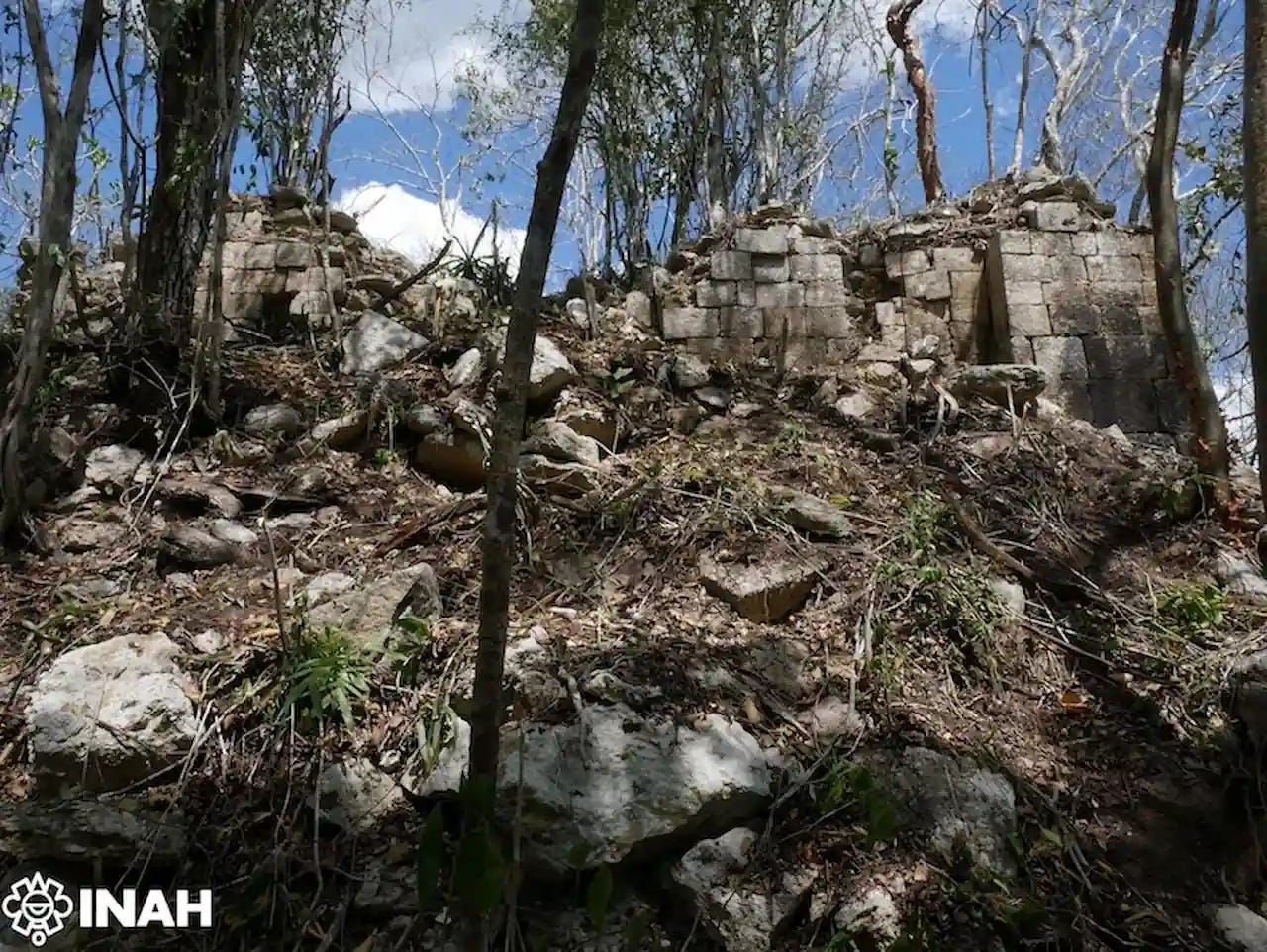
Pyramidal structure discovered in Maya city in Mexico. Credit: INAH
The discovery was announced by Mexico’s National Institute of Anthropology and History, INAH, after fieldwork in the northern sector of the Calakmul Biosphere Reserve. The work was carried out by a Mexican-Slovenian team led by archaeologist Ivan Šprajc, a researcher at the Research Centre of the Slovenian Academy of Sciences and Arts.
Minanbé stands out because it appears to have remained largely untouched by looting. In a region where many archaeological sites were reached through old logging paths, this one was different. There was no easy access, no modern road, and no visible looters’ trenches. That isolation helped preserve the city’s structures, monuments, and inscriptions.
A city hidden by the forest
The site lies north of the Calakmul Biosphere Reserve, in the municipality of Calakmul, Campeche. It is located west of Chactún, another important Maya center reported by the same research project in 2013.
The team first detected the settlement through airborne LiDAR data. LiDAR, or light detection and ranging, uses laser pulses fired from an aircraft to map the ground surface beneath dense vegetation. In tropical forests, this technology has transformed Maya archaeology because it can reveal platforms, pyramids, terraces, causeways, reservoirs, and settlement patterns hidden under the canopy.
The LiDAR images suggested the presence of a settlement of about 15 hectares. The next step was ground verification. Archaeologists and workers from the nearby community of Constitución opened a path through several kilometers of jungle, first moving by all-terrain vehicles and then continuing on foot.
The difficulty of reaching the site became part of its identity. According to Šprajc, the absence of access paths was a positive sign. It suggested that the city had escaped modern disturbance and had not been damaged by looting.
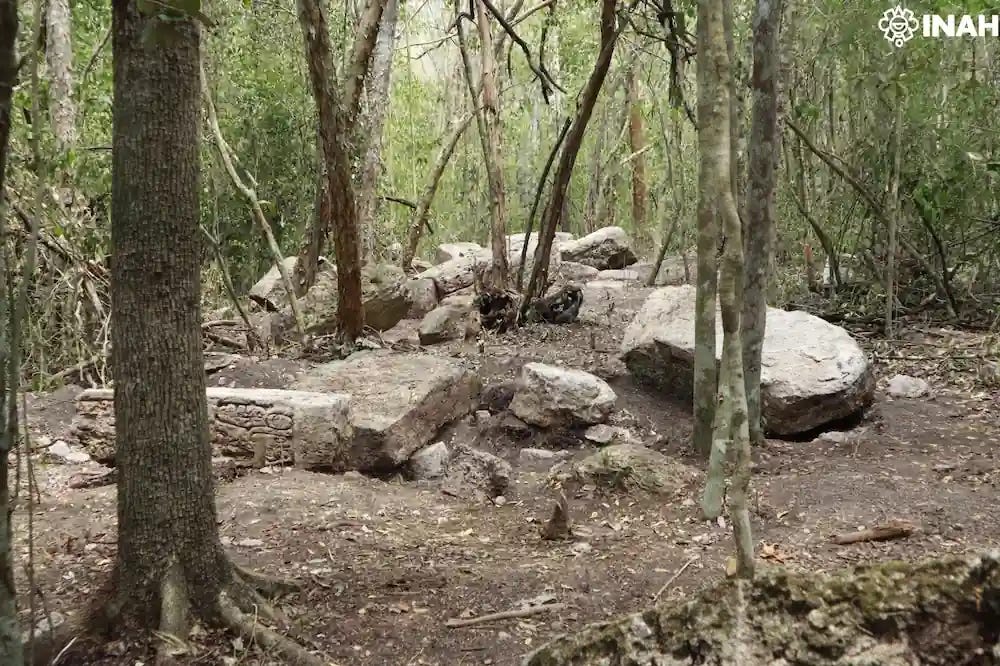
Intact Maya City Found in Campeche. Credit: INAH
Why it was named Minanbé
The name Minanbé comes from the Yucatec Maya words mina’an, meaning “there is not,” and be, meaning “road” or “path.” The name therefore refers directly to the conditions of discovery: there was no road leading to the ancient city.
This follows a common practice in Maya archaeology, where newly identified sites are often named after a notable feature of the place, a local reference, or the circumstances in which they were found.
The name is also fitting in a broader sense. Minanbé remained hidden because the forest protected it. Its difficult access preserved a rare archaeological situation: a Maya urban center with no visible looting trenches and with monuments still in place.
The end of three decades of research
The discovery marks an important moment in Ivan Šprajc’s long-running research in the Central Maya Lowlands. For around three decades, Šprajc and his collaborators have worked to identify, map, and understand ancient Maya settlements in this region.
The Central Maya Lowlands were one of the most densely occupied parts of the ancient Maya world during the Late Classic period, roughly AD 600 to 900. Recent archaeological work, especially using LiDAR, has shown that this landscape was far more urbanized, engineered, and agriculturally modified than earlier generations of scholars believed.
At its height, the region may have supported millions of people. Cities, smaller settlements, agricultural terraces, reservoirs, wetlands, roads, and ceremonial centers formed a broad inhabited landscape rather than isolated urban islands.
Minanbé belongs to this wider world. Its discovery adds another piece to the map of ancient Maya settlement in Campeche and shows that important sites remain hidden even after decades of research.
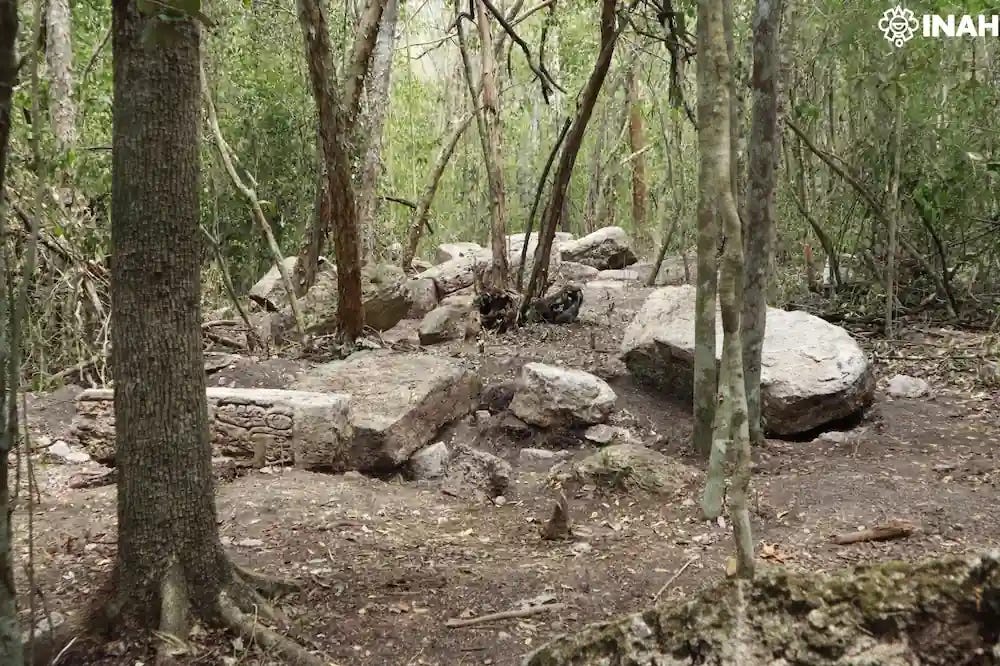
The newly discovered Maya city of Minanbé in Campeche, Mexico. Credit: INAH.
A 15-hectare urban core
Once the team reached the site, they confirmed the presence of a substantial urban nucleus. The settlement covers about 15 hectares and includes plazas, palace-like buildings, religious structures, terraces, wetlands, and hydraulic channels.
This layout shows that Minanbé was not a small rural hamlet. It had planned public spaces, monumental architecture, and infrastructure connected with water and land management.
The presence of terraces and hydraulic features is important. In the Maya Lowlands, water control was essential. Many cities were built in landscapes where rainfall was seasonal and permanent rivers were limited or absent. Communities adapted by building reservoirs, channels, modified wetlands, and drainage systems.
At Minanbé, the combination of monumental architecture and water-related features suggests a settlement integrated into a broader agricultural and political landscape.
A 13-meter-high pyramid temple
One of the most important buildings at Minanbé is a pyramid temple more than 13 meters high. According to the archaeological team, the structure preserves features associated with the Río Bec architectural style.
These features include fine masonry, smooth façade panels, a steep stairway, and upper moldings. The structure appears to be unusually well preserved, making it one of the most visually important features identified at the site so far.
The Río Bec style is one of the distinctive architectural traditions of the Maya Lowlands. It is especially associated with the southeastern Campeche and southern Quintana Roo region. Río Bec architecture often includes elaborate façades, vertical tower-like elements, decorative panels, and complex elite or ceremonial buildings.
At Minanbé, the Río Bec traits show that the city participated in the architectural world of the surrounding region while also preserving its own local character.
Palaces, plazas, and religious buildings
The city’s core includes plazas surrounded by buildings interpreted as palatial and religious structures. This is typical of many Maya urban centers, where public architecture was arranged around open plazas used for ceremony, political display, gathering, and elite activity.
Palatial buildings were not simply residences. They could serve as administrative spaces, elite compounds, reception areas, ritual settings, and symbols of local authority.
Religious buildings, including pyramid temples, formed the visual and symbolic center of many Maya cities. Their height, orientation, and placement structured the urban experience and reinforced the connection between rulers, ancestors, gods, and public ritual.
The architecture at Minanbé suggests that the site was part of the political hierarchy of the Late Classic Maya world. Its monuments and inscriptions reinforce that interpretation.
Fourteen monuments: stelae and altars
Archaeologists recorded 14 monuments at the site, including stelae and altars. Several preserve iconographic scenes and hieroglyphic texts.
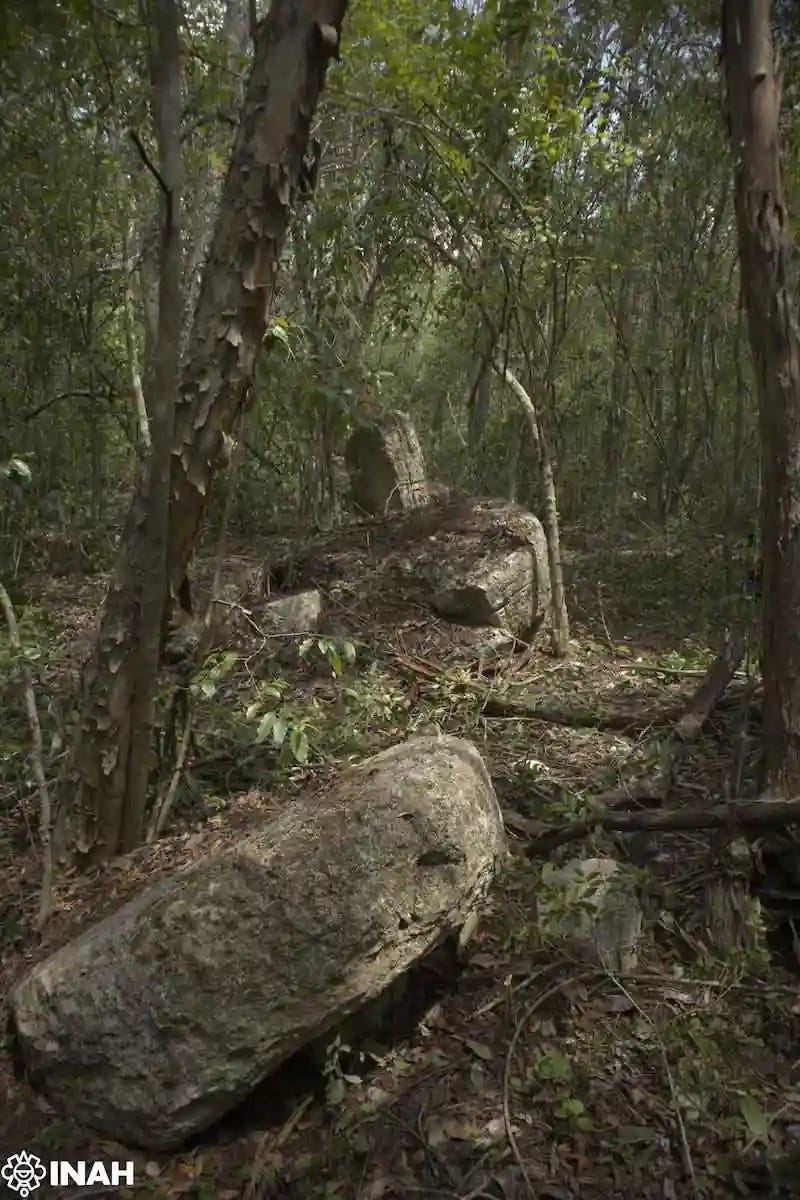
Structures and stelae uncovered at the site. Credit: INAH.
These monuments were found along a causeway that connects the central and northeastern sectors of the city. Their placement suggests a deliberate ceremonial or political arrangement, possibly marking movement through the site or linking important architectural groups.
In Maya cities, stelae and altars were central instruments of political memory. They could record dates, rulers, dynastic events, rituals, victories, accessions, or acts of public authority. They were not just stone markers. They were public statements in image and text.
The survival of such monuments at Minanbé is therefore highly significant. Their inscriptions may eventually reveal names, dates, political titles, ritual events, and connections with other Maya centers.
Stela 1 and the date AD 849
One of the most important monuments is Stela 1. It preserves a scene involving decapitation and includes a calendrical sign near the top.
Epigrapher Octavio Esparza Olguín identified a date corresponding to 5 Ajaw, which can be associated with AD 849. This places the monument in the Terminal Classic period, close to the time when many cities in the region were entering decline or abandonment.
The date is important because it may help place part of the monument group near the final phase of Minanbé’s occupation. It suggests that the city was still producing formal political or ritual monuments in the 9th century AD.
The imagery of decapitation also deserves careful study. In Maya art, such scenes can be connected with warfare, sacrifice, royal authority, ritual performance, or the display of power. The full meaning of the image will depend on further analysis of the inscription, iconography, and local context.
Monument 6 and an earlier ruler
Another important object is Monument 6. This piece is fragmentary, but it preserves the image of a ruler wearing elite insignia. The figure is shown with a feathered headdress, necklaces, wrist ornaments, and a pectoral or chest ornament associated with status and power.
The monument also preserves hieroglyphic cartouches on its sides. Preliminary study suggests that one of the texts may contain part of a Long Count date from the late 7th century.
If this reading is confirmed, Monument 6 could be one of the earliest dated monuments known from the area. That would push Minanbé’s political history deeper into the Late Classic period and show that the city was already participating in elite monument traditions before its final phase.
Because the limestone surfaces are eroded, researchers are using digital methods to study the carvings. Around 500 photographs were used to create three-dimensional models of the monuments, allowing specialists to examine the surfaces in greater detail.
Photogrammetry and digital documentation
The use of photogrammetry is especially important at Minanbé. This method creates 3D models from large sets of overlapping photographs. It allows archaeologists and epigraphers to study worn inscriptions, damaged reliefs, and complex surfaces without moving or damaging the monuments.
At Minanbé, the 14 stelae and altars were documented through this process. The resulting models were then sent for epigraphic analysis.
Digital documentation also helps preserve data from monuments exposed in the field. Since limestone can weather quickly once vegetation is removed and surfaces are exposed, detailed recording is essential.
These methods show how modern Maya archaeology combines traditional field exploration with advanced imaging, LiDAR, GIS, epigraphy, and digital reconstruction.
A city without looters’ trenches
One of the most striking aspects of Minanbé is the absence of visible looting pits.
Many Maya sites have suffered from looting, especially where roads, logging paths, or informal access routes made it easier to reach them. Looters often dig into temples, tombs, stelae, and elite buildings, leaving deep scars in the archaeological record.
Minanbé appears different. The lack of access paths helped protect it. The site remained difficult enough to reach that it escaped the kind of disturbance common elsewhere.
This does not mean the city is perfectly preserved in every detail. More research is needed to understand its condition. But the absence of looters’ trenches gives archaeologists a rare opportunity to study a site in a more intact state.
For research, this is extremely valuable. Architecture, monuments, alignments, deposits, and surface evidence can be studied in their original relationships instead of being disrupted by modern intrusion.
Late Classic and Terminal Classic Minanbé
The evidence suggests that Minanbé reached its height during the Late Classic period and remained important into the Terminal Classic.
The Late Classic, roughly AD 600 to 900, was a period of intense urban growth, political competition, monument building, and agricultural expansion in the Maya Lowlands. Many cities were connected through alliances, rivalries, warfare, trade, marriage diplomacy, and shared religious traditions.
The Terminal Classic, around the 9th and early 10th centuries, brought major transformations. Many cities in the southern and central lowlands were abandoned or reduced in population. Monumental building slowed, dynastic systems weakened, and political landscapes changed.
The AD 849 date on Stela 1 places Minanbé directly within this turbulent era. The city’s monuments may therefore help clarify how local elites responded to regional stress, political fragmentation, and shifting populations.
A regional center tied to agriculture and surplus
Šprajc and the research team suggest that Minanbé probably held a relevant position in the regional hierarchy. Its monuments, architecture, and location point to a settlement connected with agricultural production and the exchange of surplus goods.
This interpretation fits wider evidence from the Maya Lowlands. Many Maya centers were embedded in intensively modified landscapes. Fields, terraces, wetlands, and water systems supported dense populations and elite institutions.
At Minanbé, the terraces, wetlands, and hydraulic channels show that the surrounding environment was not simply wild forest. It was once a managed landscape shaped by human labor.
The city’s position may have depended on controlling or organizing production, distributing goods, and maintaining ritual authority over the surrounding area.
Possible later incursions from northern Yucatán
The discovery also raises questions about events near the end of the city’s occupation.
Researchers have suggested the possibility that groups from the northern Yucatán Peninsula may have entered the region at a late stage. Some monuments appear to have been intentionally altered in antiquity. This could reflect an attempt to change, damage, or overwrite earlier political messages.
Such practices are known in many ancient societies. Monuments were not neutral objects. They carried authority, memory, and legitimacy. Altering them could be a political act.
At Minanbé, further study of the broken or modified monuments may help reveal whether these changes were local acts, part of internal conflict, or connected with wider population movements and political reorganization at the end of the Classic period.
Calakmul and the wider Maya landscape
Minanbé lies within the broader archaeological landscape of Calakmul, one of the most important regions of the Maya world.
Calakmul itself was a major Classic-period power, and the surrounding area contains numerous sites of different sizes and functions. The reserve is also a UNESCO World Heritage landscape combining archaeological remains with tropical forest.
This region is important because it shows the deep interaction between Maya urbanism and environment. Cities were not isolated ruins in empty jungle. They were part of a heavily modified landscape with roads, reservoirs, cultivated zones, terraces, settlement clusters, and sacred architecture.
The discovery of Minanbé adds another preserved urban center to this landscape and strengthens the view that the Calakmul region was densely organized during the Classic period.
A discovery still at the beginning
For now, Minanbé is known through surface recognition, LiDAR interpretation, monument recording, and initial analysis. Excavation and detailed study will be needed to answer deeper questions.
Who ruled the city? What was its original ancient name? Which larger polity did it belong to? Did it answer to Calakmul, interact with Chactún, or operate as a smaller regional center? Why were some monuments altered? What happened when the city was abandoned?
These questions remain open.
What is already clear is that Minanbé offers a rare archaeological opportunity. It is an intact Maya city, hidden deep in the forest, preserving architecture, monuments, and inscriptions from a critical period in Maya history.
After more than a thousand years without a road leading to it, Minanbé has returned to the map of the ancient Maya world.
Sources:
Instituto Nacional de Antropología e Historia (INAH)