


A sprawling, million-square-foot production site near Aarhus reveals a level of economic organization that pushes back against the popular image of Vikings as little more than raiders.
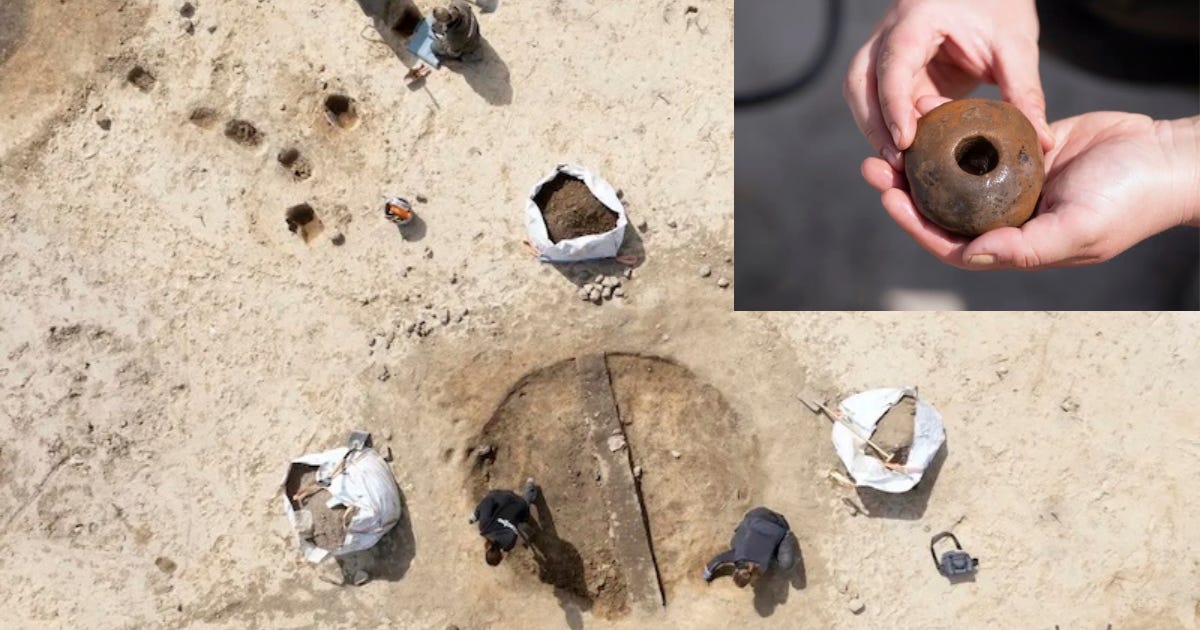
Archaeologists uncovered 82 pit houses believed to have served as places where people lived and worked. Credit: Moesgaard Museum
The Vikings are most often remembered as fearsome seaborne raiders, willing to burn and plunder their way across Europe. A newly excavated site in Denmark tells a very different story, one of skilled labor, organized production, and international commerce.
Archaeologists from the Moesgaard Museum have uncovered the remains of a sophisticated textile production complex in Søften, a small town roughly six miles north of Aarhus, Denmark’s second-largest city, on the Jutland peninsula. The find points to a community that was deeply embedded in a far-reaching trade network rather than an isolated outpost of plunderers.
A Site on an Industrial Scale
The settlement covers more than 100,000 square meters, over one million square feet, making it one of the largest Viking-era sites ever documented in Scandinavia. Archaeologists date the complex to the late Iron Age or early Viking Age, sometime between roughly 600 and 950 CE.
Excavators identified a dedicated area for processing flax, the plant fiber used to make linen, alongside more than 80 semi-buried pit houses that appear to have functioned as both workshops and living quarters. A single, larger residential structure was also found on the site, a detail researchers believe points to centralized oversight of resources and production by a single powerful figure.
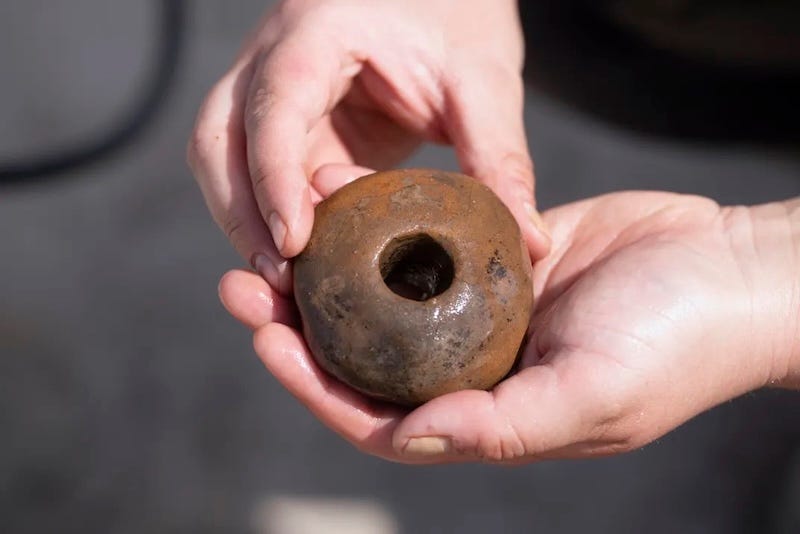
Researchers believe this artifact may have been used in textile production. Credit: Moesgaard Museum
Spindles, Looms, and Silver
The ten-month excavation, which began in August 2025, yielded an extensive toolkit tied to cloth-making, including spindle whorls used to spin raw fiber into thread and loom weights used to keep threads taut during weaving. Alongside these textile tools, archaeologists also recovered silver coins, glass beads, pearls, pottery, a pair of scissors, a knife, and a key.
According to historian Kasper Andersen of the Moesgaard Museum, the scale of the operation indicates that Vikings were not simply disorganized, uncivilized hordes wandering Europe. Sustaining a production center like Søften, he notes, required a well-organized society with an established production line and access to a market well beyond the immediate area.
Researchers hope that future analysis, including carbon dating and pollen studies, will clarify exactly what kinds of textiles were being produced at the site.
Aarhus: A Hub of Trade and Power
During the Viking Age, generally dated from 793 to 1066 CE, Aarhus (then known as Aros) served as a royal and commercial center linking Scandinavia to wider trade routes. Archaeologists believe residents of surrounding villages and settlements, Søften among them, funneled their goods through the city to reach distant markets.
As Andersen put it, a production site of this magnitude cannot be explained by local demand alone; it has to be understood as part of a much larger international network.
A Neighboring Cemetery Adds Context
The discovery builds on other recent finds in the region. Last year, archaeologists uncovered a substantial Viking-era burial ground in the nearby village of Lisbjerg, just a few kilometers from both Aarhus and the Søften site. The cemetery contained 30 graves, some furnished with valuable goods such as pottery, coins, pearls, gold thread, and scissors, suggesting high social status. Other, simpler graves were also found, which researchers suspect may belong to enslaved individuals.
Investigators believe the cemetery is connected to a large estate discovered at Lisbjerg in the late 1980s, likely belonging to a nobleman, possibly an earl or steward, who served under Harald I, king of Denmark and parts of Norway from about 958 to 985 CE. Moesgaard Museum archaeologist Liv Stidsing Reher-Langberg has suggested the estate’s owner likely held considerable economic, political, religious, and social influence.
In a separate find from 2024, an archaeology student using a metal detector discovered seven silver armbands in the nearby village of Elsted, later dated to around the ninth century CE. Such armbands may have been worn as jewelry, but are also thought to have circulated as a form of payment in Viking-era exchange.
A Fuller Picture of Viking Society
Taken together, the Søften textile complex, the Lisbjerg cemetery, and the Elsted armbands are reshaping how archaeologists understand daily life, social hierarchy, and economic activity in Viking-Age Denmark. Far from a society defined solely by raiding, the picture emerging from Aarhus and its surrounding settlements is one of organized industry, skilled craftsmanship, and integration into a commercial world that stretched well beyond Scandinavia’s shores.
Source: “Were Vikings Really ‘Uncivilized’ Barbarians? Large Textile-Production Site Discovered in Denmark Challenges That Stereotype.” Smithsonian Magazine, June 24, 2026. Additional findings courtesy of the Moesgaard Museum.
Thank you so much for your article, bringing attention to new finds that further help to change the image of the Vikings. and the roles of women in their society, because women were the spinners and weavers.
Indeed, production of and commerce in textiles were a significant part of Viking wealth. For example the creation of woolen cloth sustained the Icelandic economy for centuries, and provided for female economic power and independence.
A great read on the topic is "The Valkyries’ Loom: The Archaeology of Cloth Production and Female Power in the North Atlantic" by Michèle Hayeur Smith.