


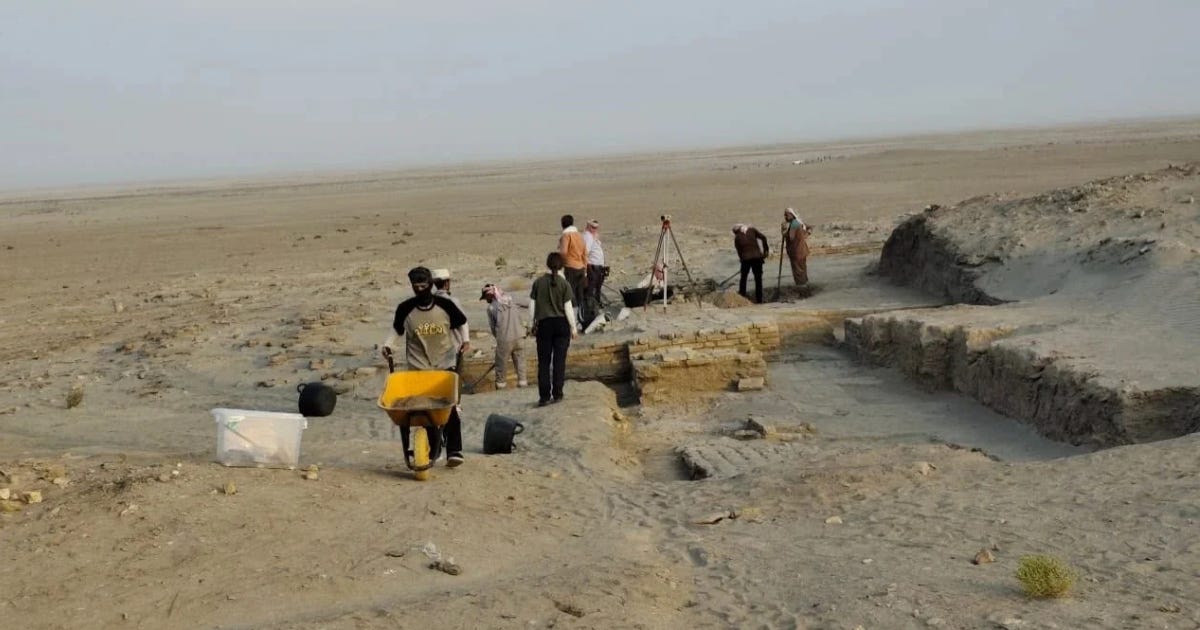
Archaeologists have partially uncovered an ancient bridge in Larsa, southern Iraq, revealing another piece of the city’s Mesopotamian infrastructure. Image credit: Shafaq News
On Sunday, November 8, 2026, antiquities officials in Dhi Qar province announced that a French-Iraqi team has uncovered about half of a fired-brick bridge across the Grand Canal of Larsa in southern Iraq. A brick on the structure names King Sin-iddinam, who ruled about 1849 to 1843 BCE, which places the bridge more than 3,800 years in the past. The mission led by Régis Vallet plans to excavate the other half in later seasons, and its records show work on the bridge since 2021.
Ancient Content, November 13, 2026
A fired-brick bridge crosses the main canal of Larsa
Shamil Al-Rumaidh, the director of antiquities and heritage in Dhi Qar, told Shafaq News that the bridge is built of fired bricks and paving bricks and crosses the main canal of the ancient city. Larsa, also called Tell as-Senkereh, lies about 25 kilometres southeast of Uruk, according to Wikipedia. Excavation has exposed about half of the bridge, and Al-Rumaidh said the rest is planned for future seasons.
La Brújula Verde reports that the bridge spans the Great Canal on the eastern side of the city, and that the canal is 22 metres (72 feet) wide according to the mission’s records. The same outlet reports that Suhail Jalub Abbas, a deputy director general of the State Board of Antiquities and Heritage, visited the site.
The mission’s own dossier for the 2023 Clio Prize gives more detail on the structure. It describes the eastern pier as fired brick, about 4 by 3 metres, only partly exposed and possibly boat-shaped. Excavators had yet to reach its base, so the depth of the canal remained unrecorded when the dossier was written.
A brick names King Sin-iddinam
Dominique Charpin of the Collège de France translated the inscription on the brick. In AFP’s January 2022 report and in La Brújula Verde, his translation reads “To the god Shamash, his king Sin-iddinam, king of Larsa, king of Sumer and Akkad.” The Clio dossier places an inscribed brick of Sin-iddinam in its original position on top of the pier, and AFP describes the brick as fired in the 19th century BCE.
Wikipedia gives Sin-iddinam’s reign as about 1849 to 1843 BCE in the middle chronology and describes him as the son of Nur-Adad. He used the titles king of Larsa and king of Sumer and Akkad. La Brújula Verde notes that the short chronology would move these dates about 65 years later. Shafaq also reports that a French team found a clay tablet with an account of the bridge, which the report says adds new information about its history and use. The report leaves the tablet’s wording and date open.
The mission has tracked the bridge since 2021
The announcement builds on earlier records. AFP reported in January 2022 that the team had cleared what appeared to be the pier of a bridge over an urban canal of Larsa, in photographs taken in late November 2021. The Clio dossier says excavation of the pier began in 2021 in trench PZ, which the team opened across the Grand Canal near the ziggurat to learn the pier’s shape, the canal’s depth and the layers around it. La Brújula Verde reports that PZ stands for Pont de la Ziggurat.
A caption on a page of the CNRS research unit TEMPS, credited to Vallet, also refers to the bridge of King Sin-iddinam on the Grand Canal.
A 2019 magnetic survey showed the Grand Canal was a canal
For decades scholars debated whether a long track running north to south toward the central ziggurat was a street or a canal. Lionel Darras and Régis Vallet report in ArcheoSciences that magnetic surveys run in 2019 at two locations settled it as a canal, which they named the Grand Canal of Larsa. At one location the survey shows the canal running under a bridge with pillars visible on both sides. The paper rests its canals and bridges on magnetic data alone.
In the north the canal joins a larger canal that runs around the city, and that canal empties westward into a very large basin, possibly a port or reservoir. The Clio dossier adds that historical texts credit Sin-iddinam with the Grand Canal, which the project located on the ground for the first time.
Hundreds of canals fed a 200-hectare city
The CNRS page describes Larsa as a 200-hectare city that dominated Mesopotamia at the start of the second millennium BCE. By 2022 the project had mapped several hundred canals across about 1,200 hectares. The Clio dossier counts about 15 basins, including an intramural reservoir of 26,000 square metres and a port of 30,000 square metres. It reports four phases of network growth, attributed to Gungunum, who reigned about 1932 to 1906 BCE, and his successors.
A canal arriving from the Tigris passed under the city rampart through a gate the dossier calls B65, which had two semicircular piers of 40 by 17.5 metres each and a central channel 5 metres wide. The dossier gives the rampart a length of about 5,376 metres.
Larsa rose after the fall of Ur
Wikipedia describes Larsa as the cult centre of the sun god Utu, whose temple was the E-babbar. After the Third Dynasty of Ur collapsed, Isin controlled the city until the Amorite governor Gungunum broke away and founded an independent dynasty. Wikipedia reports that Gungunum’s successors Abisare and Sumuel cut Isin off from canal access.
Sin-iddinam ruled for about seven years. Wikipedia reports a year name recording the defeat of Babylon’s army, and a treaty with Eshnunna and Uruk against Babylon. Rim-Sin I, who reigned about 1822 to 1763 BCE, later controlled 10 to 15 city-states before Hammurabi of Babylon defeated him.
More Sin-iddinam bricks mark a temple complex
The Clio dossier reports ten inscribed bricks of Sin-iddinam in room 3019 of building B50, a complex of 127 by 61 metres. The CNRS page suggests B50 may be the Gipar that Sin-iddinam rebuilt for the priestesses of Shamash, and the dossier calls that the most probable hypothesis rather than a confirmed identification.
The French mission returned to Larsa in 2019
French teams worked at Larsa from 1933, under André Parrot and later Jean-Claude Margueron and J.-L. Huot, according to Wikipedia and the Clio dossier. Fieldwork paused for about 30 years and resumed in 2019, according to the CNRS page. The Clio dossier lists about 40 researchers and engineers, roughly 20 of them in the field, with partners including the State Board of Antiquities and Heritage and the University of Dhi Qar. It adds that about 40 local workers are hired each year. Another TEMPS page reports that the Larsa programme won the first Clio Prize for archaeological research in 2023.
Reports differ on several details
Shafaq says the French mission excavated from 2022 to 2026, while Wikipedia dates the restart to 2019 with one-month seasons in 2021 and 2022, and the Clio dossier dates the pier excavation to 2021. La Brújula Verde calls the work the mission’s eighth excavation season, and the Clio dossier counts two excavation seasons among five campaigns since 2019 while leaving the match between years and numbers unstated. Shafaq places Larsa in northern Dhi Qar, while AFP and La Brújula Verde place it in southern Iraq near Nasiriyah.