


For more than 6,000 years, lapis lazuli has been one of the most desired stones in the ancient world. Its deep blue color, often scattered with tiny golden flecks, made it more than a decorative material. Across Mesopotamia, Egypt, the Indus world, Iran, Central Asia, and later Europe, lapis lazuli became a symbol of status, sacred power, distance, and wealth.
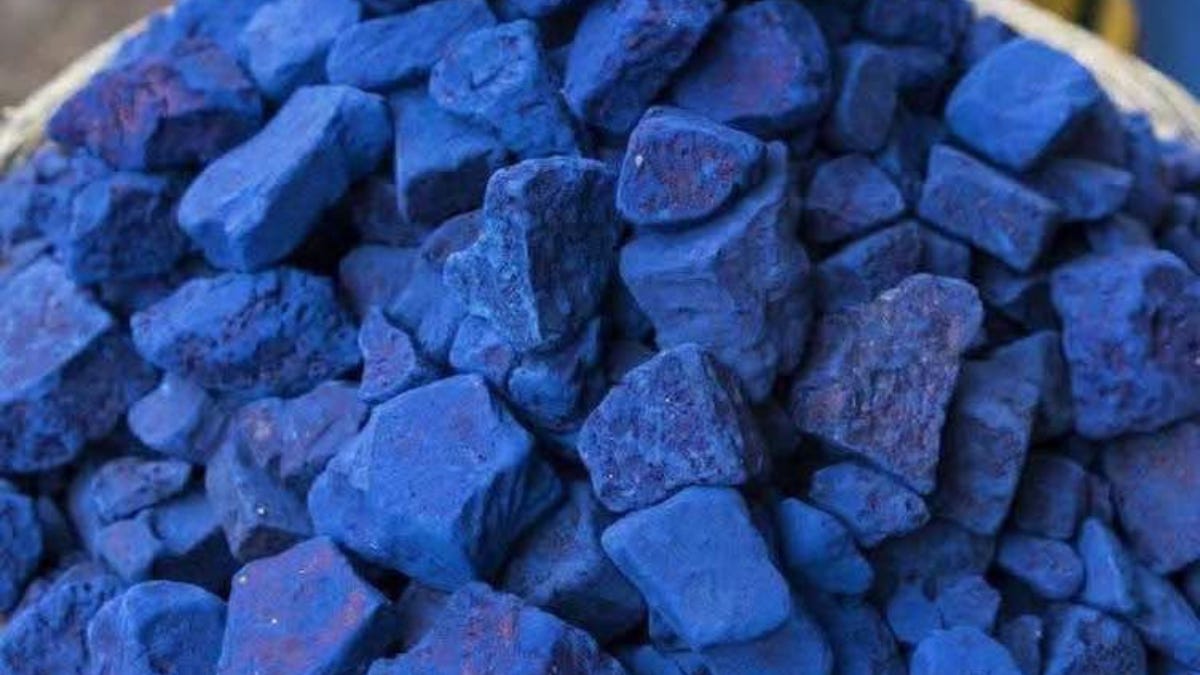
Raw lapis lazuli stones, prized for their deep blue color and long history in ancient trade.
Its story begins in the mountains of northeastern Afghanistan, especially in the remote Badakhshan region. From there, the stone traveled across deserts, mountains, rivers, and trade routes to reach royal tombs, temples, palaces, statues, seals, jewelry, manuscripts, and paintings.
Few ancient materials connect so many civilizations across such a wide geography. Lapis lazuli was mined in Afghanistan, worked by artisans, traded by merchants, worn by elites, placed in graves, used in religious images, and eventually ground into one of the most expensive pigments in the world: ultramarine.
What is lapis lazuli?
Lapis lazuli is often described as a gemstone, but scientifically it is a rock made from several minerals. Its most important component is lazurite, the mineral responsible for its intense blue color. It can also contain calcite, pyrite, diopside, amphibole, feldspar, mica, and other minerals.
The best-quality lapis has a rich, deep blue tone with little visible white calcite. Small flecks of pyrite can add a golden sparkle, giving the stone the appearance of a night sky filled with stars.
This combination explains why ancient people valued it so highly. Lapis lazuli offered a color that was difficult to find in nature. In a world before synthetic pigments and modern dyes, a stable, brilliant blue material had extraordinary visual power.
The stone could be carved, polished, drilled into beads, inlaid into sculpture, used in seals, set into jewelry, and later crushed and purified into pigment. Its value came from both its beauty and its difficulty of access.

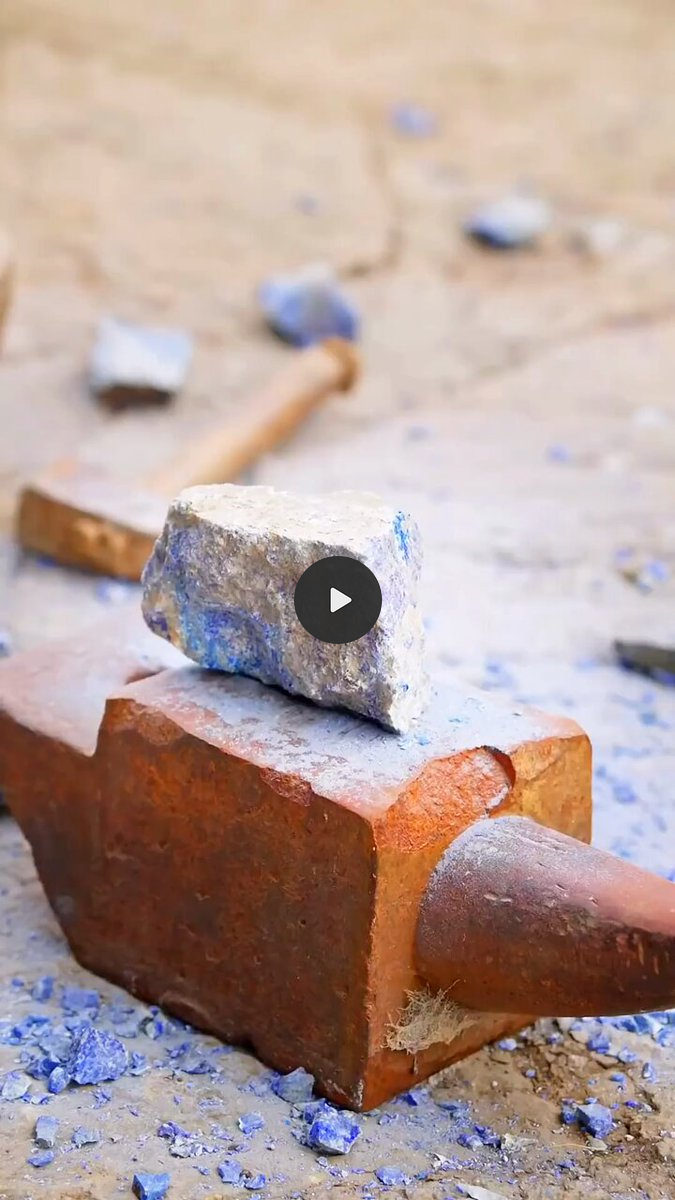
The Afghan source: Badakhshan and Sar-e-Sang
The most famous historical source of lapis lazuli is the Sar-e-Sang mining district in Badakhshan, northeastern Afghanistan. This region lies in a remote mountain landscape near the Kokcha River, within the wider Hindu Kush zone.
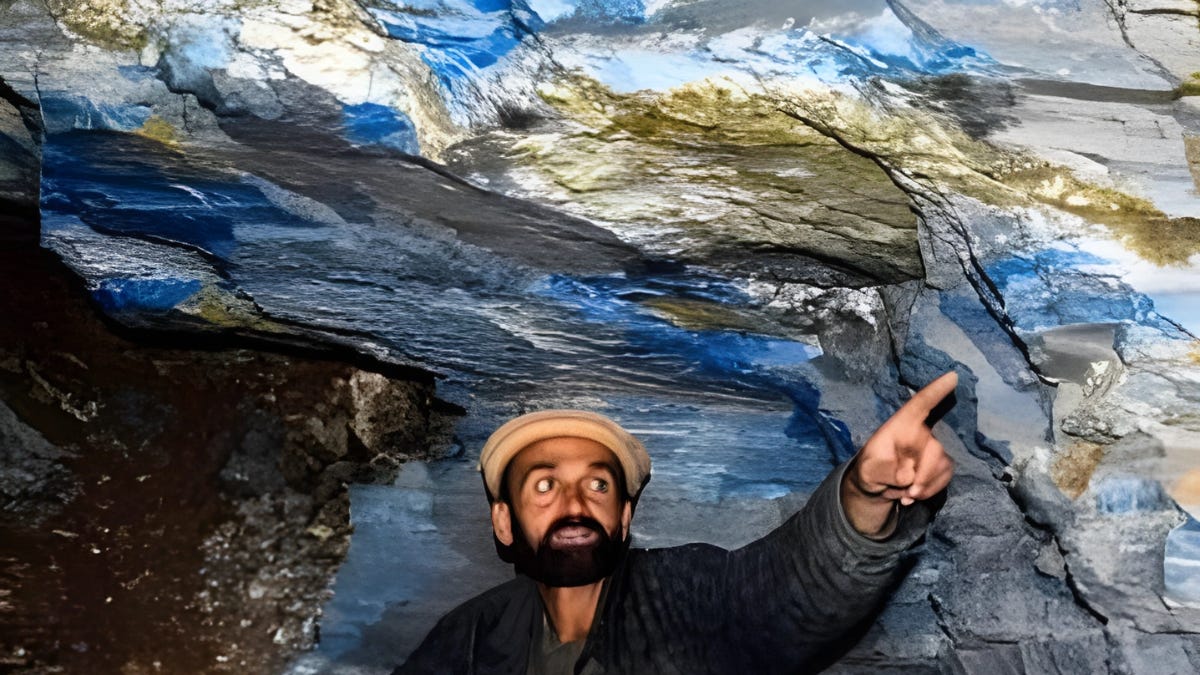
Miner in a hand-dug and blasted mine at Sar-e-Sang
The mines of Badakhshan were difficult to reach in antiquity, and that difficulty shaped the value of the stone. Lapis had to be extracted from rugged terrain, transported through mountain corridors, and moved across long-distance exchange networks before it reached major ancient cities.
This remoteness made lapis lazuli one of the clearest markers of early trade. When archaeologists find lapis in Mesopotamia, Egypt, or the Indus region, the object often points to a supply chain stretching hundreds or thousands of kilometers.
Badakhshan’s lapis deposits were known in antiquity and remained famous into later periods. Medieval and early modern travelers still associated the region with the finest blue stone. The endurance of this source is one reason lapis lazuli is sometimes called Afghanistan’s ancient “blue gold.”
A stone that moved across the ancient world
The importance of lapis lazuli lies not only in its color, but in its movement.
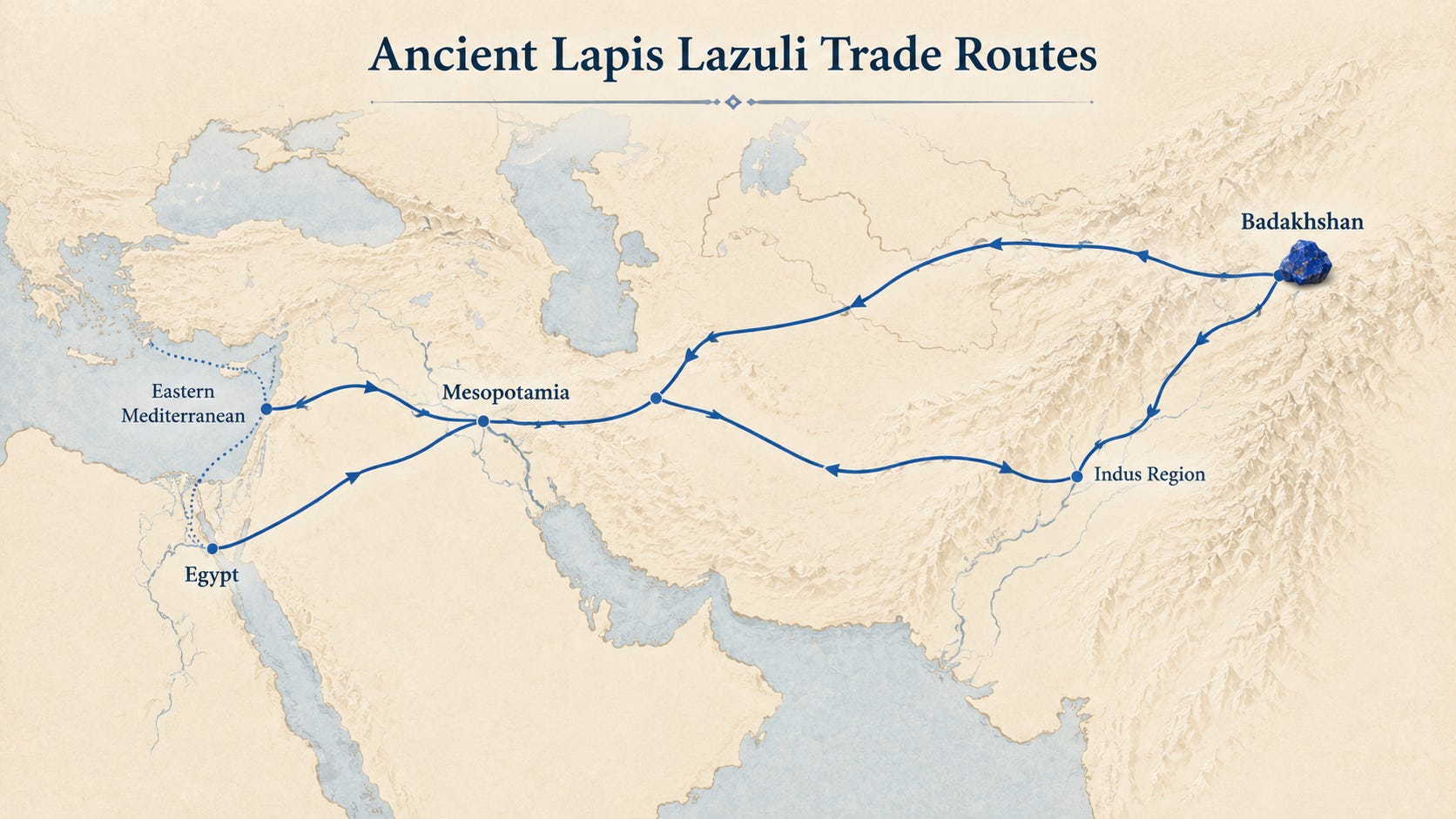
Map showing the ancient movement of lapis lazuli from Badakhshan through the Indus region, Mesopotamia, Egypt, and the eastern Mediterranean.
Unlike common local materials, lapis had to travel. Its appearance in distant archaeological sites shows that ancient societies were connected by networks of exchange long before modern globalization.
From Afghanistan, lapis likely moved through Central Asia, Iran, the Indus region, and Mesopotamia. From there, it reached Egypt and the eastern Mediterranean. These routes were not single straight roads. They were chains of exchange involving miners, local traders, caravan routes, river valleys, workshops, palace economies, temples, and elite demand.
In this sense, lapis lazuli helps archaeologists reconstruct ancient connectivity. A tiny bead or inlay can reveal links between highland mines and urban civilizations far away.
The stone became part of a wider world of prestige materials, traveling alongside metals, carnelian, shell, ivory, textiles, oils, incense, and other valuable goods.
The Indus connection and Shortugai
One of the most important places in the lapis lazuli story is Shortugai, an archaeological site in northern Afghanistan. It is often described as a Harappan or Indus-related settlement located near the routes to the Badakhshan lapis sources.
This is significant because the Indus civilization, flourishing mainly in present-day Pakistan and northwest India, had strong craft traditions and long-distance trade networks. Indus artisans were highly skilled in bead-making, drilling, polishing, and working precious materials.
The presence of an Indus-linked settlement near lapis sources suggests that the stone was important enough to draw merchants or settlers far beyond the Indus heartland. Lapis beads and related prestige goods became part of the economic and symbolic world of the Bronze Age.
Through these connections, Afghanistan’s mountain resources entered wider systems of urban exchange. Lapis lazuli was not a local stone staying in one region. It became a material that tied Central Asia, South Asia, Iran, and Mesopotamia together.
Lapis lazuli in Mesopotamia
Mesopotamia provides some of the most famous archaeological evidence for lapis lazuli’s ancient prestige.
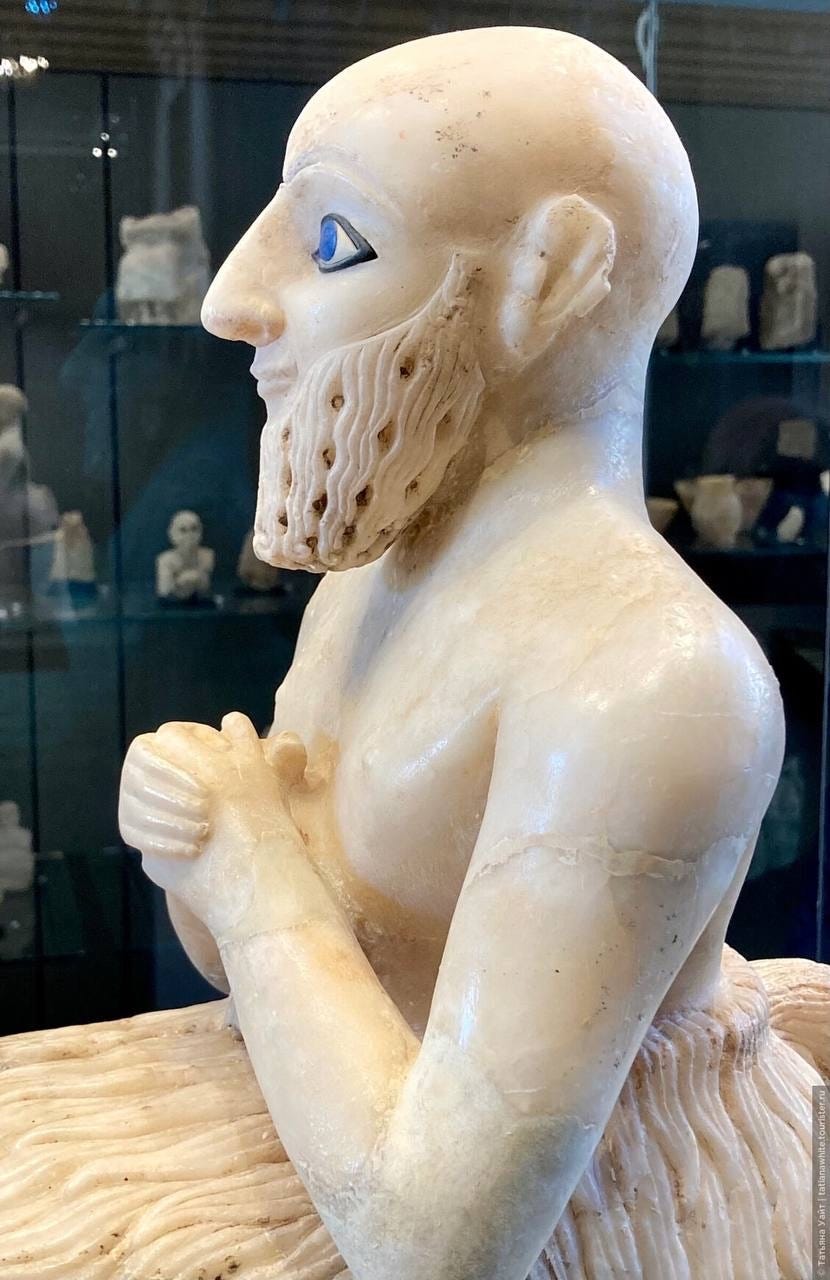
Ebih-Il, superintendent of Mari (c. 2350–2250 BCE)
At the Royal Cemetery of Ur in southern Iraq, lapis appears in some of the richest burials of the 3rd millennium BC. It was used in beads, headdresses, inlays, and luxury objects associated with elite graves.
One of the best-known objects from Ur, the so-called Standard of Ur, uses lapis lazuli together with shell and red limestone in a complex mosaic composition. The blue stone helped create contrast, depth, and visual richness in scenes of war, procession, and status.
Lapis also appears in jewelry from the Royal Graves, including objects associated with Queen Puabi and other elite burials. In this context, the stone was closely connected with wealth, royal display, and funerary prestige.
Mesopotamian cities did not have local lapis sources. Every piece had traveled from far away. That distance gave the stone additional meaning. It was beautiful, rare, and foreign — a material that demonstrated access to distant worlds.
Blue eyes in the temple of Mari
Another famous example comes from Mari, in present-day Syria. The statue of Ebih-Il, dating to around 2400 BC, shows a high-ranking official seated in prayer. His eyes are made from shell and lapis lazuli, set against dark material to create an intense gaze.
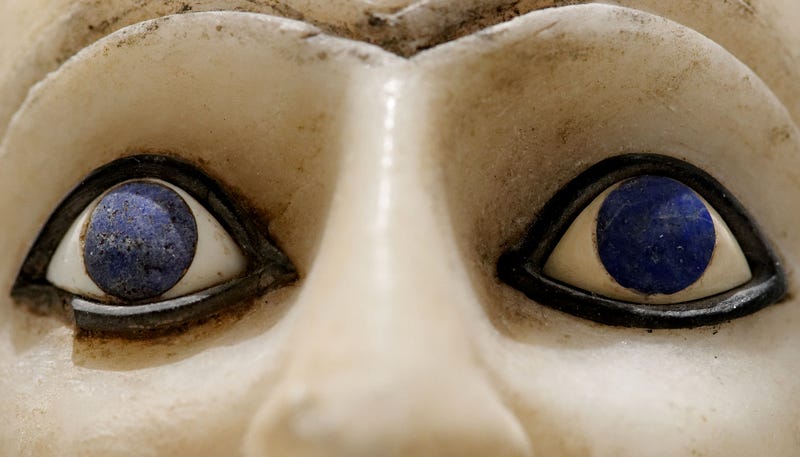
Detail from the statue of Ebiḫ II from the temple of Ishtar at Mari,Early Dynastic IIIb, ca. 2400 BCE. Louvre Museum. Image Wikipedia
The effect is striking. The blue lapis gives the statue a vivid presence, transforming the eyes into one of the most memorable features of the sculpture.
This use of lapis was not casual. In temple statuary, eyes mattered deeply. They created a sense of watchfulness, devotion, and connection between the figure and the divine. By using lapis for the eyes, the maker gave the statue both visual power and elite value.
The Ebih-Il statue shows how lapis could be used with great precision. A small amount of the stone was enough to transform the emotional and religious impact of an object.
Lapis lazuli in ancient Egypt
In ancient Egypt, lapis lazuli was also highly prized. It appears in jewelry, amulets, inlays, scarabs, and royal objects. Because Egypt had no major local lapis source, the stone had to be imported through long-distance trade.
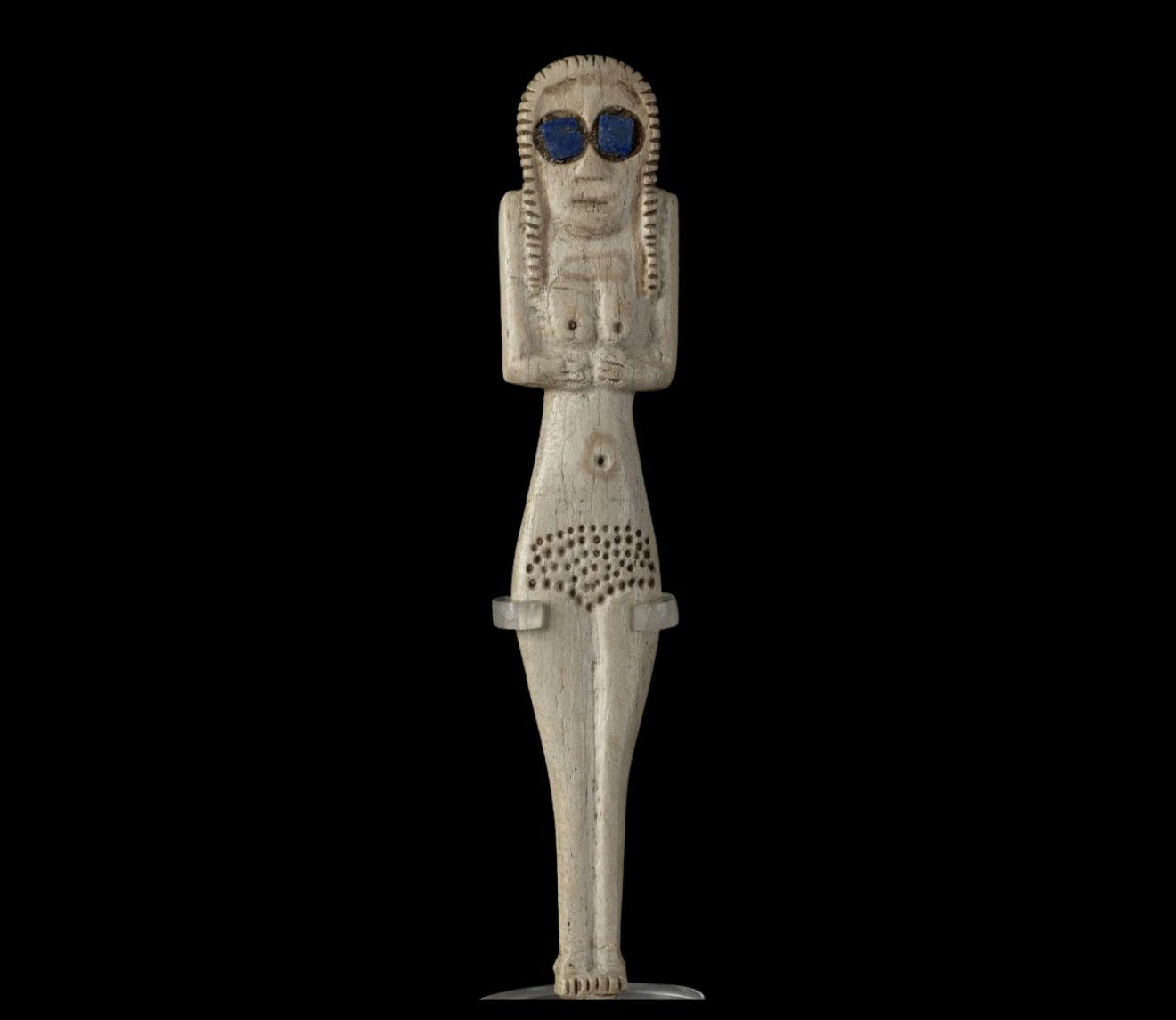
Bone Figurine of a Standing Woman with Lapis Lazuli Eyes. Pre-Dynastic Egypt, Naqada I Period (c. 4000–3600 B.C.)
Egyptians valued blue materials for their connection with the sky, water, the heavens, divine bodies, and rebirth. Lapis lazuli, with its deep blue surface and golden flecks, fit this symbolic system perfectly.
One of the most famous examples is the funerary mask of Tutankhamun. The mask combines gold with other materials, and Egyptian royal imagery associated lapis-blue hair with divine transformation. In funerary contexts, such materials helped present the king as eternal, radiant, and connected with the gods.
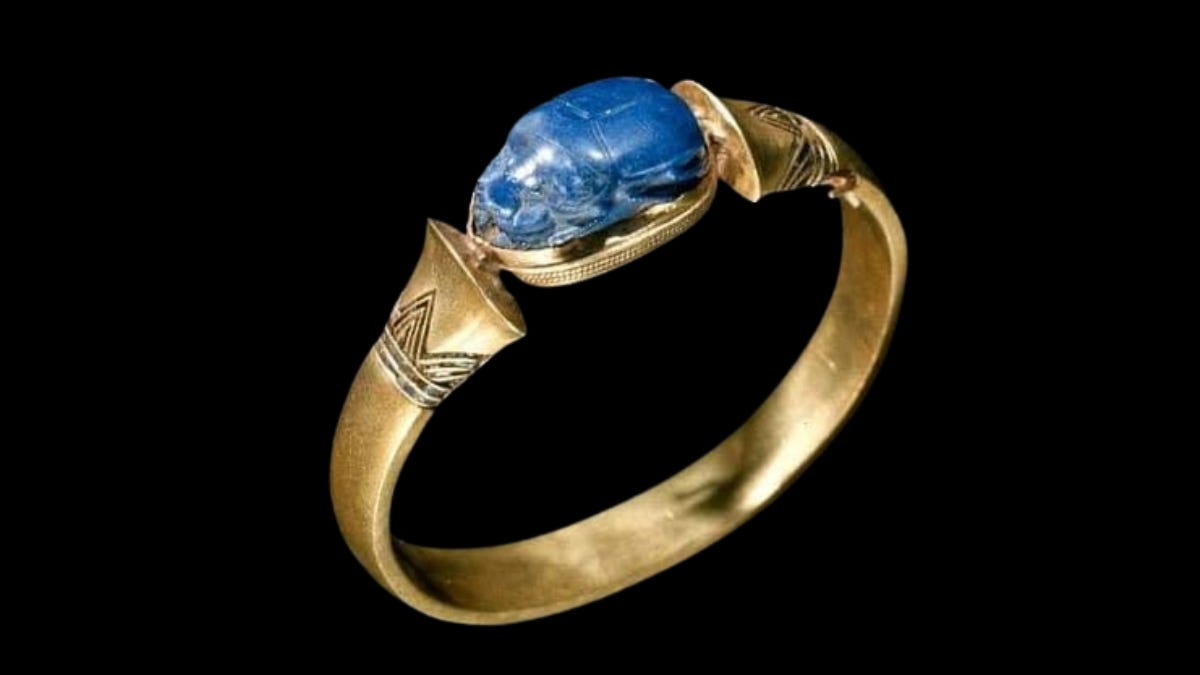
Golden bracelet adorned with a lapis lazuli scarab, from the tomb of Pharaoh Shoshenq II, Tanis, Egypt.
Lapis also appears in Egyptian amulets and ornaments. Its value was both material and symbolic. It was rare enough to signal status and visually powerful enough to carry religious meaning.
The Cultural and Symbolic Significance of the Color Blue
Blue was a difficult color to obtain in the ancient world. Natural blue stones and pigments were rare, and stable blue colorants were technically challenging.
This made lapis lazuli more than a luxury. It gave ancient artists and craftspeople access to a color associated with sky, depth, divinity, and distance.
In Mesopotamia, blue could enhance the eyes of sacred statues and enrich elite objects. In Egypt, it could be connected with gods, kingship, protection, and rebirth. In later Christian art, ultramarine derived from lapis became associated with sacred figures because of its cost and visual intensity.
The material’s meaning changed across cultures, but one pattern remained consistent: lapis was used where color needed to communicate importance.
From stone to pigment: ultramarine
Lapis lazuli entered a new chapter when it was processed into pigment.
When carefully ground, purified, and separated from impurities, lapis could produce natural ultramarine, one of the most valued blue pigments in art history. The name “ultramarine” comes from the idea of a pigment brought from “beyond the sea,” reflecting its long-distance movement into Europe.
Natural ultramarine was extremely expensive. Its cost came from the rarity of high-quality lapis, the difficulty of transport, and the labor required to extract a clean blue pigment from the stone.
In medieval and Renaissance Europe, ultramarine was often reserved for the most important parts of paintings. It was especially associated with sacred imagery, including the robes of the Virgin Mary, because its brilliance and price made it suitable for figures of high religious significance.
This means that the same Afghan stone that once decorated Mesopotamian tombs and Egyptian royal objects later shaped the visual language of European painting.
The long life of Afghan blue
The story of lapis lazuli stretches across many periods.
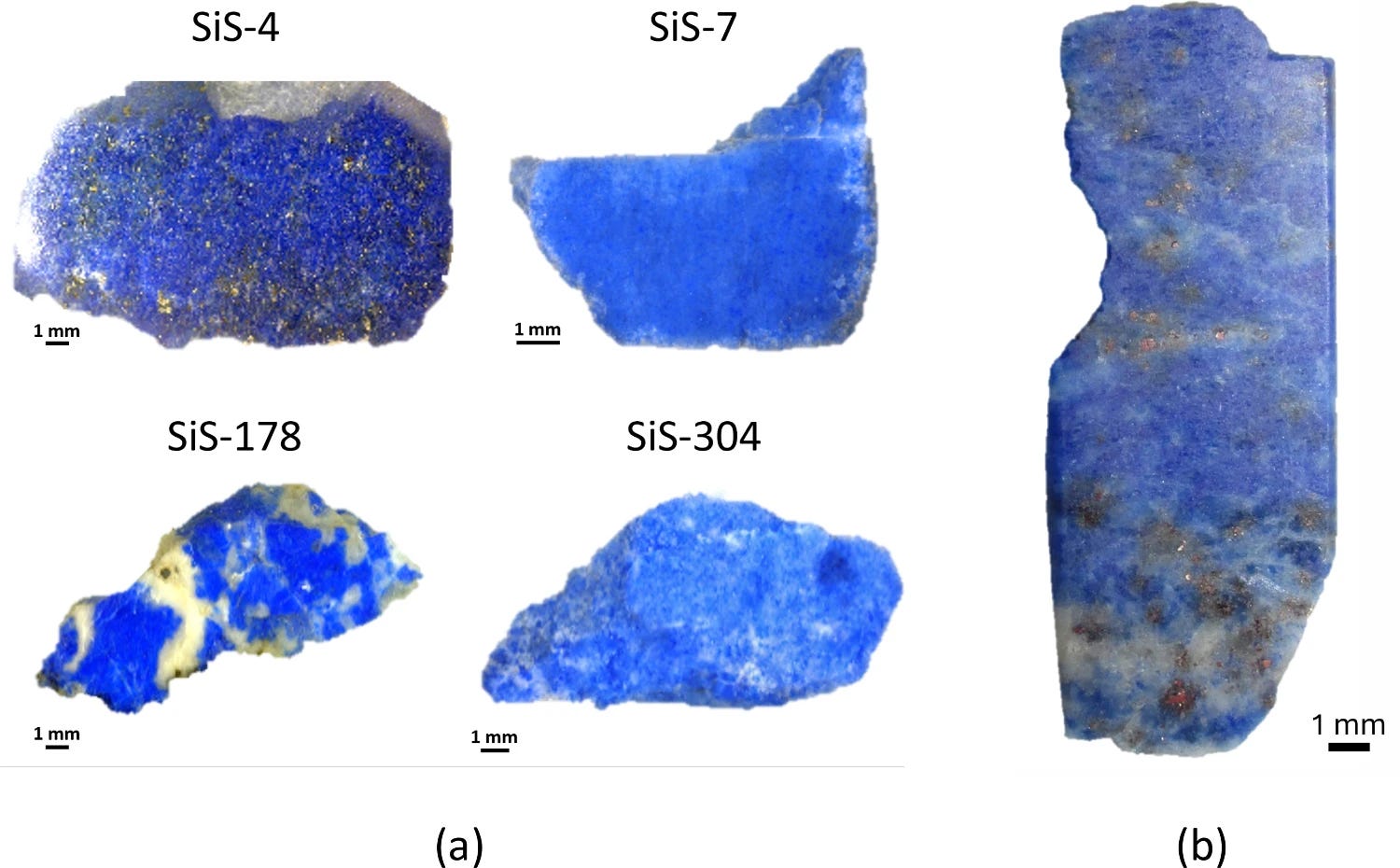
Lapis lazuli working fragments embedded in resin and polished from Shahr-i Sokhta (3rd millennium BCE, Iran). b Lapis lazuli tessera from Tanis (1050–700 BCE, XXI-XXII dynasties), Egypt
In the Bronze Age, it was a prestige stone moving through trade networks. In Mesopotamia, it appeared in royal burials and sacred objects. In Egypt, it became part of royal and religious imagery. In the medieval and Renaissance world, it became ultramarine pigment. In modern gemology, Afghan lapis remains one of the most famous and valued forms of the stone.
This continuity is rare. Many ancient luxury materials lost their importance over time, but lapis remained desirable for thousands of years.
Its value shifted from bead to seal, from inlay to amulet, from royal ornament to painter’s pigment. Yet the basic reason remained the same: the stone produced a blue that felt extraordinary.
The science of tracing lapis
Modern researchers are still trying to understand the ancient lapis trade more precisely.
For a long time, scholars assumed that most lapis found in the ancient Near East came from Badakhshan. That remains the strongest historical explanation for many objects, especially because the Afghan source was so important and long-lived.
However, proving the origin of a specific artifact is difficult. Lapis lazuli is geologically complex, and museum objects are often too valuable or fragile for destructive testing.
This has led researchers to use non-invasive or minimally invasive scientific methods, including Raman spectroscopy, ion beam analysis, PIXE, PIGE, cathodoluminescence, and related techniques. These methods can help identify mineral signatures and compare ancient objects with known lapis sources.
Such studies matter because provenance is not just a mineralogical question. It helps reconstruct trade routes, workshop systems, political connections, and the movement of prestige materials across the ancient world.
A material of power, craft, and exchange
Lapis lazuli was never just a pretty stone.
To mine it required access to remote mountains. To move it required trade networks. To shape it required skilled craft. To own it signaled wealth. To place it in a tomb or temple gave it ritual force. To grind it into pigment turned it into one of the most prized colors in art.
This is why lapis lazuli belongs at the center of ancient material history. It connects geology with archaeology, trade with religion, and color with power.
The stone shows how ancient people valued materials not only for practical use, but for the meanings they carried. Lapis could represent distance, rarity, protection, divinity, luxury, and technical mastery all at once.
Afghanistan’s blue legacy
The mountains of Badakhshan gave the ancient world one of its most powerful colors.
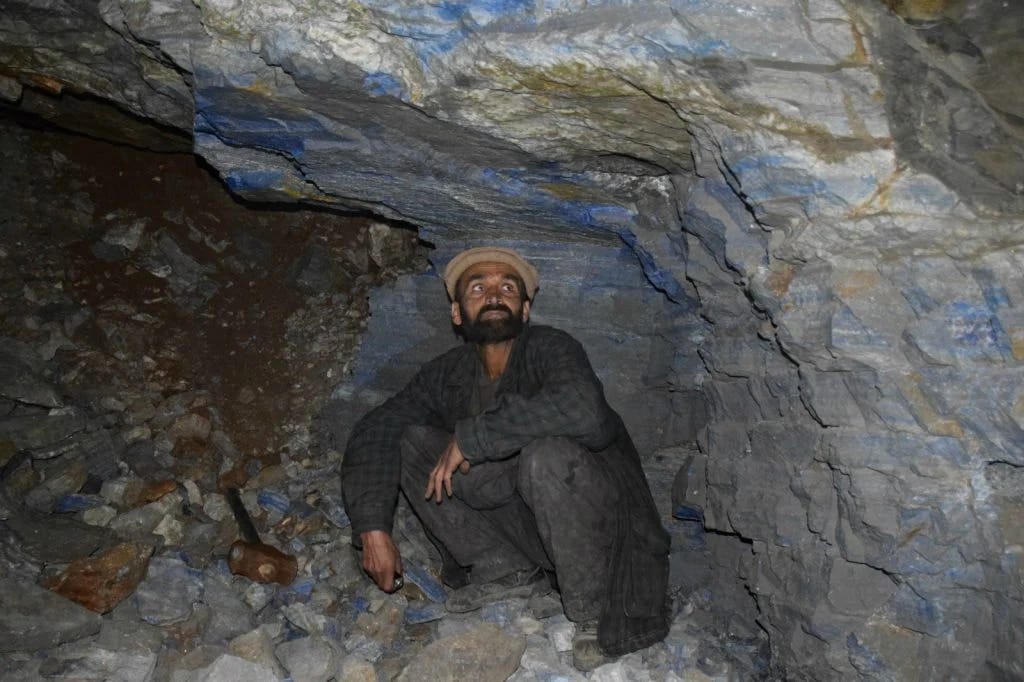
Miner in a hand-dug and blasted mine at Sar-e-Sang
From the Sar-e-Sang mines, lapis lazuli traveled into the hands of Indus bead-makers, Mesopotamian artisans, Egyptian goldsmiths, temple sculptors, royal patrons, medieval manuscript painters, and Renaissance artists.
Its blue surface became a language of prestige. Its golden pyrite flecks made it look almost cosmic. Its long journey made it valuable before it was even carved.
Lapis lazuli is therefore more than Afghanistan’s “blue gold.” It is one of the great materials of ancient connectivity — a stone that reveals how early civilizations exchanged objects, ideas, symbols, and technologies across enormous distances.
For thousands of years, people looked at lapis and saw something beyond ordinary stone: a fragment of sky, a mark of status, and a color worth carrying across the world.
Support Independent Ancient Content :
Your support helps me create more archaeology posts, articles, and mini history videos:
Sources:
GIA describes lapis lazuli as an aggregate rock composed mainly of lazurite, calcite, and pyrite, with lazurite responsible for its prized royal blue color; it also notes that the stone was treasured by ancient civilizations including Mesopotamia, Egypt, China, Greece, and Rome.
The International Union of Geological Sciences describes the Sar-e-Sang lapis deposits near the Kokcha River and notes their importance for provenance studies using techniques such as micro-PIXE, Raman, and FTIR analysis.
Britannica identifies Shortugai in northern Afghanistan as a small Harappan colony likely connected with control of the lapis lazuli export trade from neighboring Badakhshan.
The British Museum describes the Standard of Ur as an object decorated with shell, red limestone, and lapis lazuli, and notes lapis lazuli beads found near a skeleton in the Royal Cemetery at Ur.
The Metropolitan Museum of Art describes the Royal Graves of Ur and lists Sumerian objects from around 2600–2500 BC made with gold and lapis lazuli, including headdresses, necklace beads, and necklaces.
I make jewellery for a living and often use Lapis in my work. It’s fascinating to read the context of this historic stone: where it came from and travelled to, the importance that was placed on it, its various uses. Thank you for this article 💙
Thank you for this, I learned so much … I own a bracelet of lapis lazuli and had no idea … that picture of the mine is stunning 🐝